
Polycarbonate Injection Molding
Polycarbonate injection molding can produce transparent or opaque parts where a selected PC grade offers the required impact behavior, heat performance and appearance. It is not a metal equivalent or a universal solution: grade, additives, color, conditioning, geometry, tool surface and processing all influence the result. Compare these inputs through the material selection guide.
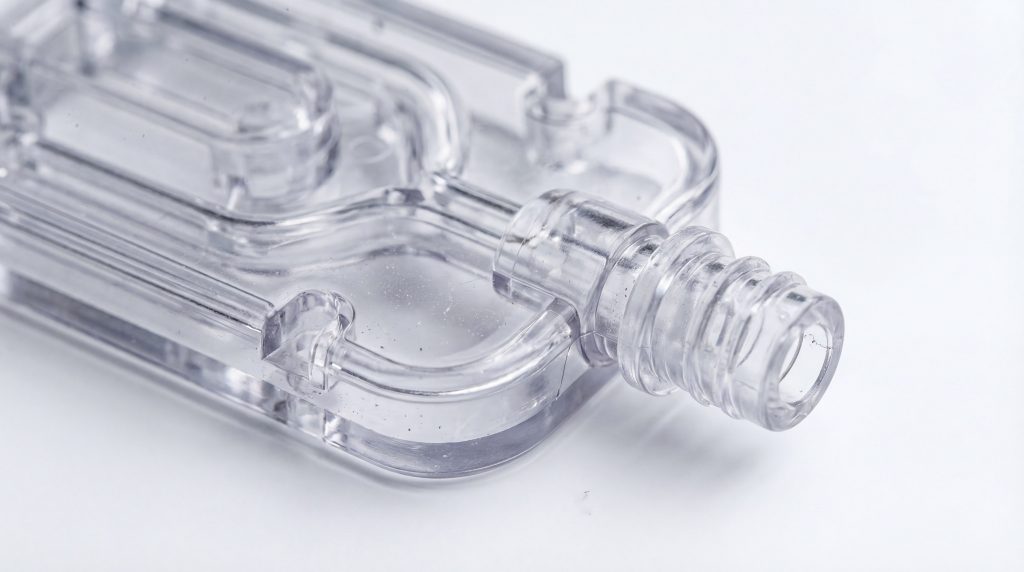
What is polycarbonate injection molding?
Polycarbonate injection molding is a high-pressure manufacturing process that transforms amorphous polycarbonate resin into precise, durable components. It utilizes specialized machinery to melt plastic pellets and inject them into custom-designed steel molds.
PC molding requires the exact grade’s drying and processing instructions to be followed. Resin condition, residence time, tool and settings should be recorded and validated for the specified part.
Defining the Amorphous Polymer
Polycarbonate is an engineering thermoplastic known for its disordered molecular structure, which allows light to pass through with minimal interference. Unlike semi-crystalline plastics, it does not have a defined melting point but rather softens gradually as temperature increases.
Consider this:
- Glass-transition and other temperature values are exact-grade, method- and condition-specific and are not finished-part service limits.
- Thermal behavior must be taken from the exact grade and stated test conditions.
- Dimensions depend on grade, geometry, orientation, cooling, packing and conditioning.
Essential Material Characteristics
Some clear PC grades combine useful impact behavior and light transmission, but neither is universal or unbreakable. Compare exact PC and acrylic grades using specified optical, impact, temperature and aging tests.
Here is the kicker: while it is incredibly tough, it is also highly hygroscopic, meaning it absorbs water from the air. If you do not dry the material properly before processing, the final parts will suffer from internal bubbling and reduced mechanical strength.
Key Takeaway: Polycarbonate injection molding is the standard for producing high-impact, transparent parts by injecting molten resin into precision tools.
| Feature | Description | |
|---|---|---|
| Material State | Amorphous Thermoplastic | |
| Primary Benefit | Impact Resistance & Clarity | |
| Key Challenge | High Melt Viscosity | |
| Common Use | Lenses, Housings, Shields |
Understanding these fundamental properties allows you to optimize the production cycle for maximum yield and quality.
Why use polycarbonate injection molding?
Engineers consider PC when an exact grade can meet the required optical and impact tests. Injection molding can form complex geometry, but feasibility and economics must be compared with machining and other processes for the actual volume and specification; see the material selection guide.
The process can support repeat production after the tool and process window are validated. Unit cost, capability and inspection frequency remain project-specific, and safety or functional compliance requires the applicable part and assembly evidence.
Unrivaled Impact Strength
PC is sometimes marketed with metal-like language, but it is not steel and can crack or fail. Use exact-grade impact data with specimen thickness, notch state, conditioning and temperature, then validate the molded part under the project impact case.
Consider this:
- It is significantly tougher than standard glass.
- Evaluate impact behavior using the selected grade, part thickness, temperature and the relevant test or application conditions.
- Cold-temperature toughness must be verified for the exact grade, conditioning, thickness and impact method.
Superior Optical Performance
In applications where visibility is critical, this material offers light transmission levels comparable to glass. It is the preferred choice for safety equipment and high-end consumer electronics.
Outdoor exposure may require a specifically UV-stabilized PC grade. Stabilizer package, color, thickness, processing history and exposure conditions affect retention of clarity and mechanical properties, so use current grade data and application-specific weathering tests.
Key Takeaway: PC may suit clear, impact-resistant components, but performance and unit economics depend on the exact grade, part, tooling, process window, quality requirements and volume.
| Advantage | Practical Benefit | |
|---|---|---|
| Toughness | Reduced breakage in the field | |
| Transparency | Crystal clear visibility for lenses | |
| Scalability | Low unit cost at high volumes | |
| Versatility | Supports overmolding and inserts |
These advantages make it a cornerstone of modern industrial design across multiple high-stakes sectors.
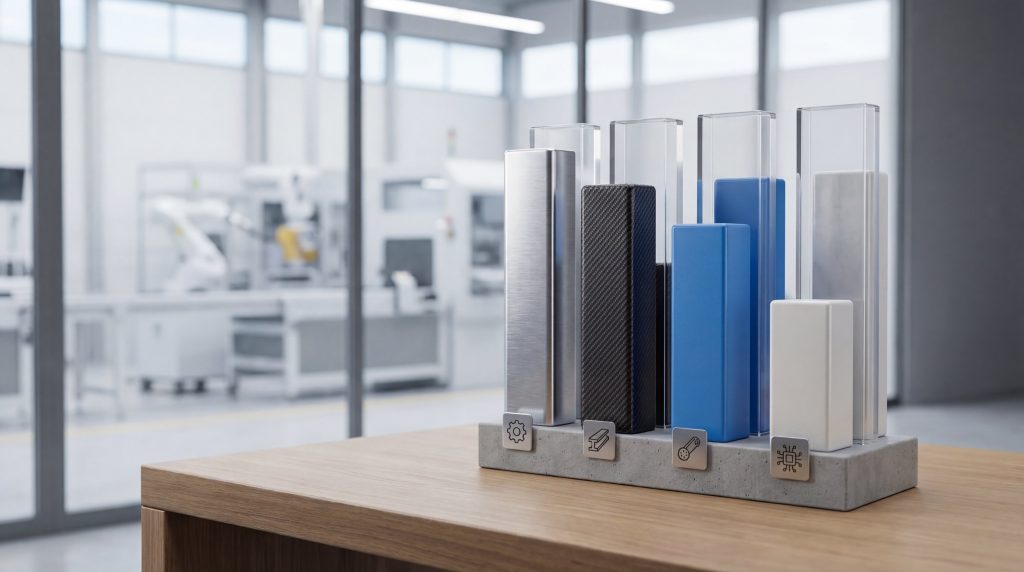
How does polycarbonate injection molding work?
The process plasticizes a specified PC grade and injects it into a machined cavity. Fill speed, pressure and shear profile are grade-, geometry-, gate-, machine- and tool-specific process parameters established during development.
Once the cavity is filled, the material is held under pressure to compensate for shrinkage as it cools. The mold then opens, and ejector pins push the solidified part out so the cycle can restart.
The Heating and Plasticizing Stage
Pellets are fed from a hopper into a heated barrel where a rotating screw grinds and melts them. This stage is critical because polycarbonate requires higher temperatures than most common plastics to flow correctly.
Here is the kicker: the residence time in the barrel must be minimized. If the material stays hot for too long, it begins to degrade chemically, leading to brittle parts and surface discoloration.
Injection and Cooling Cycles
High pressure is required to force the thick, molten polycarbonate into the thin sections of the mold. The cooling phase is often the longest part of the cycle, as the part must reach a specific temperature to maintain its shape.
Consider this:
- Injection speeds must be carefully profiled.
- Holding pressure may reduce sink when geometry, gate freeze and the process window allow.
- Controlled cooling helps manage internal stress and must be checked on the molded part.
Key Takeaway: The process relies on high-heat plasticization and high-pressure injection to overcome material viscosity and achieve precise dimensions.
| Process step | Exact-grade input to record | |
|---|---|---|
| Pre-drying | Supplier moisture limit, drying temperature, time, dew point and material depth | |
| Plasticizing | Supplier melt window, residence-time limit and shear considerations | |
| Injection | Fill profile, pressure limit, gate and cavity response established in trials | |
| Ejection | Part temperature, draft, texture and acceptable marks or distortion |
Precise control over these variables is what separates a functional part from a failed production run.
Where is polycarbonate injection molding applied?
PC appears in automotive, industrial, consumer and selected medical applications, but a polymer name does not establish safety-critical suitability. The exact grade, additives, application, tests, traceability and current regulatory evidence must be reviewed.
From the phone in your pocket to the safety goggles on a construction site, this technology is everywhere. Its ability to be sterilized and colored makes it adaptable to almost any commercial environment.
Automotive and Transportation
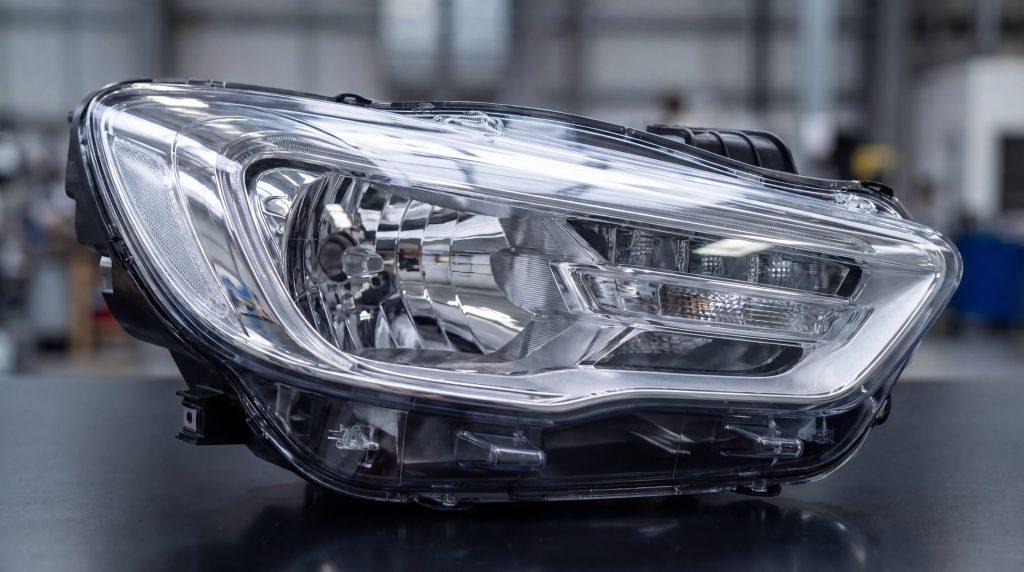
Automotive projects may evaluate selected PC grades for lighting, glazing or trim. Crash, optical, weathering, coating, flammability and regulatory requirements are component- and market-specific and require the applicable system evidence.
But wait, there is more:
- Headlight lenses provide impact protection from road debris.
- Sunroof panels reduce vehicle weight compared to glass.
- Interior touchscreens benefit from its scratch resistance.
Medical and Laboratory Gear
Some healthcare PC grades are intended for selected devices or sterilization methods. Verify the exact grade, color, intended contact and duration, sterilization method and cycle count, stress state, target market and current supplier documentation; do not generalize autoclave suitability to all PC.
Medical-device examples do not make all PC biocompatible. Verify the exact healthcare grade, formulation, intended contact type and duration, processing and sterilization history, relevant biological evaluation, target market and current documentation.
Key Takeaway: Polycarbonate applications span across industries that prioritize safety, transparency, and the ability to withstand harsh environmental conditions.
| Industry | Specific Application | |
|---|---|---|
| Automotive | Headlights and tail light lenses | |
| Medical | Syringes and oxygenator housings | |
| Consumer | Laptop shells and phone cases | |
| Industrial | Safety shields and machine guards |
The diversity of these applications proves the material’s unique status as a high-performance engineering plastic.
What techniques improve polycarbonate injection molding?
Specialized methods like Rapid Heating and Cooling (RH&C) and water-assisted molding enhance the final part’s surface quality and structural complexity. In the world of polycarbonate injection molding, these techniques allow you to push the boundaries of traditional part design.
Advanced cooling systems and multi-material molding are also common. These upgrades solve issues like internal stress and the need for secondary assembly operations.
Rapid Heating and Cooling (RH&C)
Rapid heat-and-cool changes the mold-surface temperature profile and may alter weld-line visibility or gloss. Results depend on geometry, grade, gate, venting, surface and process, and must be compared on trial samples.
Here is the kicker:
- It improves the flow of resin into micro-features.
- It significantly reduces visible surface blemishes.
- It helps in achieving “piano black” or mirror finishes.
Multi-Material Overmolding
You can combine polycarbonate with soft-touch materials like TPE to create ergonomic grips or integrated seals. This is achieved through two-shot molding or secondary overmolding processes.
Overmolding may replace selected adhesives or fasteners when the exact materials, interface geometry, bond, sealing and environmental tests support the design. Durability and appearance require project-specific acceptance criteria.
Key Takeaway: Advanced techniques like RH&C and overmolding allow for superior surface finishes and the integration of multiple material properties into one part.
| Technique | Project-specific evaluation | |
|---|---|---|
| RH&C | Weld-line visibility, gloss, cycle, energy and thermal control | |
| Overmolding | Exact material pairing, adhesion, geometry and environmental tests | |
| Gas-assist | Section geometry, gas path, surface and structural requirements | |
| Insert molding | Insert retention, stress, sealing, tolerance and handling plan |
Implementing these specialized methods can significantly reduce your total assembly time and improve end-user satisfaction.
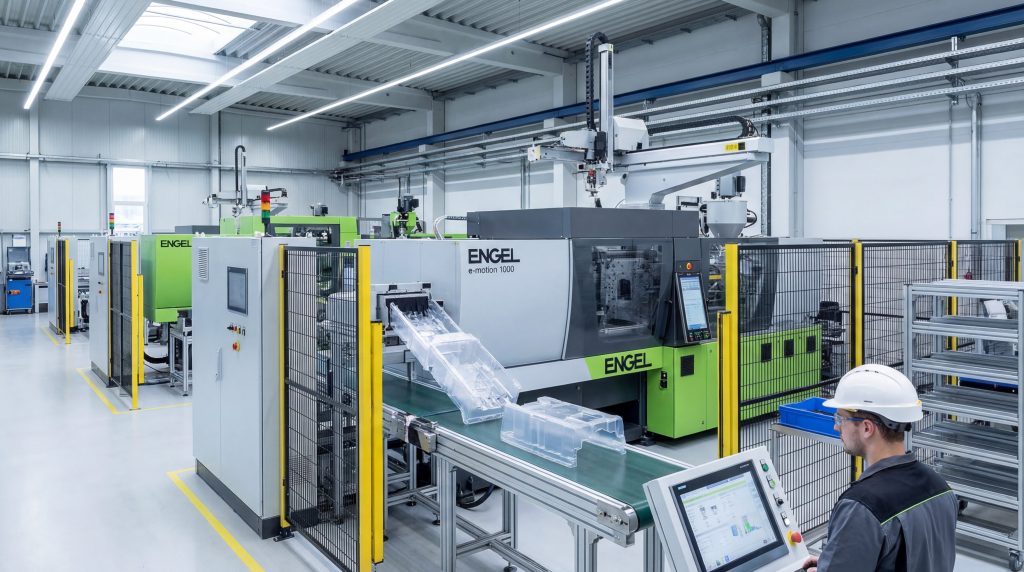
What are polycarbonate injection molding benefits?
PC molding may support repeat production and selected optical finishes after the exact grade, tool surface, process and acceptance criteria are validated. The material selection guide helps frame comparisons, while project economics require the actual volume, tool and quality plan.
Furthermore, the material’s inherent properties reduce the need for secondary coatings or reinforcements. This streamlines your supply chain and reduces the potential for quality issues during downstream processing.
Precision and Repeatability
Injection-molding capability depends on feature size, geometry, resin grade, tool, process and measurement method. Set tolerances from functional needs and demonstrate capability on the actual part rather than applying a universal value.
Here is the kicker:
- Tool life and part variation are project-specific; capability must be demonstrated and maintained.
- Automated sensors monitor every shot for consistency.
- Post-mold dimensions must be checked after the agreed conditioning and measurement interval.
Material Efficiency and Sustainability
Unlike subtractive manufacturing, this process creates very little waste because you only use the exact amount of material needed. Any leftover runners can often be reground and recycled back into the production loop.
Wall-thickness review may reduce material use, but the result depends on load, exact grade, flow, cooling, stiffness and quality requirements. Quantify any saving only after the revised design is analyzed and validated.
Key Takeaway: Output, dimensional capability and material efficiency depend on the part, exact grade, tool, validated process and inspection plan.
| Benefit | Impact on Business | |
|---|---|---|
| High Speed | Faster time-to-market for products | |
| Tight Tolerances | Seamless assembly of complex kits | |
| Waste Reduction | Lower material costs per project | |
| Finish Quality | Reduced need for painting or buffing |
These factors make injection molding the most logical choice for scaling up production of engineering-grade plastic parts.
How to design for polycarbonate injection molding?
Successful design requires careful consideration of wall thickness uniformity, draft angles, and material shrinkage to avoid internal stresses. Because polycarbonate is sensitive to flow disruptions, your geometry must encourage a smooth, continuous path for the molten resin during polycarbonate injection molding.
Design review can help identify fill, packing, cooling and release risks before tool manufacture. The proposed choices still require appropriate analysis, mold trials and part validation.
Managing Wall Thickness
Uniform walls are the most important rule in plastic design. If one section of your part is significantly thicker than another, it will cool at a different rate, causing the part to warp or develop internal voids.
But wait, there is more:
- Select wall thickness from exact-grade flow, load, optical needs, geometry, gate, cooling and process capability.
- Use ribs to provide strength instead of thickening walls.
- Incorporate gradual transitions between different thicknesses.
Draft Angles and Radii
Draft, texture, undercuts, ejection and corner transitions should be reviewed together. The required draft and radii depend on grade, depth, tool finish, geometry, load and acceptable marks.
Consider this:
- Use handbook draft values only as starting points; finalize draft for depth, texture, grade, tool surface and ejection.
- Obtain texture-specific draft guidance and confirm it against depth and ejection direction.
- Generous radii improve material flow and part toughness.
Key Takeaway: Wall transitions and draft can reduce molding risk, while warpage and ejection still require tool-specific trials and inspection.
| Design element | Inputs before finalizing | |
|---|---|---|
| Wall thickness | Grade, flow length, load, optical zone, gate, cooling and process capability | |
| Draft angle | Depth, texture, shrinkage, tool finish, ejection and acceptable marks | |
| Corner radii | Wall transition, stress, flow, machining and appearance requirements | |
| Rib geometry | Load, wall intersection, sink risk, draft, flow and tool access |
By following these guidelines, you reduce the risk of costly mold modifications after the first production samples are tested.
What limits polycarbonate injection molding?
Tooling investment and machine requirements depend on the part, exact grade, cavities, surface, volume and quality plan. Use the material selection guide for screening, then quote steel, construction and equipment from the project requirements.
Furthermore, the process demands high energy consumption to maintain the necessary melt temperatures. These factors mean that the technology is rarely the right choice for rapid prototyping or small-batch production.
High Initial Tooling Investment
PC tool material and hardness are selected from grade, additives, cavities, surface, wear, corrosion, volume, maintenance and mold-life requirements. Hardened steel may be appropriate, but it is not mandatory for every PC project and cost must come from a scoped quotation.
Here is the kicker:
- Tooling may take a typical 4–8 weeks, but timing is project-dependent and should state the start point, scope, sourcing, trial and revision assumptions.
- Modifications to the mold are difficult and costly.
- Break-even volume depends on tooling, cycle, part cost, alternatives, demand and quality assumptions.
Processing Complexity
Polycarbonate is not a “plug-and-play” material like polypropylene. It requires precise temperature control and specialized equipment to prevent it from sticking to the mold or degrading.
Consider this: The machines used must have high clamping forces and wear-resistant screws. If your molder does not have experience with high-viscosity resins, they may struggle to produce parts without aesthetic or structural defects.
Key Takeaway: High tooling costs and processing complexity make this method less suitable for low-volume projects or simple prototypes.
| Limitation | Practical Consequence | |
|---|---|---|
| Tooling Cost | High entry barrier for startups | |
| Lead Time | Slower initial project kickoff | |
| Viscosity | Requires powerful, expensive machines | |
| Energy Use | Higher operational costs per shot |
Understanding these hurdles allows you to better evaluate whether injection molding is the right fit for your specific project timeline and budget.
Can polycarbonate injection molding cause defects?
Splay, weld lines and stress cracking can occur when resin condition, geometry, tooling and process parameters interact. Moisture limits and drying conditions are exact-grade requirements from the supplier data sheet; any suspect lot should be evaluated against agreed acceptance criteria rather than assumed to be entirely unusable.
Defect analysis should combine resin condition, geometry, tooling, settings and inspected samples. Simulation may support selected projects, but its scope and benefit are project-dependent and trial evidence remains necessary.
Why is moisture control critical?
Polycarbonate is hygroscopic, meaning it pulls water from the surrounding air. If this moisture is not removed, it turns into steam during the heating process, creating silver streaks known as “splay.”
Consider this:
- Use the exact-grade supplier drying temperature, time, dew point and moisture limit.
- Measure and control moisture to the current exact-grade supplier requirement.
- Standard ovens are often insufficient; desiccant dryers are required.
Preventing Stress Cracking
Internal stresses are “frozen” into the part if it cools too quickly or if the injection pressure is too high. These stresses can lead to spontaneous cracking weeks or months after the part has been manufactured.
But wait, there is more: Using “annealing” (slowly reheating the part) can help relieve these internal stresses. Additionally, ensuring your gate locations are optimized helps the material flow naturally, reducing the pressure needed to fill the cavity.
Key Takeaway: Drying and process control can reduce splay and stress-cracking risk, while geometry, tooling, chemical exposure, conditioning and inspection also require review.
| Defect | Likely Cause | Solution | |
|---|---|---|---|
| Splay | Moisture in the resin | Better desiccant drying | |
| Weld Lines | Cold flow fronts meeting | Increase mold temperature | |
| Sink Marks | Thick sections cooling slowly | Reduce wall thickness | |
| Black Specks | Material degradation | Clean barrel and reduce heat |
A defined control plan can improve detection and prevention, while its effectiveness depends on sampling, methods, limits and corrective action for the actual project.
Is polycarbonate injection molding quality high?
PC molding quality should be defined by the drawing, approved sample, material specification, process records and agreed inspection plan. CMM, optical, color or mechanical tests can be selected when they match the critical feature and project requirement.
Traceability and monitoring can help control variation, but no two molded parts are literally identical. Capability must be demonstrated for specified characteristics using the agreed measurement method, sampling and validated process window.
Utilizing CMM Dimensional Inspection
A CMM can compare selected features with the drawing or CAD definition. Results depend on datum strategy, fixture, program, environment, sampling and measurement uncertainty; acceptance is based on the agreed inspection plan.
Here is the kicker:
- CMM capability depends on the machine, feature, setup, environment, program and measurement uncertainty.
- It identifies subtle warping that the human eye cannot see.
- Inspection reports and batch records can be arranged according to project requirements.
Defining Project-Specific Quality Controls
Quality-system requirements should be stated in the RFQ and matched to the relevant supplier and production scope. They support documented controls but do not replace the drawing, approved samples, inspection evidence or application validation.
Consider this:
- It requires documented processes for every machine.
- Audits provide evidence about the reviewed scope and date, not a blanket guarantee for every part.
- It emphasizes continuous improvement through data analysis.
Key Takeaway: Quality depends on relevant project controls, a validated process, suitable measurement methods and evidence tied to the specified characteristics.
| Quality Tool | Function | |
|---|---|---|
| CMM | Measures agreed features within the method’s demonstrated capability | |
| Spectrophotometer | Measures color or optical differences under an agreed method | |
| Tensile Testing | Tests specified specimens under stated standards and conditions | |
| ERP Tracking | Monitors raw material and batch history |
Choose a partner by reviewing relevant scope, engineering response, trial records, measurement capability and change control for the actual project.
Conclusion
PC molding decisions should connect the exact grade, conditioning, geometry, tool, process window and inspection method. Compare PC with ABS where opaque surface finish and processing trade-offs matter, and with PP where low density, chemical resistance or living hinges matter. Medical, food-contact, flame, optical and outdoor projects require additional grade- and application-specific verification.
Share the 3D model, 2D drawing, exact resin requirement, appearance zones, volume and target timing so the project team can define the engineering, tool, trial and inspection scope. Contact WOKE Molds to discuss the project.
Frequently Asked Questions
Can I use polycarbonate for food-contact applications?Only after verifying the exact grade, formulation, color, intended food type, time and temperature conditions, processing, target market and current regulatory documentation. A polymer-family name or a past supplier listing is not sufficient approval.
What’s the best way to reduce yellowing risk in clear molded parts?Select the exact grade and stabilizer package for the intended exposure, control drying and processing within the supplier window, and validate the molded part through application-specific weathering or aging tests.
How do I know if my part is too complex for standard molding?It depends. Generally, if your part has deep undercuts or internal cavities that cannot be reached by a straight-pull mold, you may need to use “slides” or “lifters,” which will increase your tooling cost but allow for high complexity.
Can I overmold polycarbonate with other materials?Potentially. Verify the exact PC and elastomer grades, adhesion mechanism, chemical compatibility, processing windows, geometry and environmental testing; an overmolded interface does not automatically provide a waterproof seal.
What’s the best way to reduce my per-part cost?Compare volume, cavity count, cycle, material usage, quality plan and secondary operations together. Thinner walls or more cavities can introduce filling, cooling, tooling and capability trade-offs, so model the project economics and validate the proposed design.
For production support, explore our plastic injection molding service. You can also share your drawing for an engineering review.