
All About Engineering Plastics: Definition, Importance, Uses, Properties, and Types
Engineering plastics are polymer families used as starting points for technical material selection. The label alone does not establish strength, temperature capability, chemical compatibility, dimensional stability, regulatory status, cost, or part life. Define the requirements first, then compare manufacturer, exact grade, formulation, process, test conditions, and finished-part evidence. Use this injection-molding material selection guide as a screening framework.
What does “engineering plastic” mean?
“Engineering plastic” is a broad commercial and design category, not a performance specification. Properties can differ among manufacturers, grades, reinforcements, modifiers, colors, conditioning states, and processing histories. A drawing or purchase specification therefore needs more than a family name.
How should it be compared with commodity plastics?
Do not treat the two labels as fixed performance tiers. Compare candidates against the same loads, temperature profile, chemicals, moisture, UV exposure, dimensions, appearance, processing route, compliance needs, volume, and failure criteria.
- Specify the mechanical property, method, conditioning, temperature, direction, and rate.
- Keep Tg, HDT, Vicat, RTI, processing temperature, and service limits separate.
- Define chemical exposure by substance, concentration, temperature, time, stress, and acceptance criterion.
| Screening item | Information required | Decision output |
|---|---|---|
| Material identity | Manufacturer, exact grade, polymer or blend, fillers, modifiers, color, and form | Traceable candidate specification |
| Property evidence | Current source, method, specimen, conditioning, temperature, load, rate, thickness, and direction where relevant | Like-for-like comparison |
| Application evidence | Finished geometry, process history, environment, duty cycle, failure criteria, and validation plan | Project-specific acceptance or rejection |
Selection note: Manufacturer data are grade- and test-condition-specific references, not a polymer-family guarantee or a substitute for application testing and current compliance review.
Key takeaway: Use the category to open a candidate list, not to close a design decision. Release an exact grade only after its evidence and the part-level acceptance criteria are agreed.
Why do manufacturers evaluate engineering plastics?
Some grades and molded designs may support lower mass, part consolidation, electrical functions, corrosion-related changes, or different production economics. Those are project outputs. Compare the current and proposed designs at the actual geometry, volume, tooling scope, assembly route, inspection plan, and service conditions.
When can molding change production efficiency?
A molded design can combine features or reduce secondary operations, but the result depends on tooling, cavity strategy, cycle, scrap, automation, quality requirements, and demand. Model total landed cost and capacity rather than assuming that either plastic or metal is uniformly cheaper or faster.
- Count operations and components in both process routes.
- Estimate tooling, material, cycle, scrap, inspection, assembly, packaging, and change-control costs.
- Confirm that integrated features remain moldable, inspectable, and serviceable.
| Claim to test | What to compare | Evidence needed |
|---|---|---|
| Lower mass | Complete assemblies with equivalent validated functions | CAD mass, inserts, fasteners, and test results |
| Fewer parts | Assembly count and service strategy | Approved design and process flow |
| Lower cost | Total landed cost at stated volume and program duration | Current quotations, yield assumptions, and sensitivity analysis |
Selection note: Keep the assumptions and validation evidence with every benefit comparison.
Key takeaway: A conversion case is credible when its geometry, process, volume, risks, and acceptance tests are visible.
Which properties need to be specified?
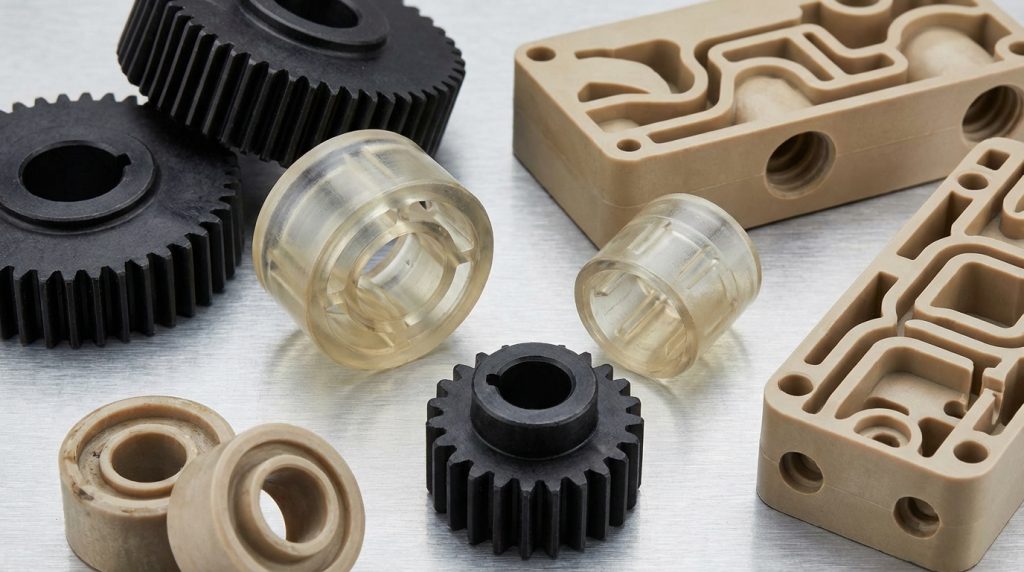
Start with measurable requirements rather than adjectives such as strong, stable, durable, or resistant. Relevant items may include stiffness, impact, creep, fatigue, wear, friction, moisture uptake, shrinkage, thermal expansion, electrical behavior, flame classification, UV exposure, and chemical compatibility. The required set depends on the part and its failure modes.
How should dimensional stability be assessed?
Dimensional change can arise from shrinkage, anisotropy, fiber orientation, residual stress, crystallization, moisture, thermal expansion, creep, post-mold history, and geometry. No family maintains an exact shape or tight tolerance under unspecified heat, humidity, load, and time.
- Define CTQ dimensions, datum scheme, measurement state, conditioning, and inspection method.
- Evaluate shrinkage and warpage with the proposed grade, tool, process window, and fiber orientation.
- Measure parts after the specified environmental and load-conditioning sequence.
| Property area | What to check | Why family wording is insufficient |
|---|---|---|
| Impact | Method, specimen, notch, temperature, direction, conditioning, and rate | Results vary with grade, test setup, process, and geometry |
| Wear and friction | Counterface, load, speed, lubrication, temperature, debris, and duty cycle | Tribology describes a system |
| UV exposure | Grade, stabilizer, color, thickness, climate or method, duration, and retention criteria | UV-modified grades cannot represent a whole family |
Selection note: Translate each property into a source-qualified comparison and a finished-part acceptance test.
Key takeaway: Dimensional control comes from the material, tool, process, conditioning, inspection, and design system. A resin name does not establish production tolerance or field fit.
How should chemical resistance be evaluated?
Chemical compatibility is conditional. Define the substance or mixture, concentration, temperature, exposure mode, duration, pressure, applied stress, prior processing, cleaning sequence, and failure criterion. Review current exact-grade supplier data and test representative parts; “engineering plastic” does not mean chemically inert or immune.
How should PTFE and PEEK be screened?
PTFE and PEEK may enter a candidate list for demanding environments, but neither family is universally resistant to every chemical or suitable for every loaded design. Check the exact compound or grade, supplier data, permeation or swelling limits, stress, temperature, pressure, joints, processing route, and application tests.
- Screen solvents and process chemicals individually, including mixtures and cleaning agents.
- Separate short-term data from continuous loaded service behavior.
- Define acceptable mass change, dimension change, cracking, permeation, and retained properties.
| Candidate family | Required compatibility check |
|---|---|
| Polyamide | Exact grade, conditioning, stress, chemical, concentration, temperature, and duration |
| PEEK | Exact grade, current supplier data, mixture, mechanical condition, temperature, and acceptance criteria |
| PTFE | Exact compound, processing route, permeation or swelling criterion, pressure, stress, temperature, and time |
Selection note: Compatibility charts are screening inputs. Validate the finished design under the actual exposure sequence and load state.
Key takeaway: Chemical decisions require an exact exposure definition and a pass/fail criterion. Avoid “highest resistance” or “best defense” without a defined comparative test.
Which polymer families are commonly screened?
ABS, polycarbonate, polyamide, PBT, POM, PPS, PEEK, PEI, and blends are among the families designers may consider. Availability, price, processability, and properties vary by grade and market. Use supplier portfolios to find candidates, then compare current data sheets and project requirements.
When should polyamide be considered?
Polyamide grades may be screened for gears, rollers, housings, and structural parts, but moisture, reinforcement, orientation, wear system, temperature, creep, fatigue, and dimensions can change the result. “Nylon” is not a complete specification or an automatic choice for a gear.
- Compare dry-as-molded and conditioned data where both are supplied.
- Name the reinforcement, modifier, color, and direction used in comparisons.
- Test the duty cycle with the actual counterface, lubrication, geometry, and environment.
| Family | Possible reason to screen | Project-specific checks |
|---|---|---|
| ABS | Housing, appearance, or processing candidate | Grade, impact, temperature, chemicals, UV, finish, and flame needs |
| Polycarbonate | Transparent or impact-related candidate | Grade, optical needs, stress cracking, UV package, thickness, and regulatory status |
| Polyamide | Mechanical or wear-system candidate | Moisture, reinforcement, orientation, creep, fatigue, wear, and dimensions |
Selection note: Application examples indicate questions to investigate, not approved end uses.
Key takeaway: Select the exact grade after comparison; do not assign one “key advantage” or application to every grade in a family.
How should thermal behavior be specified?
Use the exact grade and the quantity relevant to the failure mode. Tg, melting behavior, HDT, Vicat, RTI, processing temperature, and a part’s service limit describe different things. Keep method, load, specimen, thickness, conditioning, heating rate, environment, and source with each value.
What does glass transition temperature tell you?
Glass transition temperature is a method- and material-state-dependent transition reference. It is not HDT and does not by itself define maximum service temperature, retained stiffness, dimensional accuracy, or part life. Interpret Tg with grade, morphology, conditioning, geometry, load, time, and relevant mechanical data.
- Record the Tg method, heating rate, and material condition.
- Record HDT or Vicat separately with its own method, load, specimen, and condition.
- Set application margins from validated part behavior, not one data-sheet temperature.
| Thermal item | Context that must travel with it | Appropriate use |
|---|---|---|
| Glass transition (Tg) | Grade, method, morphology or state, conditioning, and heating rate | Transition reference within a broader analysis |
| HDT or Vicat | Grade, method, load, specimen, thickness, and conditioning | Standardized comparison under stated conditions |
| RTI or supplier service guidance | Grade, property class, thickness, duration, environment, and current source | Input to validation, not a family-wide service limit |
Selection note: Do not substitute processing temperature, HDT, Vicat, Tg, RTI, short-term exposure, or continuous-use guidance for one another.
Key takeaway: Thermal selection is a load-, time-, environment-, and geometry-dependent task. Validate the molded part across the specified temperature profile.
Can an engineering plastic replace a metal part?
It can be evaluated, but replacement is a redesigned-part decision rather than a material swap. Compare density, elastic behavior, creep, fatigue, impact, wear, thermal expansion, moisture, chemicals, flammability, joints, tolerances, process, inspection, and end-of-life requirements for the actual geometries.
How should a metal-to-plastic study begin?
Document load paths, boundary conditions, duty cycle, environment, failure modes, safety factors, interfaces, and service history. Reinforcement can change stiffness and anisotropy, but it does not make a plastic grade mechanically equivalent to aluminum or steel across all directions, temperatures, times, and loads.
- Recalculate the geometry using exact-grade data at the relevant condition.
- Include creep, fatigue, impact, joints, fiber orientation, and thermal expansion.
- Validate representative parts through the specified load and environmental sequence.
| Conversion topic | What to check | Release evidence |
|---|---|---|
| Mass | Complete geometry, inserts, ribs, fasteners, and density | Approved CAD and measured parts |
| Structural behavior | Stiffness, creep, fatigue, impact, orientation, temperature, and moisture | Analysis correlated with representative tests |
| Part consolidation | Moldability, tolerance stack, assembly, repair, inspection, and tooling risk | DFM review and validated process route |
Selection note: Lower density does not establish equivalent load capacity, life, or total cost.
Key takeaway: Treat metal replacement as an engineering program with explicit requirements and verification, not as a stiffness claim about a reinforced family.
How do industry requirements affect selection?
Automotive, aerospace, electrical, healthcare, and consumer projects impose different mechanical, flame, electrical, traceability, chemical, sterilization, and regulatory requirements. No family is automatically approved for an industry. Verify the exact grade, application, market, current document, color and additive restrictions, process controls, and part tests.
What must be checked for a medical application?
Define the device, patient-contact classification and duration, region, sterilization method and cycles, chemicals, loads, biological evaluation plan, documentation, change-control terms, and finished-part tests. A generic PSU, PEEK, or polycarbonate name does not establish biocompatibility, purity, sterilization life, or device suitability.
- Current exact-grade regulatory and biocompatibility documentation for the intended use
- Sterilization validation with defined method, conditions, cycle count, and criteria
- Traceability, additives, color, processing controls, and supplier change notification
| Project context | Material-screening questions | Evidence to verify |
|---|---|---|
| Automotive | Temperature cycle, fluids, impact, UV, emissions, flame, appearance, and life | Exact-grade documents and specified part tests |
| Aerospace | Loads, temperature, fluids, smoke or toxicity, flame, traceability, and authority needs | Application-specific approvals and validation; do not infer certification |
| Electrical or electronic | Voltage, insulation, CTI, flame test, thickness, heat, moisture, and enclosure | Current exact-grade ratings plus finished-product requirements |
Selection note: Industry examples are prompts for requirements discovery, not proof that a material or supplier is certified.
Key takeaway: Compliance is tied to the grade, application, region, current evidence, process, and finished product. Confirm these before release.
How are engineering-plastic parts manufactured?
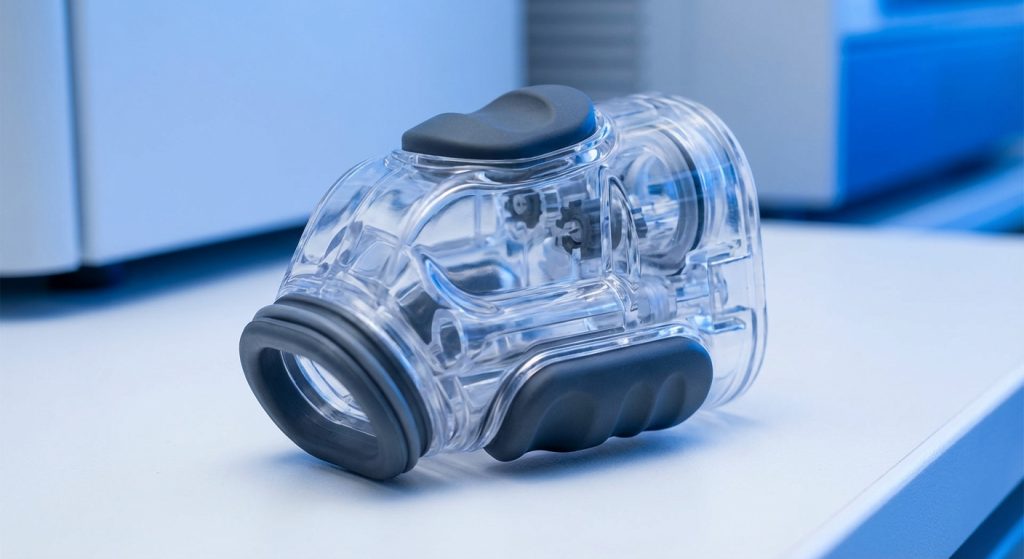
Possible routes include injection molding, machining from stock shapes, and additive manufacturing. The route depends on grade availability in the required form, geometry, tolerance, surface, anisotropy, quantity, tooling budget, traceability, and validation. Injection molding is not automatically the lowest-cost route, and machining is not automatically preferred at every low volume.
What can DFM contribute?
A DFM review can identify risks involving wall thickness, draft, ribs, bosses, undercuts, parting line, gate, runner, ejection, cooling, shrinkage, warpage, tolerance, material, and appearance. It does not eliminate defects or promise cost and schedule outcomes. Its depth and deliverables are project-specific; complete formal DFM is generally associated with project launch rather than assumed at quotation.
- Review wall transitions, sink and warpage risks, and required stiffness.
- Review draft, texture, parting line, ejection, and undercut strategy.
- Review gate, venting, cooling, CTQs, inspection state, and grade process window.
| Process route | When to screen it | What to verify |
|---|---|---|
| Injection molding | Repeat production where tooling can be justified | Grade process window, tool, cavities, cycle, yield, tolerance, and validation |
| CNC machining | Stock form, geometry, volume, or development needs favor material removal | Stock grade, orientation, stress relief, fixturing, tolerance, finish, and waste |
| Additive manufacturing | Qualified feedstock and process suit the requirements | Machine, orientation, porosity, post-process, anisotropy, traceability, and tests |
Selection note: Request quotations and validation plans for the drawing and quantity instead of assigning fixed volume or precision rankings.
Key takeaway: Pair the exact grade with a capable process and agreed inspection plan. WOKE Molds can evaluate injection-molding projects for listed engineering-plastic families, but process window, equipment, tooling, documents, and criteria must be confirmed per project.
How should materials for medical devices be screened?
Begin with device requirements and risk management, not a shortlist of families. Confirm patient contact, duration, region, sterilization, chemicals, loads, extractables or leachables concerns, additives, documentation, supplier restrictions, change control, process, and finished-device verification.
Can a grade be screened for steam sterilization?
Yes, when the supplier has relevant exact-grade data and the project defines the steam cycle. Record temperature, pressure, duration, cycle count, water quality, cleaning chemicals, drying, geometry, load, and acceptance tests. Do not infer device safety or usable life from PEEK, PSU, or another family name.
- Thermal and dimensional retention after the specified sterilization sequence
- Mechanical, visual, and chemical criteria after the defined cycle count
- Current regulatory evidence and biological evaluation for the device and market
| Candidate family | Reason it might enter screening | What must be established |
|---|---|---|
| PSU-family materials | Some grades may have relevant steam-cycle data | Grade, cycles, chemicals, property retention, documents, and device tests |
| PEEK-family materials | Some grades may have relevant mechanical or sterilization data | Grade, formulation, process, load case, cycles, regulatory evidence, and tests |
| Polycarbonate-family materials | Some specialized grades may have healthcare-related documents | Grade, sterilization route, stress cracking, additives, region, restrictions, and documents |
Selection note: Candidate families and screening reasons are not device recommendations or regulatory approvals.
Key takeaway: Patient safety and compliance depend on the finished device system and documented risk controls. Family-level marketing cannot replace device-specific evidence.

Frequently asked questions
Can engineering plastics be recycled? Recyclability depends on polymer, grade, reinforcement, contamination, additives, color, collection stream, heat history, retained properties, and local infrastructure. Regrind or recycled content requires its own specification and validation; thermoplastic behavior alone does not establish repeated closed-loop reuse.
How should a resin be screened for gears? Define torque, speed, duty cycle, tooth geometry, temperature, moisture, lubrication, counterface, noise, wear, creep, fatigue, and life test. Compare exact grades under those conditions rather than naming one family as universally suitable.
How do I know whether my part needs an engineering plastic? Start from load, duration, creep, fatigue, impact, temperature, chemicals, moisture, UV, dimensions, regulations, process, volume, and failure criteria. Compare exact grades and alternatives without a category cutoff.
Can engineering plastics be used outdoors? Some exact grades have UV packages or exposure data. Verify grade, color, thickness, climate or method, duration, and acceptable color and mechanical-property retention; do not infer outdoor life from the family name.
How should a steel-to-plastic candidate be selected? Redesign and recalculate using exact-grade, direction- and condition-relevant data. Include stiffness, creep, fatigue, impact, temperature, moisture, chemicals, joints, tolerances, fiber orientation, process variation, and safety factors, then validate representative parts.
Conclusion: specify the grade and prove the part
Engineering plastics broaden the candidate set, but the category does not establish performance, compliance, cost, or successful conversion. Define the exact grade and formulation, process, drawing requirements, loads, time, environment, source documents, compliance evidence, and part-level validation before release.
Continue with the material selection guide and the relevant ABS injection molding, polycarbonate injection molding, or nylon injection molding article. For a project review, contact WOKE Molds with the 3D model, 2D drawing, candidate grade, quantity, loads, environment, regulatory needs, and required quality documents.
Planning a part like this? See our plastic injection molding service, or send your drawing for a free DFM review.