
PPAP vs FAI: How to Pick the Right One Without Costly Delays
The PPAP vs FAI difference is scope: FAI (first article inspection) proves that the first parts from a new process match the drawing, while PPAP (Production Part Approval Process) proves that the whole production process can keep making good parts. In short, FAI checks parts; PPAP checks the process, and it usually includes an FAI as one of its elements.
For molded parts, the choice affects lead time, cost and risk. For example, asking for a full PPAP on a simple low-volume bracket adds weeks of paperwork. On the other hand, releasing a safety-related automotive clip on a dimensional report alone leaves the buyer exposed when the process drifts. In this guide, we explain how each fits a molded-part release and how they connect to quality control and inspection after launch.
FAI verifies that the first production-representative parts meet every drawing requirement, usually with a ballooned drawing and a full dimensional report. PPAP is a structured submission, defined by the AIAG manual and widely used in automotive, that adds process evidence such as the process flow, PFMEA, control plan, measurement system analysis and capability studies. Use FAI when you need part conformance; use PPAP when you need proof that the process is stable at volume.
In short: FAI answers “is this part right?” while PPAP answers “will every part be right?”
Key points:
- FAI is a part-level check, common in aerospace (AS9102), industrial and general OEM supply.
- PPAP is a process-level approval with 18 elements and 5 submission levels, common in automotive.
- Both rely on a stable mold, a documented process and agreed acceptance criteria.
What Is the Difference Between PPAP vs FAI?
The difference between PPAP vs FAI is what they prove. FAI proves that the first parts meet the drawing. PPAP proves that the process, including the tool, machine, material, people and measurement, can repeat that result in serial production.
| Aspect | FAI | PPAP |
|---|---|---|
| Main question | Does the part meet the drawing? | Can the process keep producing conforming parts? |
| Typical standard | AS9102 in aerospace; customer formats elsewhere | AIAG PPAP manual, often with customer-specific requirements |
| Typical content | Ballooned drawing, full dimensional results, material and process certificates | Up to 18 elements, including FAI-type dimensional results |
| Process evidence | Limited | Process flow, PFMEA, control plan, MSA, capability studies |
| Effort | Days | Weeks, depending on level |
| Typical industries | Aerospace, industrial, medical devices, general OEM | Automotive and suppliers that follow automotive practice |
In other words, a PPAP usually contains an FAI-style dimensional report. However, an FAI alone does not contain PPAP process evidence.
Key Takeaway: Treat FAI as a subset of PPAP. Ask for PPAP only when you also need process evidence, not just part evidence.
When Does a Molded Part Need PPAP vs FAI?
A molded part needs PPAP when the customer contract or industry practice requires process approval, typically in automotive and safety-related applications. By contrast, FAI is usually enough when the buyer needs proof of conformance but not a full process package.
Situations that usually call for PPAP
- Automotive or automotive-style supply chains
- Safety, sealing or regulated functions where process drift is costly
- High-volume parts with capability (Cpk) requirements on key characteristics
- New tools, new materials or a supplier change on a released part
Situations where FAI is usually enough
- Industrial, consumer or equipment parts without automotive requirements
- Low-volume programs or prototypes moving to first production
- Engineering changes that affect only a few dimensions
- Re-qualification after a minor mold repair
For example, a connector housing destined for an automotive assembly normally goes through PPAP. A cover for a lab instrument, however, is usually released on FAI plus a material certificate.
Key Takeaway: Let the contract and the risk decide. If no customer requirement exists, start with FAI and add process documents only where the risk is real.
What Does a PPAP vs FAI Package Include?
A PPAP vs FAI package differs mainly in the process documents. An FAI focuses on the part and its records, while a PPAP adds evidence about the process that makes the part.
Typical FAI content for molded parts
- Ballooned 2D drawing with every characteristic numbered
- Full dimensional results for each cavity
- Material certificate for the resin lot
- Visual and functional checks agreed with the customer
Additional PPAP content
- Process flow diagram and PFMEA
- Control plan for production
- Measurement system analysis (MSA), such as gauge R&R
- Initial process capability studies on key characteristics
- Part Submission Warrant (PSW) and appearance approval where required
For multi-cavity molds, both packages must cover every cavity. Therefore, a 16-cavity mold needs far more measurement than a single-cavity mold, which affects inspection time and cost.
Key Takeaway: Count cavities before agreeing to a package. Measurement effort grows with every cavity, so agree the scope early.
How Do PPAP Levels Change the Workload?
PPAP levels change the workload by deciding what the supplier submits and what it only keeps on file. The AIAG manual defines five levels, from a warrant only to full documents with an on-site review.
| PPAP level | What is submitted |
|---|---|
| Level 1 | Part Submission Warrant only |
| Level 2 | Warrant plus product samples and limited supporting data |
| Level 3 | Warrant plus product samples and complete supporting data (the common default) |
| Level 4 | Warrant plus other requirements defined by the customer |
| Level 5 | Warrant plus samples and complete data reviewed at the supplier’s site |
In practice, most automotive buyers default to Level 3. However, a lower level can make sense for low-risk parts with an established supplier. That choice shortens approval without removing the supplier’s duty to keep the records.
Key Takeaway: Agree the PPAP level in the purchase order, not after the mold trial. A late change from Level 2 to Level 3 can delay the launch by weeks.
How Does the Mold Trial Report Feed PPAP vs FAI?
The mold trial report feeds PPAP vs FAI by recording the process window and the corrective actions that led to conforming parts. Without a clear trial history, the FAI or PPAP results have no baseline.
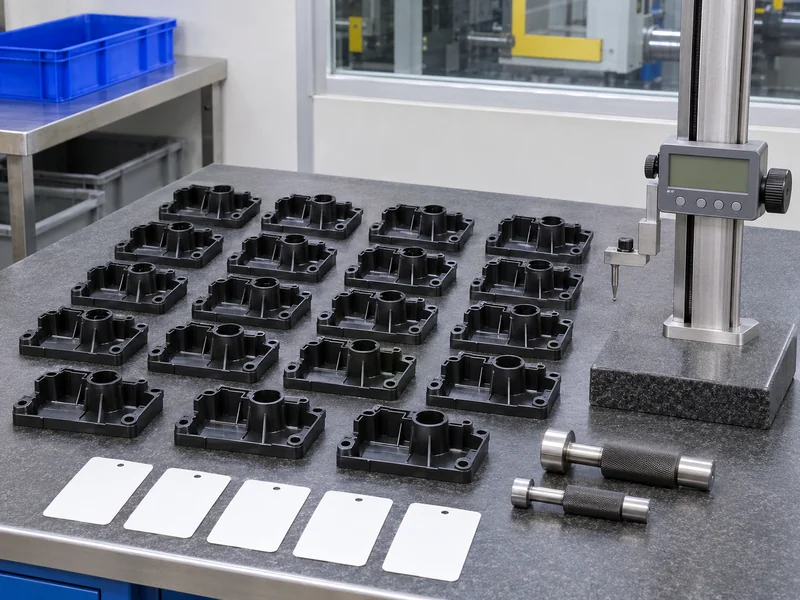
A useful mold trial report includes:
- Trial number (T1, T2, T3) and date
- Machine, material lot and drying conditions
- Key process settings, such as temperatures, pressures, speeds and cycle time
- Dimensional results and defects found
- Corrective actions and who approved them
Corrective actions after a trial need formal approval. For example, if steel is removed to correct a dimension, the buyer should approve the change before the next trial. Otherwise, the FAI may pass on a tool condition nobody signed off. Our mold inspection standards guide covers the tool-side checks.
At WOKE Molds, a standard mold quote includes up to 3 mold trials with 10-shot samples, and every export mold is trialed and inspected before packing. Mold trial reports, FAI and full dimensional or CMM reports are supplied when the project requires them.
Key Takeaway: Release FAI or PPAP only on an approved tool condition. Link every corrective action to a trial number and a sign-off.
How Should AQL Sampling Work After Release?
AQL sampling after release should follow an agreed plan, usually based on ISO 2859-1 sampling schemes, so both sides know how many parts to check and how many defects reject a lot. FAI and PPAP approve the start; AQL sampling protects every lot after that.

The plan needs four decisions:
- Inspection level, which sets the sample size for a given lot size
- AQL values for critical, major and minor defects
- Defect definitions, with photos or limit samples for appearance issues
- Switching rules between normal, tightened and reduced inspection
For example, many buyers use a tighter AQL for functional defects, such as a short shot on a snap-fit, and a looser AQL for cosmetic marks on hidden surfaces. However, critical safety characteristics usually need 100% checks or process controls, not sampling.
Key Takeaway: Write the AQL plan before the first lot ships. Unclear defect definitions cause more rejected lots than poor parts do.
What Belongs in a Supplier Quality Agreement?
A supplier quality agreement belongs in place before PPAP vs FAI submission, because it sets the rules both documents depend on. It defines responsibilities, documents, change control and how problems are handled.
Key sections for molded parts:
- Document requirements: FAI, PPAP level, material certificates, CMM reports, COC
- Change notification: material, mold, machine, location or process changes
- Inspection and sampling: AQL plan, critical characteristics, retained samples
- Problem handling: containment, root cause, corrective action and 8D reports
- Mold ownership and maintenance: who approves repairs and spare parts
In practice, change control is the section buyers regret skipping. For example, a supplier may switch to an equivalent resin grade without telling anyone, and the next lot shrinks differently. Our article on questions to ask an injection molding company covers this from the sourcing side.
Key Takeaway: Put change notification in writing. Most quality escapes after PPAP or FAI come from an unannounced change, not from the original approval.
What Should a Production Startup Checklist Cover?
A production startup checklist should confirm that the approved process is what actually runs on the first production lot. It bridges the gap between the PPAP vs FAI approval and steady-state production.
A practical checklist covers:
- Approved mold, cavity count and mold number confirmed
- Approved resin grade and lot, with drying verified
- Process settings matched to the approved trial window
- Gauges, fixtures and limit samples available at the press
- First-off parts checked against key characteristics before the lot runs
- Packaging and labeling matched to the agreed specification
For example, if the startup uses a different machine size than the trial, the process window may shift. Therefore, the checklist should flag any difference from the approved conditions for review.
Key Takeaway: Check the first production lot against the approval, not just against the drawing. That is where process drift is cheapest to catch.
What Should Buyers Ask For from a Molding Supplier?
Buyers should ask for the documents that match the part’s risk, and they should state them in the RFQ. A clear request avoids paying for a full PPAP where FAI is enough, or receiving FAI where PPAP was needed.
Quality documents we supply on request include FAI, full dimensional or CMM reports, material certificates, mold trial reports, inspection reports, PPAP, 8D, control plans, PFMEA, process flow and COC. Issues follow a sequence of containment, root cause, corrective action and verification, with an 8D report when required. For RFQ structure, see our injection molding quote checklist.
A short RFQ note is enough, for example:
- “FAI per cavity with CMM report and material certificate”
- “PPAP Level 3 with control plan and PFMEA on key characteristics”
Key Takeaway: Name the documents and the level in the RFQ. It turns PPAP vs FAI from a late debate into a priced, scheduled deliverable.
FAQ
- Q: Is FAI part of PPAP?
- Usually yes. A PPAP includes dimensional results that serve as a first article inspection, plus process evidence that a stand-alone FAI does not contain.
- Q: Which industries use PPAP?
- PPAP comes from the automotive industry and is used by automotive suppliers and by other buyers who adopt automotive practice.
- Q: What is AS9102?
- AS9102 is the aerospace standard for first article inspection. It defines the forms and records used to prove that a part meets its design.
- Q: What PPAP level is most common?
- Level 3 is the most common default. It includes the warrant, product samples and complete supporting data.
- Q: Do I need PPAP for every molded part?
- No. Many industrial and consumer parts are released on FAI plus material certificates. PPAP is usually required by contract or by high-risk applications.
Conclusion
The PPAP vs FAI choice depends on whether you need proof of the part or proof of the process. Define the documents, level, AQL plan and change rules before the mold trial. To plan the release documents for your project, send your 3D model, 2D drawing and quality requirements to our team.