
Delrin vs Nylon: How to Choose the Right One Without Waste
The Delrin vs nylon choice comes down to moisture, wear and fit: Delrin (acetal, POM) stays dimensionally stable in humid conditions, while nylon (PA6 or PA66) is tougher and handles heat and impact better. Both are low-friction engineering plastics, so they often compete for the same gears, bushings, clips and housings.
The wrong choice usually shows up after the parts ship. For example, a nylon gear that measured perfectly in a dry lab can swell in a humid warehouse and bind its mating part. On the other hand, an acetal snap-fit can crack where nylon would have flexed. In this guide, we compare both materials for plastic injection molding projects, with the trade-offs that matter in production.
Delrin, a trade name for acetal homopolymer (POM-H), absorbs very little water, so it holds tight dimensions and runs smoothly in gears and sliding parts. Nylon (PA6 or PA66) absorbs more moisture, which changes size and stiffness, but it offers higher toughness, higher heat resistance and strong glass-filled grades. Choose Delrin for dimensional stability and precision fit; choose nylon for impact, heat and structural strength.
In short: if humidity and fit matter most, start with Delrin; if toughness and heat matter most, start with nylon.
Key points:
- Moisture: acetal absorbs roughly 0.2% water at room conditions, while nylon 66 can reach about 2.5%.
- Wear: both run well against steel; acetal keeps its fit, while nylon tolerates more impact and abrasion.
- Heat and strength: nylon, especially glass-filled PA66, handles higher temperatures and loads.
What Is the Difference Between Delrin vs Nylon?
The difference between Delrin vs nylon starts with their chemistry. Delrin is a brand of polyoxymethylene (POM), also called acetal, in its homopolymer form. Nylon is the common name for polyamide (PA), most often PA6 or PA66 in molded parts.
That chemistry explains their behavior. Acetal is highly crystalline and does not attract water, so it is stiff, slippery and stable. Nylon, by contrast, contains amide groups that bond with water molecules. As a result, nylon absorbs moisture, becomes tougher, and changes size.
Other acetal brands and copolymer grades (POM-C) exist as well. Similarly, nylon comes in many forms: PA6, PA66, PA12, impact-modified and glass-filled grades. Therefore, the real comparison is always grade against grade, not brand against brand.
| Property (typical, unfilled) | Delrin / POM-H | Nylon PA66 |
|---|---|---|
| Density | about 1.41 g/cm³ | about 1.14 g/cm³ |
| Water absorption, 23 °C / 50% RH | about 0.2% | about 2.5% |
| Melting point | about 175 °C | about 260 °C |
| Friction and wear | Very low, smooth sliding | Low, better with some moisture |
| Toughness | Good, but notch-sensitive | High, especially when conditioned |
Values vary by grade, so always confirm them on the resin datasheet before release.
Key Takeaway: Compare the exact grades, not just “Delrin vs nylon”. Acetal is stable and slippery; nylon is tough and heat-resistant.
How Does Moisture Change Delrin vs Nylon Dimensions?
Moisture changes nylon dimensions far more than Delrin dimensions. For example, unfilled PA66 can absorb about 2.5% water at normal room humidity and up to about 8% when saturated. Acetal, in contrast, stays around 0.2% at room humidity and below 1% when saturated.
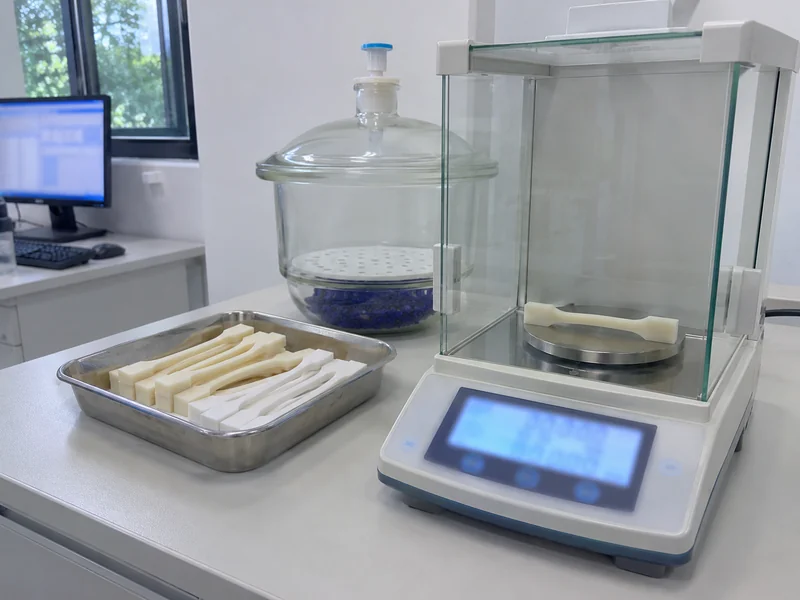
Water absorption is measured with standard methods such as ASTM D570, published by ASTM International. However, datasheet numbers only show part of the story. In practice, a nylon part grows slowly as it absorbs water, so a gear can measure correctly when molded and bind weeks later.
This matters most for:
- Gears and bushings with tight center distances or running clearances
- Snap-fits that must hold a specific retention force
- Sealing or press-fit features where a small size change shifts the fit
- Long parts, where a small percentage change adds up to a large length change
Here’s the thing: dimensional checks on fresh nylon parts are taken “dry as molded”. If the assembly lives in a humid climate, the parts should also be measured after conditioning. Otherwise, the first-article report passes while field parts fail.
Key Takeaway: For tight fits in humid service, Delrin is usually the safer choice. If you must use nylon, design the clearances for the conditioned size, not the dry size.
Which Wears Better in Delrin vs Nylon Gears and Bearings?
Delrin usually wears better in precision gears and sliding parts where fit must stay constant, while nylon often wears better under impact, shock loads and abrasive conditions. Both have low friction against steel, which is why they replace metal in many mechanisms.
When acetal wins on wear
- Small precision gears in printers, meters and actuators
- Sliding parts that must keep a consistent gap
- Wet or humid environments, where nylon would swell
- Parts running against acetal or steel at moderate loads
When nylon wins on wear
- Gears and rollers that see shock or impact loads
- Abrasive or dusty environments, where nylon’s toughness helps
- Higher temperature service, especially with PA66 or PA46
- Applications where small amounts of absorbed moisture act as a lubricant
In practice, many designers pair the two. For instance, an acetal gear running against a nylon gear often wears less than two identical gears. In addition, lubricated or PTFE-filled grades of both materials reduce friction further.
Key Takeaway: Choose acetal for steady, precise motion; choose nylon for shock and abrasion. Consider mixed pairs and lubricated grades before upgrading to a more expensive resin.
How Do Strength, Stiffness and Impact Compare?
Strength, stiffness and impact compare differently depending on moisture. Dry nylon PA66 is strong and stiff, but it softens as it absorbs water. Acetal, by contrast, keeps nearly the same stiffness across humidity levels.
That difference has two consequences. First, a nylon part designed with dry stiffness values can deflect more in service. Second, conditioned nylon becomes tougher, so it resists cracking at snap-fits and living features better than acetal.
- Stiffness: acetal is typically stiffer than conditioned unfilled nylon.
- Impact: conditioned nylon usually absorbs impact better; acetal is sensitive to sharp corners and notches.
- Creep: acetal has good creep resistance for an unfilled plastic; glass-filled nylon is better still under long-term load.
- Fatigue: acetal performs well in repeated flexing, which is why it is common in springs and clips.
For example, a clip that flexes thousands of times often works well in acetal. However, a bracket that must survive a drop test may perform better in nylon. Generous corner radii help both materials, because sharp inside corners concentrate stress.
Key Takeaway: Use conditioned property values for nylon designs. Add radii to every snap-fit and corner, whichever material you choose.
Which Handles Heat and Chemicals Better: Delrin or Nylon?
Nylon generally handles heat better, while acetal generally handles fuels and solvents well but is weak against strong acids. Therefore, the service environment can rule out one material quickly.
Acetal homopolymer melts at about 175 °C. Nylon 66 melts at about 260 °C, and glass-filled PA66 keeps useful stiffness at much higher service temperatures. As a result, under-hood or near-motor parts usually favor nylon.
Chemical resistance follows a different pattern:
- Acetal: good with fuels, oils and many solvents; attacked by strong acids, oxidizers and chlorine.
- Nylon: good with oils, greases and fuels; sensitive to acids and absorbs water and some alcohols.
- Both: check UV exposure, because unstabilized grades degrade outdoors.
Our guide to plastics for high-temperature parts covers more options when neither material is enough.
Key Takeaway: List the service temperature and every chemical the part touches. That list often decides Delrin vs nylon before cost does.
How Do Delrin vs Nylon Mold and Shrink Differently?
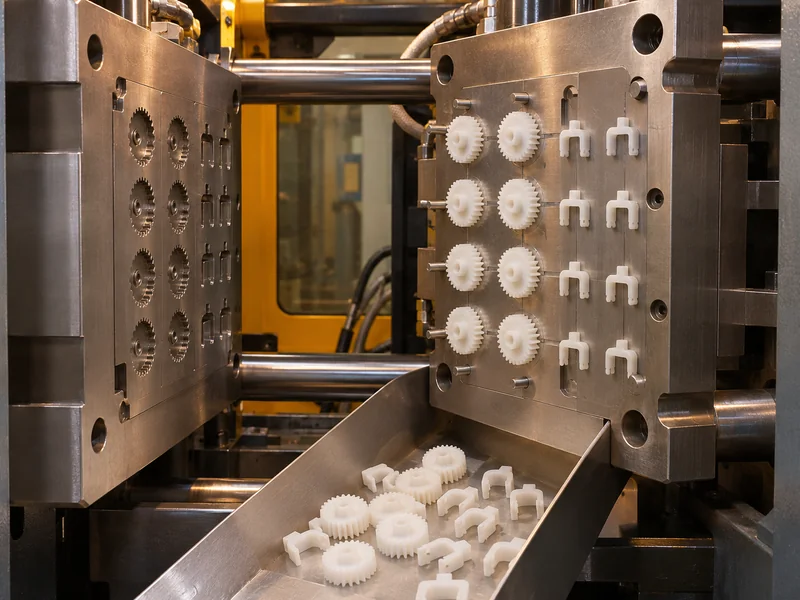
Delrin vs nylon also behave differently in the mold. Acetal shrinks more, needs good venting and must not overheat. Nylon must be dried carefully and can flash because its melt is very fluid.
| Molding factor | Acetal (POM) | Nylon (PA66) |
|---|---|---|
| Typical mold shrinkage, unfilled | about 1.8–2.2% | about 1.2–1.8% |
| Drying | Usually light or none for most grades | Required; moisture must be kept low |
| Venting | Critical; trapped gas causes burns | Important; thin melt can flash |
| Overheating risk | Degrades and releases formaldehyde gas | Discolors and loses properties |
| Post-mold change | Small | Grows as it absorbs moisture |
Drying nylon is not optional. Wet resin causes splay, bubbles and lower strength. Our guide to plastic resin drying explains the targets and checks.
For acetal, the risk is heat. Long residence time in the barrel can degrade the melt, so machine size and cycle time must match the shot. In addition, the mold needs good vents, because acetal releases gas that burns at the end of fill.
Key Takeaway: Build the mold for the chosen resin. Shrinkage, venting and gate size differ, so switching from acetal to nylon after the mold is cut usually means rework.
When Does Glass-Filled Nylon Beat Delrin?
Glass-filled nylon beats Delrin when the part needs high stiffness, high strength or high heat resistance under long-term load. A grade such as PA66 GF30 is much stiffer than unfilled acetal and keeps its shape at higher temperatures.
However, glass fiber changes other things too:
- Surfaces become rougher, so sliding and wear against soft parts can get worse.
- Shrinkage becomes direction-dependent, which can increase warpage.
- Tool wear increases, so gates and cavities may need harder steel.
- Moisture still affects the part, although less than in unfilled nylon.
For example, a structural bracket or a motor housing usually suits glass-filled nylon. A precision gear or a smooth slide, by contrast, still suits acetal. More options appear in our engineering plastics guide.
Key Takeaway: Do not compare unfilled acetal with glass-filled nylon on stiffness alone. Check surface finish, warpage and wear as well.
How Do Cost and Machinability Compare for Delrin vs Nylon?
Cost and machinability usually favor nylon on resin price and acetal on machining. Unfilled nylon resin is often cheaper per kilogram, while branded acetal homopolymer costs more. Prices change with the market, so compare current quotes for the exact grades.
Machinability matters for prototypes and low-volume parts:
- Acetal machines cleanly, holds tolerances well and leaves a smooth finish.
- Nylon machines well but can move after machining as it absorbs moisture.
- Glass-filled nylon wears cutting tools faster.
For molded parts, the resin price is only one cost driver. Scrap, cycle time, drying and secondary operations also count. For example, a cheaper nylon that needs conditioning before assembly can end up costing more than acetal.
Key Takeaway: Compare total part cost, not resin price. Include drying, scrap, conditioning and assembly issues in the Delrin vs nylon decision.
How Do You Choose Delrin vs Nylon for Your Part?
You choose Delrin vs nylon by ranking the part’s needs: dimensional stability, wear, impact, heat, chemicals and cost. Then the strongest requirement usually decides the material.
A quick selection checklist:
- Tight fits in humid service? Choose acetal.
- Shock loads, drop tests or flexible snap-fits? Choose nylon.
- Service above about 100 °C or high structural load? Choose nylon, often glass-filled.
- Precision gears or smooth sliding? Choose acetal, or an acetal–nylon gear pair.
- Strong acids or chlorine exposure? Avoid acetal and check nylon carefully.
We mold both materials, including PA, PA+GF and POM grades, and we review material choice as part of project engineering. For more background, see our injection molding material selection guide.
Key Takeaway: Pick the requirement you cannot compromise on, then choose the material that protects it. Test with production-grade resin, not a substitute.
FAQ
- Q: Is Delrin stronger than nylon?
- It depends on conditions. Acetal is often stiffer than conditioned nylon, while dry or glass-filled nylon can be stronger. Nylon is usually tougher under impact.
- Q: Which absorbs more water, Delrin or nylon?
- Nylon absorbs much more. Unfilled PA66 can reach about 2.5% at room humidity, while acetal stays near 0.2%.
- Q: Is Delrin or nylon better for gears?
- Acetal suits precision gears with steady loads and tight fits. Nylon suits gears that see shock loads or higher temperatures. Mixed pairs often wear best.
- Q: Can Delrin and nylon be injection molded in the same mold?
- Not without changes. Their shrinkage, venting and gating needs differ, so a mold built for one usually needs adjustment for the other.
- Q: Which is better for high temperatures?
- Nylon, especially glass-filled PA66, handles higher temperatures than acetal, which melts at about 175 °C.
Conclusion
The Delrin vs nylon decision depends on whether stability or toughness matters more. Acetal protects fit in humid service, while nylon protects against impact and heat. To compare grades for your part, send your 3D model and 2D drawing and our engineers will review the material and molding plan.