
Polypropylene vs Polyethylene: How to Choose the Right One
The polypropylene vs polyethylene choice usually comes down to stiffness, heat and cold. Polypropylene (PP) is stiffer, handles higher temperatures and makes excellent living hinges, while polyethylene (PE) stays tougher in the cold and is softer and more flexible. Both are low-cost, chemically resistant polyolefins, so they often compete for the same caps, containers, housings and closures.
The wrong choice shows up in specific ways. For example, a PE lid can soften in a dishwasher, while a PP homopolymer part can crack when dropped in a freezer. In addition, a PE part exposed to detergents under stress can crack slowly over months. In this guide, we compare polypropylene vs polyethylene for injection molded parts, with the trade-offs that matter in plastic injection molding projects.
Polypropylene (PP) has a density of about 0.90 g/cm³, a melting point of about 160–165 °C and higher stiffness, which suits hinged lids, housings and parts that see heat. Polyethylene (PE) includes HDPE and LDPE, with melting points of roughly 105–135 °C, better low-temperature impact and more flexibility, which suits squeeze bottles, cold-service parts and soft closures. Choose PP for heat, stiffness and living hinges; choose PE for cold toughness and flexibility.
In short: PP for heat and hinges, PE for cold and flex.
Key points:
- Heat: PP handles higher temperatures, including many dishwasher and hot-fill uses.
- Cold: PE, especially HDPE and LDPE, stays tougher below freezing.
- Hinges: PP is the standard material for molded living hinges.
What Is the Difference Between Polypropylene vs Polyethylene?
The difference between polypropylene vs polyethylene starts with their chain structure. Both are polyolefins, but PP has a methyl group on every other carbon, which makes it stiffer and raises its melting point. PE has a simpler chain, which keeps it more flexible and tougher at low temperatures.
| Property (typical) | Polypropylene (PP) | HDPE | LDPE |
|---|---|---|---|
| Density | about 0.90–0.91 g/cm³ | about 0.94–0.97 g/cm³ | about 0.91–0.93 g/cm³ |
| Melting point | about 160–165 °C | about 130–135 °C | about 105–115 °C |
| Stiffness | Higher | Medium | Low |
| Low-temperature impact | Fair (homopolymer) to good (copolymer) | Good | Very good |
| Living hinge | Excellent | Poor | Poor |
| Recycling code | 5 | 2 | 4 |
Density values like these are measured with standard methods, such as those published by ISO. Because both materials float in water, they are easy to tell apart from heavier plastics but harder to tell apart from each other.
Key Takeaway: Compare the exact grade family. PP homopolymer, PP copolymer, HDPE and LDPE behave very differently.
How Do Stiffness and Impact Compare in Polypropylene vs Polyethylene?
Stiffness and impact in polypropylene vs polyethylene trade off against each other. PP is stiffer, so parts hold their shape with thinner walls. PE is tougher and more flexible, so parts absorb impact without cracking, especially in the cold.
- PP homopolymer: stiff and strong, but impact strength drops near and below 0 °C.
- PP impact copolymer: better impact, including at low temperatures, with slightly lower stiffness.
- HDPE: good impact and moderate stiffness.
- LDPE: very flexible and tough, but too soft for structural parts.
For example, a stiff crate wall in PP can be thinner than the same wall in HDPE. However, if the crate is used in a cold store, an impact copolymer PP or HDPE avoids brittle cracks.
Key Takeaway: Specify the service temperature with the stiffness requirement. Cold service often rules out PP homopolymer.
Which Handles Heat Better: Polypropylene or Polyethylene?
Polypropylene handles heat better than polyethylene. PP melts at about 160–165 °C, while HDPE melts at about 130–135 °C and LDPE at about 105–115 °C. As a result, PP keeps its shape at temperatures where PE softens.
That matters for:
- Dishwasher-safe parts, which commonly use PP
- Hot-fill containers and microwavable food containers
- Parts near warm components, such as appliance housings
- Steam sterilization of some medical items, where certain PP grades are used
However, both materials lose stiffness as temperature rises. Therefore, always check the grade’s heat deflection temperature for parts under load.
Heat also affects dimensions. For example, a PP lid that fits perfectly at room temperature can loosen after repeated hot washing if the wall is thin and the snap is shallow. In addition, hot-fill containers need enough wall thickness and a suitable grade so the walls do not panel or bulge. As a result, the polypropylene vs polyethylene decision for warm service should include a functional test at the real temperature, not only a datasheet comparison.
Key Takeaway: For hot service, start with PP. Use PE only where temperatures stay moderate.
Which Is Better for Living Hinges: Polypropylene or Polyethylene?
Polypropylene is far better for living hinges than polyethylene. A well-designed PP living hinge can flex many thousands of times without breaking, which is why flip-top caps and hinged boxes use PP.
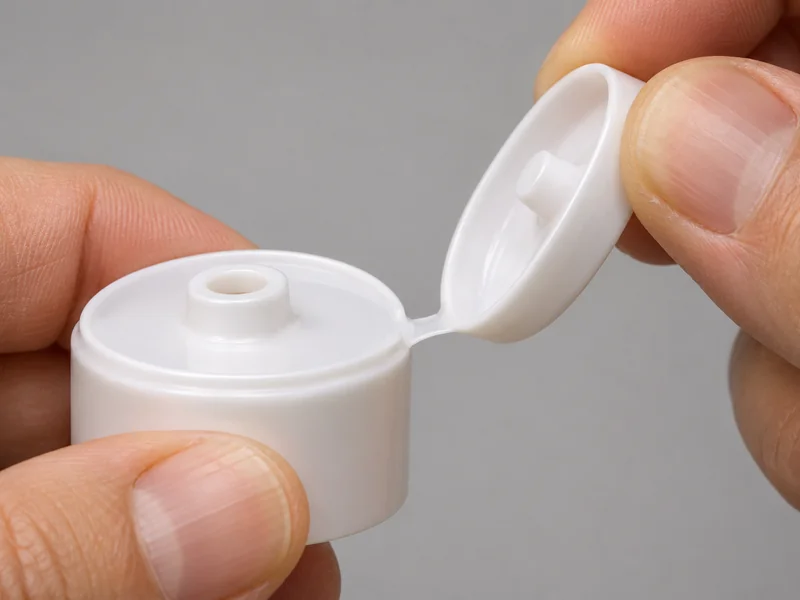
PE hinges tend to whiten, stretch or tear after fewer cycles. Therefore, PE is rarely used for molded living hinges.
Good living hinge practice includes:
- A thin, uniform hinge section, typically a few tenths of a millimeter
- Gating so flow crosses the hinge, which aligns molecules along the flex direction
- Flexing the hinge right after molding, which improves orientation and life
- Generous radii where the hinge meets the thicker walls
Key Takeaway: If the part has a molded hinge, choose PP and design the gate and hinge together.
How Do Chemical Resistance and Stress Cracking Compare?
Chemical resistance is excellent for both polypropylene vs polyethylene, but they differ in stress cracking. Both resist most acids, bases, salts and many solvents at room temperature.
The key difference is environmental stress cracking (ESC):
- PE, especially some HDPE grades, can crack over time when exposed to detergents, oils or surfactants while under stress.
- PP generally shows better resistance to stress cracking in the same conditions.
- Both can swell in some hydrocarbons and aromatic solvents.
For example, a PE closure that is screwed tightly onto a detergent bottle can crack around the threads after weeks. Choosing an ESC-resistant grade or switching to PP can solve the problem.
Key Takeaway: List every chemical the part touches and whether the part is under stress. ESC failures are slow and expensive to discover in the field.
Which Works Better in the Cold: Polypropylene or Polyethylene?
Polyethylene works better in the cold than polypropylene. PE, especially LDPE and HDPE, keeps its impact strength well below freezing. PP homopolymer becomes brittle near and below 0 °C, while PP copolymers improve cold impact.
- Freezer and cold-chain parts: PE or impact-copolymer PP
- Outdoor winter use: PE or impact-copolymer PP with UV stabilizer
- Room temperature only: PP homopolymer is usually fine
In practice, cold failures appear during handling, not in storage. For example, a frozen container that is dropped onto a concrete floor, or a cap that is opened with force at low temperature, sees a sudden impact. Therefore, a drop test at the lowest service temperature is the most useful check. In addition, sharp corners and thin hinges concentrate stress, so generous radii help both materials survive cold impacts.
Key Takeaway: For cold service, avoid PP homopolymer. Use PE or an impact-copolymer PP.
How Do Polypropylene vs Polyethylene Mold Differently?
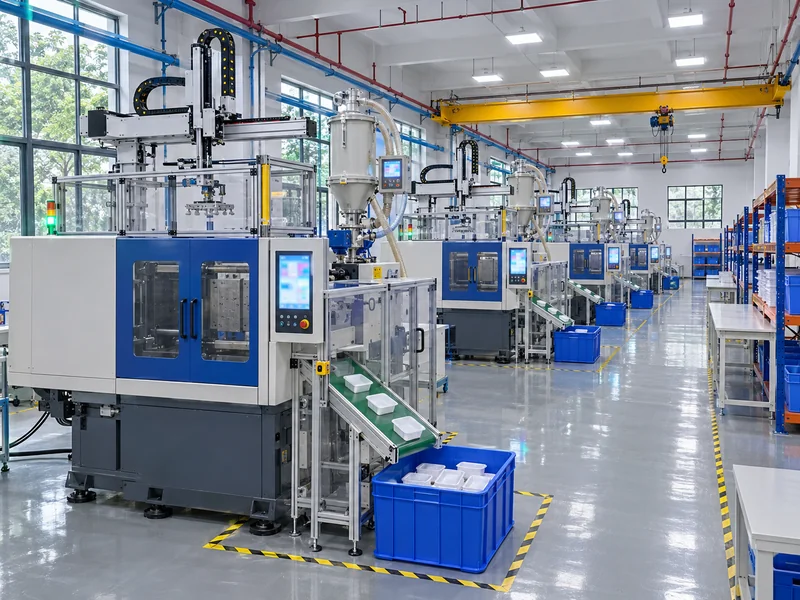
Polypropylene vs polyethylene both mold easily, but they shrink and warp differently. Both are semi-crystalline, so they shrink more than amorphous plastics such as ABS.
| Molding factor (typical) | PP | HDPE |
|---|---|---|
| Mold shrinkage | about 1.0–2.5% | about 1.5–3.0% |
| Warpage tendency | Moderate | Higher on flat parts |
| Drying | Usually not needed | Usually not needed |
| Flow | Good; easy to fill thin walls | Good |
| Surface | Can be glossy | Often waxy feel |
Because HDPE shrinks more and less evenly, large flat HDPE parts warp more easily. Therefore, ribs, uniform walls and balanced cooling matter. Our guide to plastic shrinkage explains how to plan for it, and our article on polypropylene injection molding covers PP in more depth.
Key Takeaway: Do not swap PP and PE in the same mold without checking shrinkage. Dimensions and warpage usually change.
How Do You Tell Polypropylene and Polyethylene Apart?
You can tell polypropylene and polyethylene apart by their recycling codes, stiffness and behavior when flexed. Laboratory tests are needed for certainty.
- Recycling codes: PP is 5, HDPE is 2 and LDPE is 4.
- Stiffness: PP feels stiffer at the same thickness.
- Hinge test: PP can form a durable living hinge; PE cannot.
- Lab methods: density, melting point (DSC) or infrared spectroscopy identify the material reliably.
Key Takeaway: Use molding marks and lab checks for production parts. Hand tests are only rough guides.
Which Should You Choose: Polypropylene or Polyethylene?
You choose between polypropylene vs polyethylene by ranking heat, cold, stiffness, hinges and stress cracking for your part.
- Living hinge or flip-top lid? PP.
- Dishwasher, hot-fill or warm service? PP.
- Freezer, cold-chain or winter outdoor use? PE or impact-copolymer PP.
- Squeeze bottle or very flexible part? LDPE.
- Detergent or surfactant contact under stress? PP or ESC-resistant PE grade.
We mold PP and other commodity and engineering resins for custom parts. For broader comparisons, see our common plastic materials guide.
Key Takeaway: Pick the requirement you cannot compromise on. That single requirement usually decides PP vs PE.
FAQ
- Q: Is polypropylene stronger than polyethylene?
- PP is stiffer and usually stronger in tension, while PE is tougher and more flexible, especially at low temperatures.
- Q: Which is more heat resistant, PP or PE?
- PP. It melts at about 160–165 °C, while HDPE melts at about 130–135 °C.
- Q: Can polyethylene make living hinges?
- Not well. PP is the standard material for molded living hinges.
- Q: Which is better for freezer use?
- PE or an impact-copolymer PP. PP homopolymer becomes brittle in the cold.
- Q: How can I tell PP and PE apart?
- Check the recycling code: 5 is PP, 2 is HDPE and 4 is LDPE. Lab tests confirm the material.
Conclusion
The polypropylene vs polyethylene choice depends on heat, cold, stiffness and hinges. Use PP for heat and living hinges, and PE for cold toughness and flexibility. To confirm the right grade for your part, send your 3D model and 2D drawing to our engineers.