
Multi Cavity Injection Molding: How to Pick the Best Count
Multi cavity injection molding uses one mold with several identical cavities, so each cycle produces several identical parts. The key decision is the cavity count. More cavities lower the cost per part and raise output, but they increase mold cost, need a larger press and make every cavity harder to keep identical.
The right cavity count comes from numbers, not habit. For example, a part needed at 2 million pieces a year may justify 8 or 16 cavities, while the same part at 50,000 a year is usually cheaper in 1 or 2 cavities. In this guide, we explain how to calculate cavity count for multi cavity injection molding, how press size and layout limit it, and how cavities are balanced and accepted at the trial. If you are comparing multi-cavity and family molds, start with our guide to multi-cavity vs family molds.
In multi cavity injection molding, the cavity count is chosen from annual volume, cycle time, available machine hours, part size and required quality. A common estimate is: cavities = annual demand × cycle time ÷ (available seconds per year × yield). The result is then checked against press clamping force, shot size, platen and tie-bar space, balance between cavities and mold cost payback. Higher cavity counts lower part cost but raise mold cost and quality risk.
In short: calculate cavities from demand and cycle time, then check that the press, the layout and the budget can carry them.
Key points:
- Demand first: cavity count follows annual volume and cycle time.
- Press limits: clamp force, shot size and tie-bar space cap the count.
- Balance: every cavity must fill and measure the same.
What Is Multi Cavity Injection Molding?
Multi cavity injection molding is molding with a mold that contains two or more identical cavities. Each shot fills all cavities at once, so the output per cycle multiplies.
Common cavity counts are 2, 4, 8, 16, 32 and higher for small parts such as caps, clips and medical components. Symmetrical counts are preferred, because they make balanced runner layouts easier.
Compared with a single-cavity mold, a multi-cavity mold:
- Lowers the machine time per part
- Raises the mold cost and lead time
- Needs a larger press
- Needs each cavity to be identified and inspected
Our multi-cavity injection molds page shows typical designs.
Key Takeaway: In multi cavity injection molding, more cavities are not automatically better. They pay back only when volume is high enough.
How Do You Calculate Cavity Count for Multi Cavity Injection Molding?
You calculate cavity count for multi cavity injection molding by dividing the time needed to make the annual demand by the machine time available.
Cavities = annual demand × cycle time ÷ (available seconds per year × yield)
A worked example:
- Annual demand: 1,000,000 parts
- Cycle time: 20 seconds
- Available machine time: 5,000 hours per year = 18,000,000 seconds
- Yield: 95%
Cavities = 1,000,000 × 20 ÷ (18,000,000 × 0.95) ≈ 1.17
In this case, 2 cavities are enough, with spare capacity. If demand rises to 5,000,000 parts, the result becomes about 5.8, so an 8-cavity mold is the practical choice.
Cycle time also changes with cavity count. Larger molds can need slightly longer cycles. Our guide to estimating molding cycle time explains the main drivers.
Key Takeaway: Run the calculation for today’s demand and for the expected peak. Then choose the count that covers the peak with some margin.
How Does Cavity Count Change Part Cost and Mold Cost?
In multi cavity injection molding, cavity count changes part cost and mold cost in opposite directions. More cavities reduce the machine time per part, but they add steel, machining and balancing work to the mold.
| Cavity count | Mold cost | Machine time per part | Best for |
|---|---|---|---|
| 1 | Lowest | Highest | Low volume, large or precise parts |
| 2–4 | Moderate | Moderate | Medium volume |
| 8–16 | High | Low | High volume, small parts |
| 32+ | Very high | Very low | Very high volume, very small parts |
The best choice gives the lowest total cost over the part’s life. For example, an 8-cavity mold may cost far more than a 2-cavity mold, but save that difference within the first year at high volume. At low volume, the extra mold cost may never pay back.
Key Takeaway: Compare total cost over the expected life: mold cost plus part cost times volume.
How Does Press Size Limit Multi Cavity Injection Molding?
Press size limits multi cavity injection molding through clamping force, shot size and the space between the tie bars. A mold that is too large for the press cannot run, however good the design.
Check these limits:
- Clamping force: projected area of all cavities and runners × cavity pressure must stay within the press rating.
- Shot size: the press must inject enough material for all cavities and runners, ideally within a comfortable range of its capacity.
- Tie-bar spacing: the mold must fit between the tie bars.
- Mold height and opening stroke: the press must open far enough to eject the parts.
- Platen size: the mold must be supported across its area.
Our Shenzhen plant runs 41 presses from 30 to 380 T. Therefore, very large multi-cavity molds need to be planned against the available press sizes early. Machine and mold interface dimensions follow standards such as those from EUROMAP.
Key Takeaway: Check press clamp force, shot size and tie-bar space before fixing the cavity count.
How Do You Lay Out a Multi-Cavity Mold for Press Clearance?
You lay out a multi-cavity mold for press clearance by arranging cavities so the mold stays compact, balanced and easy to cool and eject. Layout affects mold size as much as cavity count does.
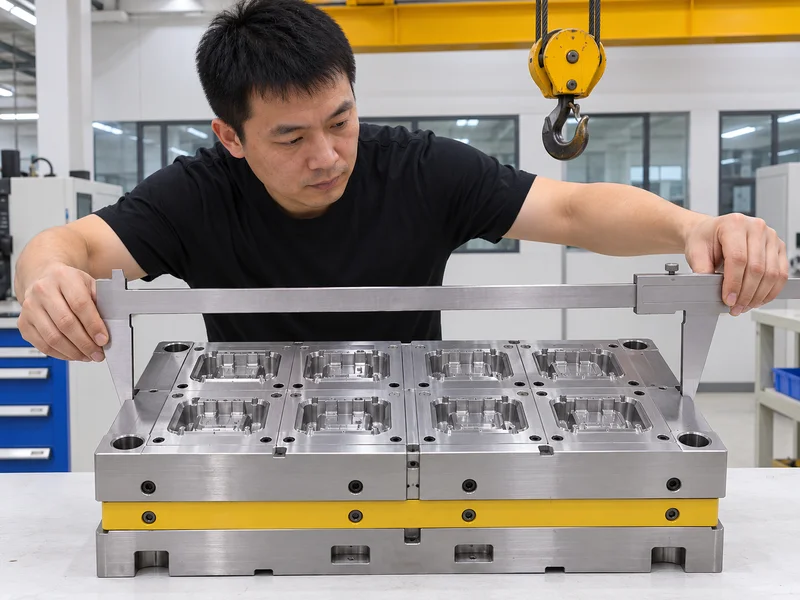
Good layout practice:
- Symmetrical layouts, such as 2 × 2 or 2 × 4, for balanced runners
- Compact spacing, with enough steel between cavities for strength and cooling
- Cooling around every cavity, not only the outer ones
- Room for slides, if each cavity needs side actions
- Access for maintenance, so inserts can be changed without removing the whole mold
For example, a 16-cavity mold with slides on every cavity can become too wide for the planned press. A 2 × 8 layout may fit where a 4 × 4 layout does not, or the slides may need to be combined.
Key Takeaway: Ask for the mold’s outer dimensions with the cavity layout. Then compare them with the press data.
How Do You Balance Cavities in Multi Cavity Injection Molding?
In multi cavity injection molding, you balance cavities by making every cavity fill at the same time and pressure. Unbalanced cavities produce different weights, dimensions and defects.

Balancing methods include:
- Naturally balanced runners, where every cavity has the same flow length
- Hot runner systems with controlled nozzle temperatures
- Equal cooling for every cavity
- Flow simulation to check filling before steel is cut
Hot runners help many multi-cavity molds, because they remove runner waste and allow nozzle-by-nozzle control. Our guide to hot runner vs cold runner molds explains the trade-offs, and mold flow analysis shows how balance is checked.
Key Takeaway: Ask how the supplier will prove cavity balance, such as by short-shot studies or part weights per cavity.
How Are Family Molds Balanced and Accepted at the Trial?
Family molds are balanced and accepted with extra care, because they make different parts in one shot. Different volumes and wall thicknesses fill at different rates, so balance is harder than in a multi-cavity mold.
At the trial, typical checks include:
- Short-shot study: fill partially to see which cavity fills first.
- Part weight per cavity: compare weights to detect imbalance.
- Dimensions per cavity: measure every cavity, not only one.
- Appearance per cavity: check for flash, sink and short shots.
For both family and multi-cavity molds, each cavity needs a molded cavity number, so parts can be traced. In addition, approval reports should show results per cavity. Our quality control and inspection process supports per-cavity dimensional reports when required.
Key Takeaway: Accept a multi-cavity or family mold only with results for every cavity. One bad cavity can contaminate a whole shipment.
When Is a Lower Cavity Count the Better Choice?
In multi cavity injection molding, a lower cavity count is the better choice when volume is uncertain, the part is large or tolerances are very tight. In these cases, risk outweighs the saving per part.
Choose fewer cavities when:
- Demand is not yet proven
- The part is large or heavy
- Tolerances must be held very tightly across all parts
- The part needs complex side actions in every cavity
- The budget for the mold is limited
A common approach is to start with a lower cavity count and add a second mold when demand grows. That spreads risk and keeps a backup tool. For mold types, see our injection mold manufacturing page.
Key Takeaway: When in doubt, start smaller and add capacity later. A second mold also protects supply.
FAQ
- Q: What is multi cavity injection molding?
- It is injection molding with a mold that has several identical cavities, so each cycle produces several identical parts.
- Q: How do you calculate the number of cavities?
- Divide annual demand × cycle time by available machine seconds per year × yield, then round up to a practical layout.
- Q: Are more cavities always cheaper?
- No. More cavities lower part cost but raise mold cost, so they pay back only at high volume.
- Q: What limits the number of cavities?
- Press clamping force, shot size, tie-bar space, cavity balance, part size and mold budget.
- Q: How is a multi-cavity mold accepted?
- With results for every cavity, including part weight, dimensions and appearance, usually after a short-shot balance check.
Conclusion
Multi cavity injection molding lowers part cost when cavity count matches demand, press size and quality needs. Calculate the count, check the press and layout, and accept the mold only with per-cavity results. To plan the right cavity count, send your 3D model, 2D drawing and annual volume to our engineers.