
PEEK vs Torlon: How to Pick the Best One Without Waste
PEEK vs Torlon is a choice between two of the highest-performing engineering plastics. PEEK (polyether ether ketone) offers excellent chemical resistance, high heat resistance, low moisture uptake and relatively straightforward molding. Torlon, a trade name for PAI (polyamide-imide), offers even higher strength, stiffness and wear resistance at high temperatures, but it is harder to mold, absorbs more moisture and needs a long post-cure.
Both materials replace metal in demanding parts, so the wrong choice is expensive either way. For example, a thrust washer running dry against steel at high load may last far longer in a bearing-grade PAI. On the other hand, a valve seat exposed to hot steam and chemicals usually performs better in PEEK. In this guide, we compare PEEK vs Torlon for molded and machined engineering components, including strength, heat, wear, chemicals, moisture, processing and cost. For other high-temperature options, see our guide to plastics for hot temperatures.
PEEK is a semi-crystalline thermoplastic with a glass transition of about 143 °C, a melting point of about 343 °C and continuous service up to about 250 °C, with excellent chemical, steam and hydrolysis resistance and low moisture absorption. Torlon (PAI) is an amorphous polymer with a glass transition of about 275–280 °C, very high strength and stiffness up to about 260 °C and outstanding wear grades, but it absorbs more moisture, can be attacked by strong bases and steam, and molded parts need an extended thermal post-cure. Choose PEEK for chemical and steam exposure; choose PAI for maximum strength and wear at high temperature.
In short: PEEK for chemicals, steam and easier processing; Torlon for the highest strength and wear at temperature.
Key points:
- Strength and wear: PAI is stronger and stiffer, especially near 200 °C and above.
- Chemicals and steam: PEEK resists them better.
- Processing: PEEK molds conventionally; PAI needs post-curing and careful control.
What Is the Difference Between PEEK vs Torlon?
The difference between PEEK vs Torlon starts with their structure. PEEK is semi-crystalline, so it keeps chemical resistance and toughness above its glass transition. PAI is amorphous, with a very high glass transition, so it keeps stiffness to higher temperatures.
| Property (typical, unfilled) | PEEK | Torlon (PAI) |
|---|---|---|
| Structure | Semi-crystalline | Amorphous |
| Density | about 1.30–1.32 g/cm³ | about 1.41–1.42 g/cm³ |
| Glass transition | about 143 °C | about 275–280 °C |
| Continuous service | up to about 250 °C | up to about 260 °C |
| Strength and stiffness | Very high | Highest among common thermoplastics |
| Moisture absorption | Low | Higher |
| Chemical resistance | Excellent | Good; weaker to strong bases and steam |
| Processing | Conventional molding, high temperatures | Difficult; needs post-cure |
Properties like these are measured with standard methods, such as those published by ASTM International, so compare datasheets that use the same test.
Key Takeaway: Compare grades, not families. Glass-filled, carbon-filled and bearing grades change the balance a lot.
Which Is Stronger: PEEK or Torlon?
Torlon is stronger and stiffer than PEEK, especially at elevated temperatures. Unfilled PAI has one of the highest tensile strengths of any unreinforced thermoplastic.
The gap grows with temperature:
- At room temperature: both are very strong; PAI leads.
- Above about 150 °C: PEEK is above its glass transition and loses stiffness faster.
- Near 200–250 °C: PAI keeps much more of its stiffness.
For example, a structural bracket that must hold load at 200 °C may creep in unfilled PEEK but stay stable in PAI. However, carbon- or glass-filled PEEK closes much of the gap at lower cost and with easier processing.
Key Takeaway: If the part carries high load near 200 °C or more, test PAI. Otherwise, filled PEEK often meets the target.
How Do PEEK vs Torlon Compare in Wear and Friction?
PEEK vs Torlon both offer excellent wear grades, but bearing-grade PAI is often the benchmark for dry-running parts under high load and speed. PEEK bearing grades are also widely used, especially where chemicals or steam are present.
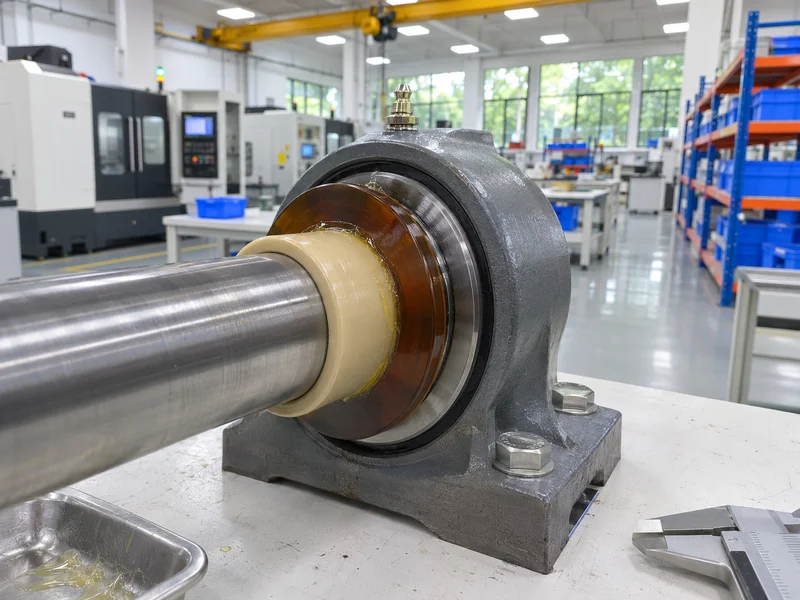
Typical wear applications:
- Thrust washers and bushings
- Seal rings and piston rings
- Bearing cages
- Valve seats and wear pads
In practice, the counterface, lubrication, temperature and pressure-velocity (PV) level decide which grade lasts longer. Therefore, wear testing in the real conditions is the reliable way to choose.
Key Takeaway: Specify load, speed, temperature, counterface and lubrication. Wear performance depends on all five.
Which Handles Chemicals and Steam Better?
PEEK handles chemicals and steam better than Torlon. PEEK resists most organic solvents, acids and bases, and it tolerates repeated steam sterilization. It is attacked mainly by concentrated sulfuric acid and a few other aggressive media.
PAI also resists many fuels, oils and solvents. However:
- Strong bases can attack PAI.
- High-temperature steam can degrade PAI over time.
- Moisture absorption causes dimensional change in PAI parts.
As a result, PEEK is often chosen for chemical processing, oil and gas, and medical or food equipment that is cleaned with steam. Food or medical use also requires grade-specific compliance documents, for example against U.S. FDA requirements.
Key Takeaway: For steam, alkaline cleaning or aggressive chemicals, start with PEEK.
How Does Moisture Affect PEEK vs Torlon Parts?
Moisture affects PEEK vs Torlon parts very differently. PEEK absorbs little water, so its dimensions stay stable. PAI absorbs more water over time, which makes it swell slightly and can affect tight fits.
Practical effects of moisture in PAI:
- Dimensional growth as the part absorbs water
- Fit changes in bushings and seal rings
- Blistering risk if wet parts are heated quickly
For tight-tolerance PAI parts, designers allow for growth or condition parts before final measurement. In addition, PAI parts that will see sudden high temperatures should be kept dry.
Electrical properties are a further point. Both materials are good insulators with high dielectric strength. However, PAI’s moisture uptake slightly reduces its electrical performance in humid conditions, while PEEK stays more stable. As a result, PEEK is often preferred for insulating parts in humid or wet environments.
Key Takeaway: For tight fits in humid environments, PEEK is easier to control. Account for moisture growth if you choose PAI.
How Are PEEK and Torlon Molded and Machined?
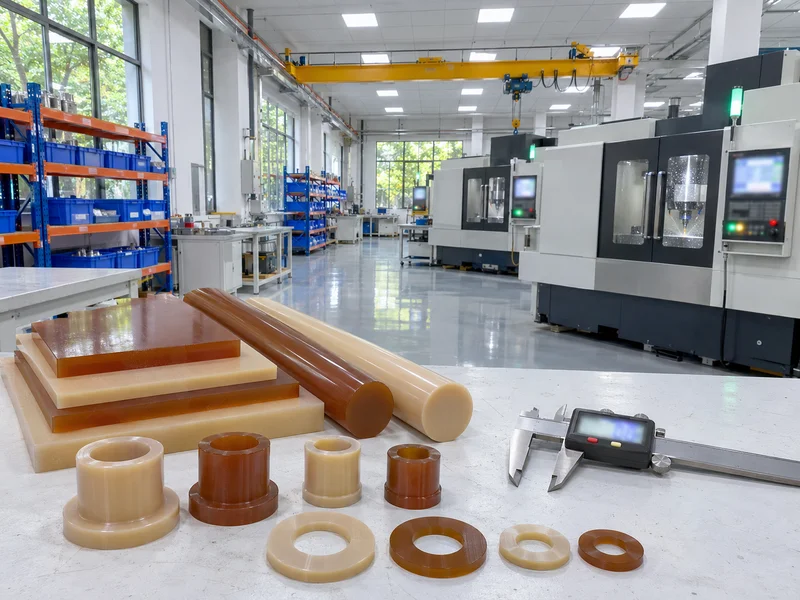
PEEK and Torlon are both molded and machined, but PAI is much harder to process. PEEK molds on suitable injection molding machines with high barrel and mold temperatures. PAI needs tighter control and an extended thermal post-cure to reach its full properties.
| Processing factor | PEEK | Torlon (PAI) |
|---|---|---|
| Injection molding | Conventional at high temperatures | Specialized; narrow window |
| Mold temperature | High, for crystallinity | High |
| Post-cure | Annealing optional | Required, often days long |
| Drying | Required | Required |
| Machining from stock | Common | Very common |
Because PAI molding is specialized, many PAI parts are machined from stock shapes, especially at low volume. PEEK is common in both routes. We mold and machine PEEK, including filled grades, within our plastic injection molding and CNC machining services.
Key Takeaway: For low volumes, compare machined PEEK and machined PAI. For molded volumes, PEEK is usually the simpler route.
How Do PEEK and Torlon Compare in Cost?
PEEK and Torlon are both among the most expensive engineering plastics. PAI is usually more expensive than PEEK, and its post-cure adds processing cost.
Cost drivers to compare:
- Resin or stock price per kilogram
- Processing: PAI post-cure and lower yields
- Machining time for stock-shape parts
- Scrap: high-value material makes scrap costly
- Part life: longer life can justify higher price
For example, a PAI bushing that lasts three times longer than a PEEK bushing may lower the total cost, even at a higher piece price. Our comparison of Delrin vs nylon covers lower-cost options for less demanding parts.
Key Takeaway: Compare cost per operating hour, not price per part, for wear parts.
PEEK vs Torlon: Which Should You Choose?
You choose between PEEK vs Torlon by ranking load, temperature, wear, chemicals and moisture for your part.
- Highest load and stiffness near 200–260 °C? PAI.
- Dry-running wear parts under high PV? Test bearing-grade PAI and PEEK.
- Steam, strong bases or aggressive chemicals? PEEK.
- Tight fits in humid conditions? PEEK.
- Molded parts at volume? Usually PEEK.
For a broader view, see our guide to engineering plastics.
Key Takeaway: Choose PAI when strength or wear at temperature is the limit. Choose PEEK when chemicals, steam, moisture or processing are the limit.
FAQ
- Q: Is Torlon stronger than PEEK?
- Yes. Torlon (PAI) is stronger and stiffer, especially at high temperatures, while PEEK is easier to process and more chemically resistant.
- Q: Which has higher temperature resistance, PEEK or Torlon?
- PAI keeps stiffness to higher temperatures because its glass transition is about 275–280 °C, compared with about 143 °C for PEEK.
- Q: Which is better for steam and chemicals?
- PEEK. It resists steam, hydrolysis and most chemicals better than PAI.
- Q: Why do Torlon parts need post-curing?
- Molded PAI needs an extended thermal cure to complete its chemical reaction and reach full strength and chemical resistance.
- Q: Is Torlon more expensive than PEEK?
- Usually, yes, and its post-cure and processing add further cost.
Conclusion
PEEK vs Torlon comes down to strength and wear at temperature against chemical resistance, moisture stability and easier processing. Choose PAI for the hardest mechanical duty and PEEK for chemicals, steam and molded volume. To review material and process for your part, send your 3D model and 2D drawing to our engineers.