
8D Report: How to Avoid Costly Mistakes the First Time
An 8D report is a structured problem-solving document that takes a quality problem from first containment to permanent correction in eight disciplines: team, problem description, containment, root cause, corrective action, verification, prevention and closure. Customers ask for an 8D report when a defect reaches them, so they can see that the supplier has found the real cause and stopped it from coming back.
A good 8D report reads like evidence, not a promise. For example, “operator retrained” is a weak corrective action for short shots, while “dryer dew-point alarm added and resin moisture checked every shift” is strong, because it removes the cause. In this guide, we explain each step of the 8D report, walk through an example for a molded part defect, and show what customers look for. For the documents that come before production, see our guide to PPAP levels.
An 8D report documents eight problem-solving disciplines: D1 form the team, D2 describe the problem, D3 contain it, D4 find and verify the root cause, D5 choose permanent corrective actions, D6 implement and validate them, D7 prevent recurrence across similar products and processes, and D8 close and recognize the team. Many customers also require a D0 step for emergency response. A strong 8D report explains both why the defect occurred and why it escaped detection.
In short: contain fast, prove the root cause, fix the process and stop it everywhere it could happen.
Key points:
- Containment first: protect the customer within hours or days.
- Two root causes: why it happened and why it was not detected.
- Evidence: every step is backed by data, not opinion.
What Is an 8D Report?
An 8D report is the written record of the 8 disciplines method, a problem-solving process that started in the automotive industry and is now used across manufacturing. It is used for customer complaints, field failures and serious internal problems.
Customers request an 8D report because it shows:
- What was done to protect them immediately
- What the real root cause was
- What was changed to fix it permanently
- How the fix was verified
- How similar problems will be prevented
Many customers set response deadlines, such as an initial containment response within one or two days and a complete report within a few weeks. Check the customer’s supplier manual for their exact timing.
Key Takeaway: Treat an 8D report as proof, not paperwork. Customers judge suppliers by the quality of their 8Ds.
What Are the Steps of an 8D Report?
The steps of an 8D report follow a fixed order, so every problem is handled the same way.
| Step | Name | What it answers |
|---|---|---|
| D0 | Emergency response | Is anyone at risk right now? |
| D1 | Team | Who has the knowledge and authority to solve it? |
| D2 | Problem description | What exactly is wrong, where, when and how many? |
| D3 | Containment | How is the customer protected now? |
| D4 | Root cause | Why did it happen, and why was it not detected? |
| D5 | Corrective actions | What permanent change removes the cause? |
| D6 | Implementation and validation | Is the change in place and does it work? |
| D7 | Prevention | Where else could this happen, and how is it stopped? |
| D8 | Closure | Is the customer satisfied and the team recognized? |
Each step builds on the one before. Therefore, a weak problem description in D2 usually leads to a wrong root cause in D4.
Key Takeaway: Spend time on D2. A precise problem description saves days in root cause analysis.
How Do You Write the Problem Description in an 8D Report?
You write the problem description in an 8D report by stating facts that anyone can verify: what, where, when, how many and how it was detected.
A useful method is “is / is not”:
- What is the defect, and what is it not?
- Where is it found: which cavity, line, location on the part?
- When did it start, and when was it not present?
- How many parts are affected, and which lots?
For example: “Short shot at the snap hook of part 12345, cavity 3 only, found by the customer at assembly in lot 2409-07; cavities 1, 2 and 4 are not affected; lots before 2409-05 are not affected.” That description already points toward cavity 3 and a recent change.
Key Takeaway: Include what the problem is not. It narrows the root cause faster than any brainstorming.
How Do You Contain a Problem in an 8D Report?
You contain a problem in an 8D report by stopping suspect parts from reaching the customer while the root cause is still unknown. Containment is temporary, but it must be fast and complete.
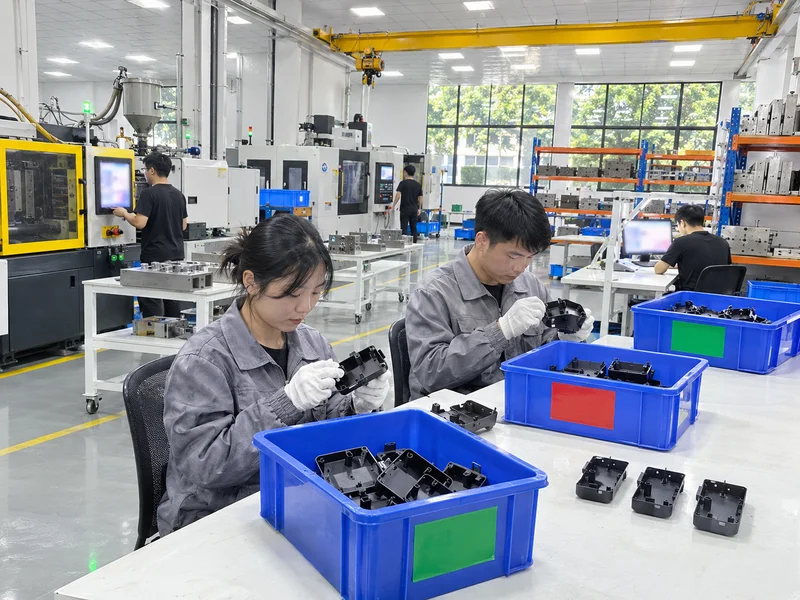
Typical containment actions:
- Sort or rework stock at the supplier, in transit and at the customer
- Quarantine suspect lots
- Add 100% inspection of the defect feature
- Mark certified-good shipments clearly
- Stop or adjust the affected cavity or machine
Record the quantities sorted, rejected and released. As a result, the customer can trust that everything shipped after containment is good.
Key Takeaway: Containment must cover every location: production, warehouse, transit and customer stock.
How Do You Find the Root Cause in an 8D Report?
You find the root cause in an 8D report by testing possible causes against the facts until one explains everything. Common tools include the 5 Whys, fishbone (Ishikawa) diagrams and comparison of good and bad parts.
An 8D report should identify two root causes:
- Occurrence: why the defect was produced
- Escape: why the inspection or controls did not catch it
Verify the root cause by switching the defect on and off. For example, if wet resin caused brittleness, drying the resin should remove the defect, and using wet resin on purpose should bring it back. Statistical tools from the NIST Engineering Statistics Handbook help when the evidence is in process data.
Key Takeaway: A root cause is verified only when you can turn the defect on and off. Otherwise, it is still a theory.
What Does an 8D Report Example for a Molded Part Look Like?
An 8D report example for a molded part shows how the steps connect. The example below is an engineering illustration, not a customer case.
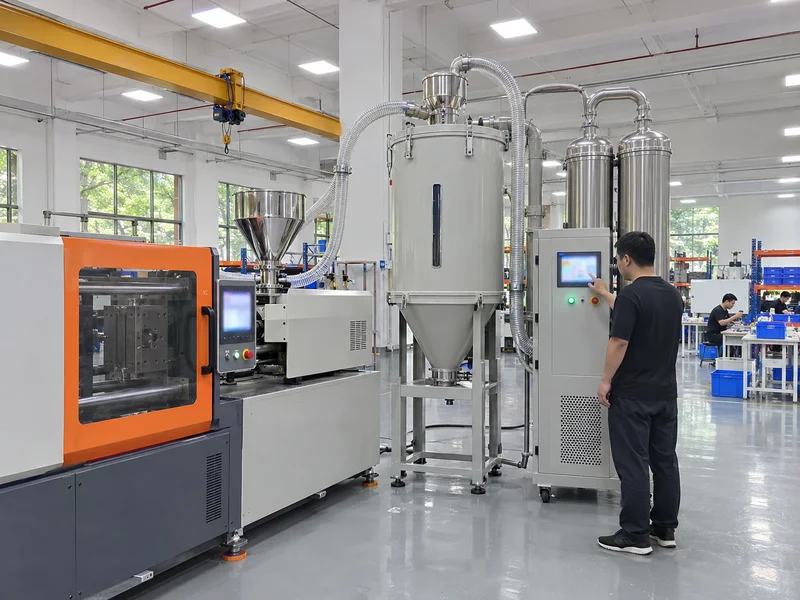
D2 – Problem: Cracked snap hooks on a PA66 housing, found at customer assembly, about 2% of one lot.
D3 – Containment: All stock quarantined and checked by a bend test on each snap hook; results recorded by lot.
D4 – Root cause (occurrence): Resin dryer dew point drifted, so moisture in the PA66 caused degradation and brittle hooks. Verified by moisture tests and by reproducing cracks with undried resin.
D4 – Root cause (escape): The control plan had no moisture check and no functional test of the hooks.
D5/D6 – Corrective actions: Dew-point alarm on the dryer, moisture check every shift, and a snap-hook bend test per lot; validated over several lots.
D7 – Prevention: Same controls applied to all hygroscopic resins and dryers; PFMEA and control plan updated.
Our guide to plastic resin drying explains why moisture control matters.
Key Takeaway: Each corrective action in the example removes a cause or closes a detection gap. That is what customers look for.
How Do Corrective Actions and Prevention Work in an 8D Report?
Corrective actions and prevention work in an 8D report by changing the process so the cause cannot return, then spreading that change to similar parts and processes.
Strong corrective actions:
- Error-proofing, such as sensors, interlocks or fixtures
- Process changes, such as new settings with monitoring
- Mold changes, such as venting or gate corrections
- Control changes, such as new checks in the control plan
Weak corrective actions include “retrain the operator”, “be more careful” and “increase inspection” on their own. They depend on people remembering, so the problem tends to return.
For prevention (D7), update the PFMEA, the control plan and the work instructions. Then apply the lesson to similar parts. Our guide to the control plan explains how controls are documented.
Key Takeaway: Prefer actions that remove the cause or detect it automatically. Training alone rarely closes an 8D.
What Do Customers Look for in an 8D Report?
Customers look for an 8D report that is fast, complete and backed by evidence. A report that only lists actions without data is often rejected.
Common reasons customers reject an 8D report:
- Containment does not cover all stock
- Root cause is stated but not verified
- No escape root cause
- Corrective actions rely only on training or inspection
- No proof that the actions work
- PFMEA and control plan not updated
At WOKE Molds, issues are handled through containment, root cause, corrective action and verification, with an 8D report when the customer requires it. See our quality control and inspection process for how inspection supports this.
Key Takeaway: Attach the evidence: photos, measurements, test results and updated documents.
FAQ
- Q: What is an 8D report?
- It is a structured problem-solving report with eight disciplines, from forming a team to closing the problem with permanent corrective and preventive actions.
- Q: What are the 8 disciplines?
- Team, problem description, containment, root cause, corrective actions, implementation and validation, prevention, and closure. Many customers add D0 for emergency response.
- Q: How long does an 8D take?
- Containment usually starts within a day or two; the full report often takes a few weeks, depending on the customer’s requirements.
- Q: What is an escape root cause?
- It explains why existing controls or inspection did not detect the defect before it reached the customer.
- Q: Why is retraining a weak corrective action?
- It depends on people remembering and does not change the process, so the defect often returns.
Conclusion
An 8D report proves that a supplier has contained a problem, verified its root cause and changed the process for good. Describe the problem precisely, verify both root causes and prefer actions that remove the cause. To discuss quality documents for your project, send your drawing and quality requirements to our team.