
6061 T6 Aluminum vs 7075 T6: How to Pick the Best One and Save Money
6061 T6 aluminum vs 7075 T6 is a choice between versatility and strength. 6061-T6 is the general-purpose machining alloy: good strength, excellent corrosion resistance, weldable and easy to anodize, at a lower price. 7075-T6 is almost twice as strong, with higher hardness and fatigue strength, but it costs more, is not suitable for normal fusion welding and resists corrosion less well.
Both alloys machine well, so the decision usually comes from load, environment and finishing. For example, a machine base plate or a sensor bracket rarely needs 7075, because stiffness, not strength, limits it. A thin, highly loaded lever or a fixture clamp, by contrast, can be smaller and lighter in 7075. In this guide, we compare 6061 T6 aluminum vs 7075 T6 for machined parts, including strength, stiffness, corrosion, anodizing, welding and cost. For machining options, see our CNC milling services.
6061-T6 has a typical yield strength of about 276 MPa and tensile strength of about 310 MPa, good weldability and excellent corrosion resistance. 7075-T6 has a typical yield strength of about 503 MPa and tensile strength of about 572 MPa, higher hardness and fatigue strength, but poor fusion weldability, lower corrosion resistance and higher cost. Both have almost the same stiffness (about 69–72 GPa) and similar density (2.70 vs 2.81 g/cm³), so 7075 helps only when strength, not stiffness, limits the part.
In short: 6061-T6 for general, welded or corrosion-exposed parts; 7075-T6 for highly stressed parts where strength sets the size.
Key points:
- Strength: 7075-T6 is about 1.8 times stronger in yield.
- Stiffness: nearly identical, so 7075 does not reduce deflection.
- Cost and corrosion: 6061-T6 is cheaper and more corrosion resistant.
What Is the Difference Between 6061 T6 Aluminum vs 7075 T6?
The difference between 6061 T6 aluminum vs 7075 T6 comes from their alloying elements. 6061 is alloyed mainly with magnesium and silicon. 7075 is alloyed mainly with zinc, plus magnesium and copper. The T6 temper means both are solution heat treated and artificially aged for high strength.
| Property (typical) | 6061-T6 | 7075-T6 |
|---|---|---|
| Density | about 2.70 g/cm³ | about 2.81 g/cm³ |
| Yield strength | about 276 MPa | about 503 MPa |
| Tensile strength | about 310 MPa | about 572 MPa |
| Elastic modulus | about 69 GPa | about 72 GPa |
| Hardness (Brinell) | about 95 HB | about 150 HB |
| Fatigue strength | Moderate | Higher |
| Thermal conductivity | about 167 W/m·K | about 130 W/m·K |
| Weldability | Good | Poor for fusion welding |
| Corrosion resistance | Excellent | Fair; needs protection |
Plate, bar and extrusion specifications, such as those published by ASTM International, define the guaranteed minimum properties for each product form.
Key Takeaway: Use guaranteed minimum values from the material specification for design, not typical values.
6061 T6 Aluminum vs 7075 T6: Which Is Stronger?
7075-T6 is much stronger than 6061-T6. Its yield strength is about 1.8 times higher, and it is also harder and more resistant to fatigue.
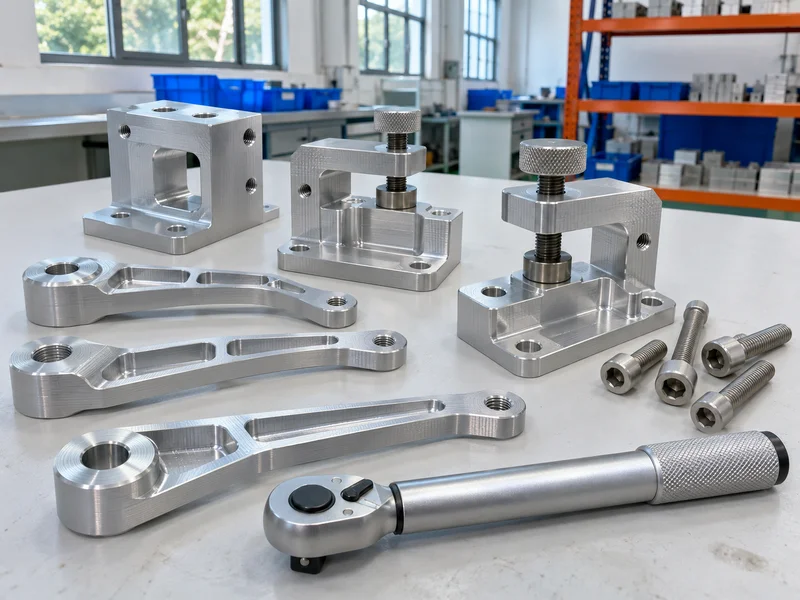
That strength matters for:
- Thin, highly loaded levers and arms
- Fixture clamps and tooling parts that see repeated loads
- Threads that must carry high preload
- Parts that must resist denting and wear
For example, a bracket sized by strength can be made with roughly 45% less cross-section in 7075-T6 than in 6061-T6. As a result, it can be smaller and lighter, even though 7075 is slightly denser.
Fatigue is another reason to choose 7075-T6. Parts that see millions of load cycles, such as levers in automation equipment, benefit from its higher fatigue strength. However, sharp corners, rough surfaces and poor thread design reduce fatigue life in both alloys. Therefore, generous radii and good surface finish matter as much as the alloy choice.
Key Takeaway: In 6061 T6 aluminum vs 7075 T6, use 7075-T6 when the part would break or yield in 6061-T6. Strength is its main advantage.
Is 7075-T6 Stiffer Than 6061-T6?
No, 7075-T6 is not meaningfully stiffer than 6061-T6. Their elastic moduli are about 72 GPa and 69 GPa, a difference of only about 4%. Therefore, a part that bends too much in 6061 will bend almost as much in 7075.
Stiffness-limited parts include:
- Base plates and frames
- Long arms and beams
- Optical and measurement mounts
- Thin housings that must hold alignment
For these parts, the way to reduce deflection is geometry: add ribs, increase section depth or change the shape. Switching to 7075 adds cost without solving the problem. Our guide to titanium weight vs aluminum weight explains the same stiffness rule for titanium.
Key Takeaway: If deflection is the problem, change the shape, not the aluminum alloy.
How Do Corrosion and Anodizing Compare in 6061 T6 Aluminum vs 7075 T6?
In 6061 T6 aluminum vs 7075 T6, corrosion resistance favors 6061-T6. It performs well in normal and outdoor environments, often without coating. 7075-T6 contains copper and zinc, so it corrodes more easily and can suffer stress corrosion cracking under sustained tensile stress in some environments.
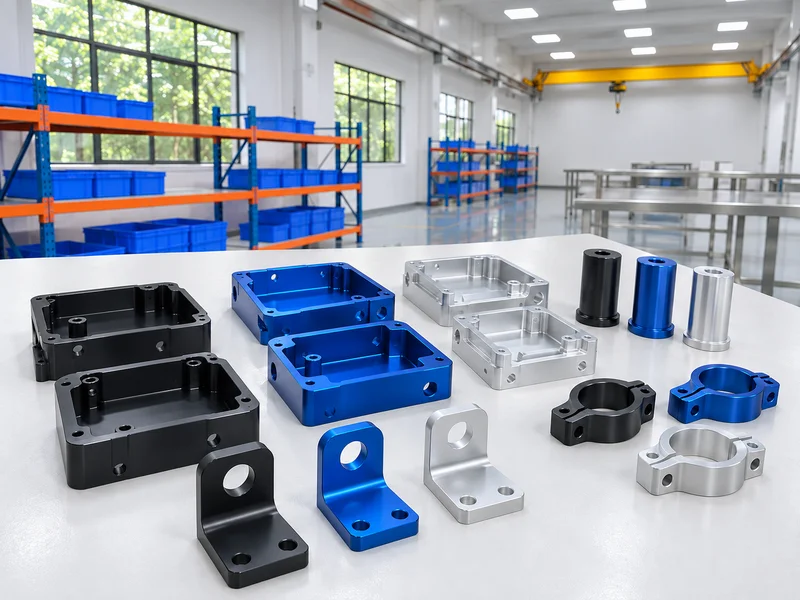
Anodizing works on both alloys, with some differences:
- 6061-T6: consistent, even color; a common choice for cosmetic anodizing.
- 7075-T6: anodizes well and hard anodizes well, but color can be slightly less uniform.
- Hard anodizing: common on both for wear surfaces.
For 7075 parts in humid or marine environments, anodizing or another protective coating is strongly recommended. Our machining work includes anodizing, hard anodizing, plating and other finishes through our qualified finishing suppliers.
Key Takeaway: For outdoor, marine or cosmetic parts, 6061-T6 is the safer default.
Can You Weld 6061-T6 and 7075-T6?
You can weld 6061-T6 with standard methods, but 7075-T6 is generally not suitable for fusion welding. Welding 7075 tends to cause hot cracking and a weak heat-affected zone.
Even with 6061-T6, welding reduces strength near the weld, because heat removes the T6 temper locally. Therefore, welded 6061 structures are designed with lower allowable stresses at the welds, or are heat treated again after welding.
If a 7075 part must be joined, mechanical fasteners or adhesive bonding are the usual choices.
In addition, welding distorts thin machined parts. For precise assemblies, machining after welding or using bolted joints usually gives better accuracy.
Key Takeaway: If the design needs welding, choose 6061-T6. Use bolted joints for 7075-T6 parts.
How Do 6061 T6 Aluminum vs 7075 T6 Machine?
6061 T6 aluminum vs 7075 T6 both machine very well, which is why both are popular for CNC parts. However, they behave a little differently at the cutting edge.
- 6061-T6: easy to machine; can be slightly gummy, so sharp tools and good chip evacuation help.
- 7075-T6: harder, gives fine chips and an excellent surface finish; tools wear slightly faster.
- Thin walls: both can distort from residual stress; balanced roughing and finishing help.
- Threads: 7075 threads are stronger and resist wear better.
For example, a thin 7075 plate machined on one side can bow as stress is released. Roughing both sides first, then finishing, keeps it flatter. Our guide to 4 axis CNC explains how alternating sides reduces distortion.
Key Takeaway: Both alloys machine fast. Plan for residual stress on thin parts in either alloy.
How Do 6061-T6 and 7075-T6 Compare in Cost?
In 6061 T6 aluminum vs 7075 T6 pricing, 6061-T6 usually costs noticeably less. It is the most common machining aluminum, so it is widely stocked in plate, bar and extrusion. 7075 is a premium alloy, with higher raw material cost and sometimes fewer stock sizes.
Cost drivers to compare:
- Raw material price and stock availability
- Machining time, usually similar
- Finishing, including protective coatings for 7075
- Lead time for less common 7075 sizes
As a result, 7075 is best used selectively, for parts that truly need its strength. Our guide to rapid CNC machining explains why stock alloys also shorten lead time.
Key Takeaway: Default to 6061-T6 and justify every 7075-T6 part by its load.
6061 T6 Aluminum vs 7075 T6: Which Should You Choose?
You choose between 6061 T6 aluminum vs 7075 T6 by deciding what limits the part.
- General machined parts and housings? 6061-T6.
- Welded structures? 6061-T6.
- Outdoor, marine or cosmetic anodized parts? 6061-T6.
- Stiffness-limited parts? 6061-T6, with better geometry.
- Highly stressed, thin or fatigue-loaded parts? 7075-T6.
- Tooling, fixtures and wear-prone threads? 7075-T6.
We machine both alloys, as well as stainless steel, titanium and plastics, from prototype to production. Machine capability is not the same as finished-part tolerance, which is controlled per drawing. See our CNC machining services for the full range.
Key Takeaway: Choose 7075-T6 for strength and 6061-T6 for everything else.
FAQ
- Q: Is 7075-T6 stronger than 6061-T6?
- Yes. Its typical yield strength is about 503 MPa, compared with about 276 MPa for 6061-T6.
- Q: Is 7075 stiffer than 6061?
- Only slightly. Their elastic moduli are about 72 and 69 GPa, so deflection is almost the same.
- Q: Can 7075 aluminum be welded?
- It is generally not suitable for fusion welding because it tends to crack. 6061-T6 welds well.
- Q: Which alloy is more corrosion resistant?
- 6061-T6. 7075-T6 needs protective coatings in humid or marine environments.
- Q: Which is cheaper, 6061 or 7075?
- 6061-T6 is usually cheaper and more widely stocked.
Conclusion
6061 T6 aluminum vs 7075 T6 comes down to strength against cost, corrosion resistance and weldability. Choose 7075-T6 only when strength sets the size, and 6061-T6 for most other machined parts. To compare both alloys on your design, send your 3D model and 2D drawing to our engineers.