
4 Axis CNC: How to Design Parts the Right Way, No Waste
4 axis CNC machining adds a rotary axis, usually called the A-axis, to the three linear axes of a milling machine. The rotary axis turns the part, so the tool can reach several sides in one clamping. As a result, parts with features around their circumference, such as shafts with flats, cams or housings with holes on four faces, need fewer setups than on a 3-axis machine.
That saving only appears when the part fits the rotary axis. For example, a long aluminum profile with slots on four sides can finish in one 4 axis CNC setup instead of four, which removes three re-clamps and three chances of location error. On the other hand, a part with compound angles still needs 3+2 or 5-axis machining. In this guide, we explain when 4 axis CNC pays off, how it compares with 3+2 and simultaneous 5-axis, and how to control thin-wall distortion. If you are new to milling options, our guide to 3 axis CNC machining covers the baseline.
4 axis CNC machining combines X, Y and Z movement with rotation around one axis, usually the X-axis (A-axis), using a rotary table or indexer. It can index the part to fixed angles between cuts or rotate it continuously while cutting. It suits parts whose features are arranged around one axis, such as shafts, cams, manifolds and profiles, and it reduces setups compared with 3-axis machining.
In short: 4 axis CNC is the right step up when a part’s features wrap around one axis.
Key points:
- One rotary axis lets the machine reach four sides in one clamping.
- Indexed or continuous rotation covers both multi-face parts and wrapped features.
- Limits: compound angles and undercuts on several axes still need 5-axis machining.
What Is 4 Axis CNC Machining?
4 axis CNC machining is milling with three linear axes plus one rotary axis. The rotary axis is usually mounted on the machine table as a rotary indexer with a chuck or fixture, often supported by a tailstock for long parts.
There are two ways to use it:
- Indexed (positional) 4-axis: the part rotates to a fixed angle, locks, and the machine cuts in 3-axis mode.
- Continuous (simultaneous) 4-axis: the part rotates while the tool cuts, which produces helical grooves, cams and wrapped profiles.
Most 4 axis CNC work is indexed. Continuous rotation is used when the geometry truly wraps around the axis.
Key Takeaway: Ask whether the part needs indexing or continuous rotation. Indexing covers most multi-face parts at lower programming cost.
How Does a 4 Axis CNC Rotary Axis Work?
A 4 axis CNC rotary axis works by turning the workpiece around a horizontal axis while the spindle stays vertical. The controller coordinates the rotation with the X, Y and Z axes.
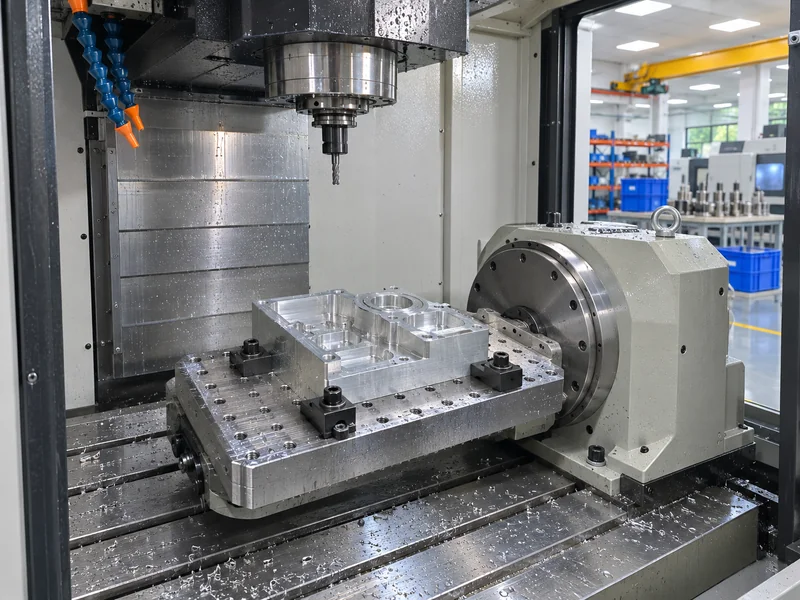
Typical rotary hardware
- A rotary indexer or table bolted to the machine table
- A chuck, collet or fixture plate on the rotary face
- A tailstock or support for long parts
- A brake or clamp that locks the axis during indexed cuts
What the rotary axis enables
- Holes and pockets on four faces in one setup
- Flats, slots and keyways around a shaft
- Helical grooves and cam profiles in continuous mode
For example, a manifold with ports on four sides can be indexed at 0°, 90°, 180° and 270°. Because the part never leaves the fixture, the positions of all ports share one reference.
Key Takeaway: The main benefit of 4 axis CNC is one shared datum for all faces. That improves accuracy as much as it saves time.
Which Parts Benefit From a Fourth Axis?
Parts benefit from 4 axis CNC when their features are arranged around one axis and would otherwise need several 3-axis setups.
- Shafts with flats, cross holes and keyways
- Cams and parts with helical grooves
- Manifolds and valve bodies with ports on several faces
- Long profiles and extrusions machined on four sides
- Cylindrical housings with radial holes
- Fixture parts with features on multiple sides
On the other hand, flat plates, simple brackets and parts with features on only one or two faces gain little from the rotary axis.
Key Takeaway: If a part needs three or four 3-axis setups around one axis, 4 axis CNC usually lowers cost and improves accuracy.
4 Axis CNC vs 3 Axis: When Is the Extra Axis Worth It?
The extra axis is worth it in 4 axis CNC vs 3 axis comparisons when it removes setups without adding much programming or fixture cost.
| Factor | 3-axis | 4-axis |
|---|---|---|
| Setups for a four-sided part | Usually 3–4 | Usually 1 |
| Feature-to-feature accuracy | Depends on re-clamping | One shared datum |
| Fixture cost | Simple vises | Rotary fixture or chuck |
| Programming | Simpler | More complex, especially continuous |
| Best for | One- or two-sided parts | Parts with features around one axis |
As a result, a batch of 500 four-sided parts often costs less on 4 axis CNC, even with a higher machine rate. A batch of 5 prototypes, by contrast, may still be cheaper on a 3-axis machine with manual re-clamping.
Key Takeaway: Compare total cost per batch, including setups and inspection. The rotary axis pays off as setups and quantities grow.
3+2 vs Simultaneous Five-Axis: Where Does 4 Axis CNC Fit?
4 axis CNC sits between 3-axis and five-axis machining. It reaches four sides around one axis, while 3+2 reaches compound angles and simultaneous five-axis follows complex surfaces.
| Type | Motion | Best for | Limits |
|---|---|---|---|
| 4-axis | One rotary axis | Features around one axis | No compound angles |
| 3+2 (positional five-axis) | Two rotary axes tilt, then lock | Angled holes and faces on many sides | Not for continuous sculpted surfaces |
| Simultaneous five-axis | All axes move together | Impellers, molds, organic shapes | Highest cost and programming effort |
In practice, many shops run 4-axis work on five-axis machines when available. Our core facility includes a Makino D500 five-axis machining center for parts that need compound angles or simultaneous motion. However, machine capability is not the same as finished-part tolerance, which is controlled per drawing.
Key Takeaway: Use 4-axis for features around one axis, 3+2 for compound angles, and simultaneous five-axis only for true free-form surfaces.
How Do You Control Thin Wall Aluminum Distortion on 4 Axis CNC?
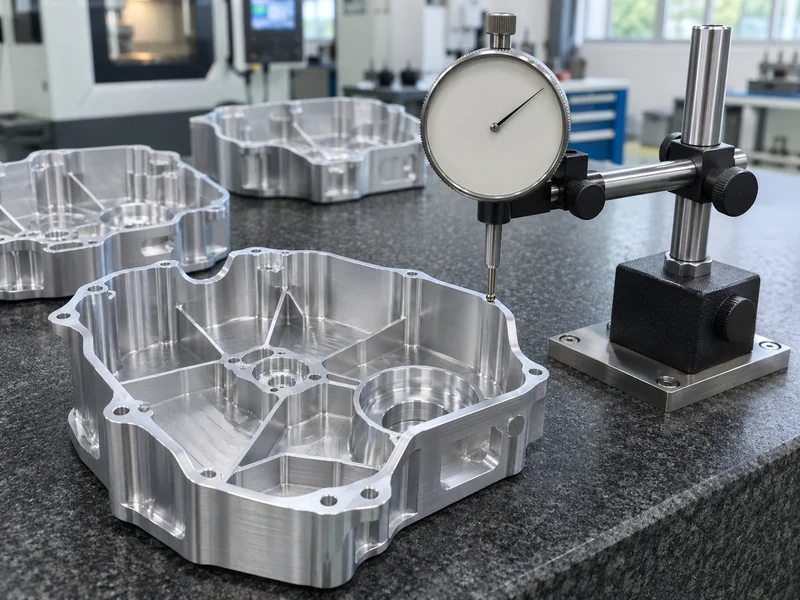
You control thin wall aluminum distortion on 4 axis CNC by balancing material removal, limiting clamping force and finishing in light passes. Thin walls move when stress is released unevenly.
- Rough all sides first, then finish, so stress releases evenly before final cuts.
- Leave even stock on all walls for the finishing pass.
- Reduce clamping force and support the part close to thin areas.
- Use sharp tools and light finishing cuts to limit heat and cutting force.
- Choose stable material, such as stress-relieved plate, for critical parts.
- Check flatness and wall thickness before unclamping when possible.
The rotary axis helps here. Because the part can be turned between passes, the machine can alternate sides and keep stress balanced. As a result, thin housings stay flatter than when each side is finished in a separate setup.
Key Takeaway: Balance the cuts around the part. Rotating between roughing and finishing passes is one of the best uses of the fourth axis.
What Tolerances Can 4 Axis CNC Hold?
4 axis CNC can hold general tolerances such as ISO 2768-1 class m easily, and tighter tolerances on key features with suitable fixtures and inspection. The rotary axis adds its own positioning accuracy, so angular features depend on the indexer’s quality.
Practical points:
- Features cut in one clamping relate closely, because they share the same datum.
- Angular positions depend on the rotary axis accuracy and the lock during cutting.
- Long parts need tailstock support to limit deflection.
- Tight tolerances should be limited to functional features to control cost.
Our quality control and inspection process uses CMM measurement where the drawing requires it.
Key Takeaway: Put critical radial features in the same 4-axis clamping. That protects their relationship better than any later correction.
How Should You Design Parts for 4 Axis CNC?
You should design parts for 4 axis CNC by arranging features around one axis and leaving room for holding the part on that axis.
- Keep a clamping zone at one or both ends for the chuck or tailstock.
- Orient holes and pockets radially or on faces parallel to the axis.
- Avoid features that need compound angles unless five-axis is planned.
- Use standard tool sizes and consistent corner radii.
- Mark the datum axis on the drawing so the machinist fixtures the part correctly.
Key Takeaway: Design around one axis and give the machine somewhere to hold the part. Those two choices make 4 axis CNC efficient.
How Do You Get a Quote for 4 Axis CNC Parts?
You get an accurate quote for 4 axis CNC parts by sending a 3D model and a 2D drawing with datums, tolerances, material, finish and quantity. The supplier then decides whether 3-axis, 4-axis or five-axis is the lowest-risk route.
A complete RFQ includes:
- 3D model (STEP preferred)
- 2D drawing with the datum axis and critical radial tolerances
- Material and finish, such as 6061-T6 with anodizing
- Quantity for prototypes and production
- Inspection needs, such as FAI or a CMM report
Our CNC machining services cover milling, turning, EDM and grinding from prototype to production. For turned parts with milled features, see our guide on CNC lathe vs CNC mill.
Key Takeaway: Send the geometry and let the supplier choose the axes. Asking for 4 axis CNC by name can block a cheaper route.
FAQ
- Q: What is 4 axis CNC machining?
- It is milling with X, Y and Z plus one rotary axis, usually the A-axis, which turns the part so the tool can reach several sides in one setup.
- Q: What is the difference between 4-axis and 5-axis CNC?
- 4-axis adds one rotary axis; 5-axis adds two. Five-axis can reach compound angles and free-form surfaces that 4-axis cannot.
- Q: When should I use 4 axis CNC instead of 3-axis?
- When the part has features around one axis that would need three or four separate 3-axis setups.
- Q: Is 4 axis CNC more expensive?
- The hourly rate is usually higher, but fewer setups often make the total part cost lower for multi-face parts.
- Q: Can 4 axis CNC machine thin-wall parts?
- Yes, with balanced roughing, light finishing passes and low clamping force to control distortion.
Conclusion
4 axis CNC machining cuts setups and improves accuracy for parts whose features wrap around one axis. Use it for shafts, manifolds and profiles, and move to five-axis only when compound angles demand it. To get a machining plan and quote, upload your 3D model and 2D drawing for our engineers to review.