
316L SS vs 316 SS: How to Pick the Best One Without Waste
316L SS vs 316 SS is a choice between welding performance and a small gain in strength. Both are molybdenum-bearing austenitic stainless steels with the same corrosion basis. The “L” grade has lower carbon, which protects welded areas from sensitization and intergranular corrosion. Standard 316 has slightly higher carbon, giving slightly higher strength, especially at elevated temperature.
For a machined part that is never welded, the difference is small. For a machined-and-welded assembly, however, it can decide whether the welds corrode in service. For example, a 316 bracket welded to a 316 frame may show corrosion beside the welds after exposure to chloride cleaning, while the same design in 316L stays clean. In this guide, we compare 316L SS vs 316 SS for machined parts and welded assemblies, including chemistry, strength, corrosion, machining, dual certification and cost. For our machining range, see our CNC machining services.
316L SS vs 316 SS: 316L has a maximum carbon content of 0.03%, while 316 allows up to 0.08%. The lower carbon reduces chromium carbide formation in the heat-affected zone, so 316L resists intergranular corrosion after welding without post-weld annealing. 316 has slightly higher minimum strength (typically about 205 MPa yield vs 170 MPa for 316L in annealed condition) and is sometimes preferred for higher-temperature service. Many mills supply dual-certified 316/316L that meets both specifications.
In short: choose 316L for welded or sensitization-risk parts; 316 only matters where its small strength margin at temperature is needed.
Key points:
- Carbon: 316L ≤ 0.03%, 316 ≤ 0.08%.
- Welding: 316L avoids weld-zone sensitization.
- Supply: dual-certified 316/316L is common and covers both.
What Is the Difference Between 316L SS vs 316 SS?
The difference between 316L SS vs 316 SS is the maximum carbon content. Everything else in the composition is nearly the same.
| Property (typical, annealed) | 316 | 316L |
|---|---|---|
| Carbon (max) | 0.08% | 0.03% |
| Chromium | 16–18% | 16–18% |
| Nickel | 10–14% | 10–14% |
| Molybdenum | 2–3% | 2–3% |
| Yield strength (min) | about 205 MPa | about 170 MPa |
| Tensile strength (min) | about 515 MPa | about 485 MPa |
| Intergranular corrosion after welding | Risk without annealing | Low risk |
| Magnetic | Essentially non-magnetic when annealed | Essentially non-magnetic when annealed |
The exact limits come from the material specification, such as those published by ASTM International for stainless plate, sheet and bar.
Key Takeaway: Read the specification and mill certificate, not only the grade name.
Why Does Carbon Content Matter for Welding?
Carbon content matters for welding because, at about 450–850 °C, carbon combines with chromium to form chromium carbides at grain boundaries. The chromium next to those boundaries is depleted, so the steel can corrode along the grains.
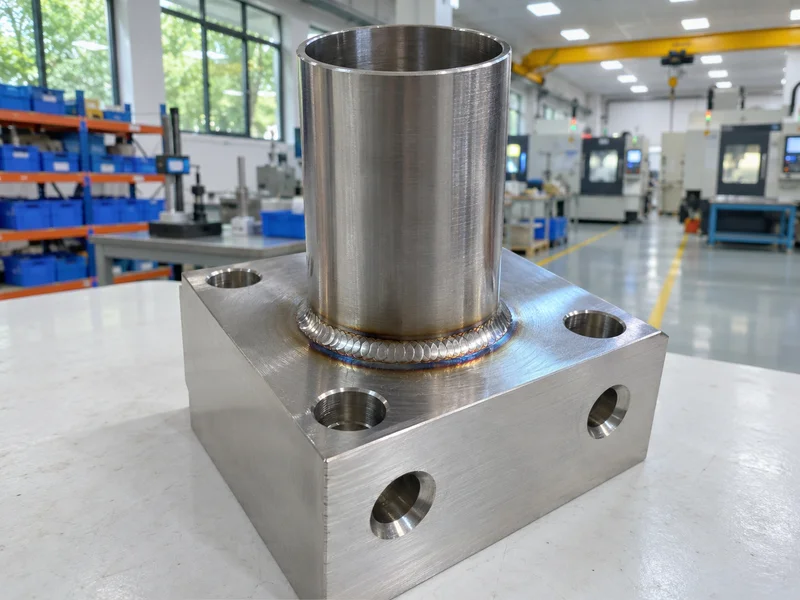
This is called sensitization. It happens in the heat-affected zone beside a weld.
- 316: higher carbon, so sensitization is more likely after welding.
- 316L: low carbon, so few carbides form in normal welding.
- Thick sections and multi-pass welds: spend longer in the sensitizing range, which raises the risk.
For example, a thick 316 flange welded in several passes is more at risk than a thin sheet welded quickly. Post-weld solution annealing can restore 316, but it is rarely practical for machined assemblies, because it causes distortion and scale.
Key Takeaway: For welded assemblies, specify 316L and avoid post-weld annealing.
316L SS vs 316 SS: Which Is Stronger?
In 316L SS vs 316 SS, standard 316 is slightly stronger. Its minimum yield strength is about 205 MPa, compared with about 170 MPa for 316L in the annealed condition.
In practice:
- Room temperature: the difference rarely sets part size.
- Elevated temperature: 316 or the high-carbon 316H keeps strength better.
- Cold-worked bar: both can be much stronger than annealed values, so check the certificate.
For example, a machined shaft from cold-drawn 316L bar may have a much higher yield strength than annealed plate of either grade. Therefore, design from the actual product form and certificate values.
Key Takeaway: If strength is critical, specify the product form and minimum properties, not just “316”.
How Does Corrosion Resistance Compare?
Corrosion resistance is essentially the same for 316L SS vs 316 SS in the unwelded condition. Both contain about 2–3% molybdenum, which improves resistance to chlorides compared with 304.
Differences appear only after welding or heat exposure:
- General and pitting corrosion: similar in both grades.
- Intergranular corrosion after welding: lower risk in 316L.
- Chloride stress corrosion cracking: both can crack in hot chloride environments.
For example, a welded tank fitting in a chloride cleaning line is a typical 316L application. Surface finish also matters. Passivation and electropolishing improve corrosion resistance on both grades, and both are available through our qualified finishing suppliers.
Key Takeaway: For unwelded parts, choose either grade. For welded parts in corrosive service, choose 316L.
How Do 316L SS vs 316 SS Machine?
316L SS vs 316 SS machine in a very similar way. Both are austenitic stainless steels that work harden, produce stringy chips and need sharp tools and steady feeds.
Machining guidelines:
- Keep the tool cutting. Dwelling or light rubbing work-hardens the surface.
- Use rigid setups and sharp, positive-rake tools.
- Apply plenty of coolant to control heat and chip welding.
- Plan chip breaking for turning and drilling.
- Allow for burrs, which are tougher than on aluminum.
For example, a deep pocket in 316L needs steady feed through the corner; pausing there leaves a hardened layer that dulls the next tool. Our CNC milling and CNC turning services handle both grades.
Key Takeaway: Machining cost is similar for both grades. Choose the grade for welding and service, not for machining.
What Should You Specify for a Machined-and-Welded Assembly?
For a machined-and-welded assembly, you should specify 316L or dual-certified 316/316L, plus the weld filler and the order of machining and welding.
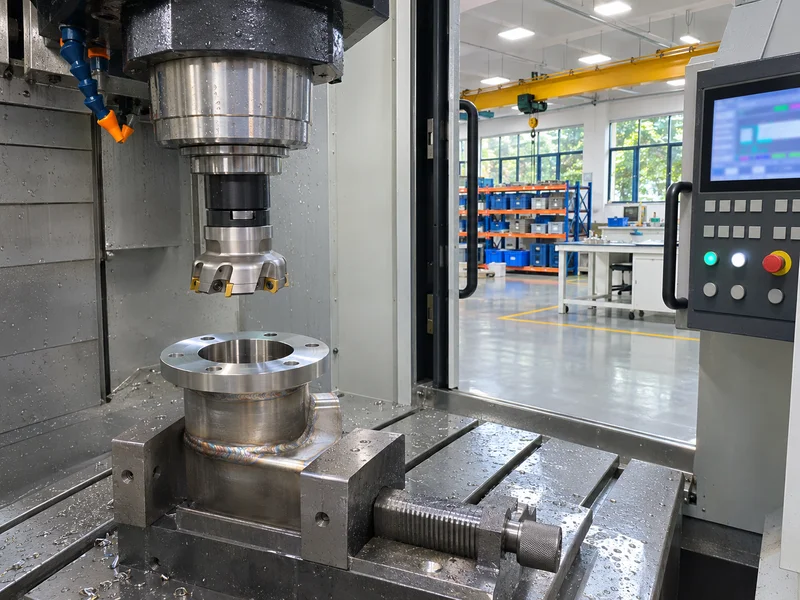
A clear specification includes:
- Base material: 316L or 316/316L dual-certified, with mill certificates
- Filler metal: a low-carbon 316L-type filler
- Sequence: rough machine, weld, stress relieve if needed, then finish machine critical features
- Post-weld treatment: pickling and passivation to restore the surface
- Inspection: weld appearance, dimensions after welding and any leak tests
For example, a flange welded to a machined body may distort by tenths of a millimeter. Finishing the sealing face after welding keeps it flat. Our guide to metals for large CNC machined parts explains distortion control in more detail.
Key Takeaway: Machine sealing faces and bores after welding, not before.
How Do 316L and 316 Compare in Cost and Availability?
316L and 316 cost about the same, and 316L is often easier to find. Many mills produce dual-certified 316/316L that meets the chemistry of 316L and the strength of 316.
Practical points:
- Bar and plate: widely available in both, often dual-certified.
- Price: very similar; the difference is usually small.
- Lead time: standard sizes are common; large or unusual sizes take longer.
- Certificates: request mill certificates if traceability is required.
Therefore, specifying 316L or dual-certified material rarely increases cost. Our quality control and inspection process can supply material certificates on request.
Key Takeaway: Specify “316L or dual-certified 316/316L” to keep both performance and availability.
FAQ
- Q: What is the difference between 316 and 316L stainless steel?
- 316L has a maximum carbon content of 0.03%, compared with 0.08% for 316, which reduces sensitization after welding.
- Q: Is 316L better than 316?
- For welded parts, yes. For unwelded parts at room temperature, they perform almost the same.
- Q: Is 316 stronger than 316L?
- Slightly. Typical minimum yield strength is about 205 MPa for 316 and 170 MPa for 316L in the annealed condition.
- Q: What is dual-certified 316/316L?
- Material that meets the requirements of both grades, combining low carbon with 316 strength.
- Q: Do 316 and 316L machine differently?
- No. Both work harden and need sharp tools, steady feeds and good coolant.
Conclusion
316L SS vs 316 SS comes down to welding and service temperature. Choose 316L or dual-certified material for welded or corrosion-critical assemblies, and consider 316 only where its small strength gain at temperature matters. To review material and process for your part, send your 3D model and 2D drawing to our engineers.