
Mold Bases for Short Production Runs: How to Pick the Best One and Save Money
Mold bases for short production runs should cost less and build faster than a full production base, without making the parts worse. The usual way is a standard or shared mold base with interchangeable cavity and core inserts. When several part numbers, versions or short runs share one base, each new part needs only new inserts, not a new mold.
The trap is choosing the cheapest base and then fighting it in production. For example, an aluminum base may save money on a 2,000-piece run but wear out its locating features before a second order arrives. Likewise, a shared base that does not fit the planned press can stop the project at the first trial. In this guide, we explain how to choose mold bases for short production runs, including aluminum vs steel bases, press data, removable inserts, insert interchangeability and insert fit inspection. For low-quantity tools in general, see our guide to rapid tooling.
Mold bases for short production runs are usually standard steel bases (for example to HASCO, Meusburger or DME standards) or master unit die (MUD) style frames that accept removable cavity and core inserts. Aluminum bases are lighter and faster to machine but wear faster at guides and parting faces. The right choice depends on part quantity, resin, number of part versions, press size and how often inserts will be changed. Inserts must be interchangeable, located by keys or pins, and checked for fit before each run.
In short: use a standard steel base with removable inserts when several short runs or versions share one tool; use aluminum only when quantity and resin allow.
Key points:
- Shared base: new parts need only new inserts.
- Standards: standard bases cut cost and lead time.
- Fit control: insert location and fit decide part repeatability.
Why Do Mold Bases for Short Production Runs Need a Different Strategy?
Mold bases for short production runs need a different strategy because the base is a large share of tool cost, while the part quantity is small. Spreading the base cost over many inserts lowers the cost per part number.
A short-run strategy fits when:
- Quantities are low, such as a few hundred to a few tens of thousands
- Several versions of a part are needed
- Designs may change after the first run
- Production is irregular, with gaps between orders
However, it does not fit high-volume parts that need multi-cavity tools, complex cooling or long life. In those cases, a dedicated mold is better. Our injection mold manufacturing team builds both dedicated and insert-based molds.
Key Takeaway: Decide the base strategy from the full product family and expected orders, not one part.
Aluminum vs Steel Mold Bases for Short Production Runs
For mold bases for short production runs, steel bases last longer and hold alignment better, while aluminum bases are lighter and faster to machine.
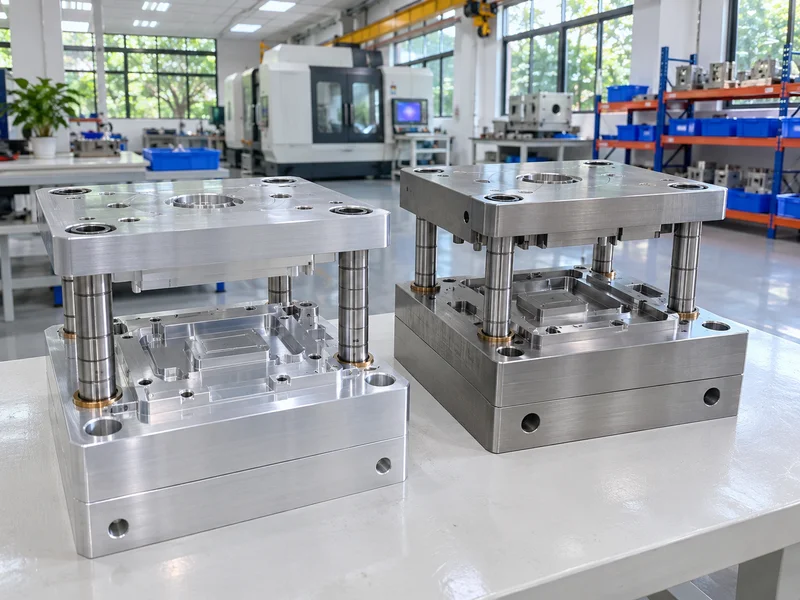
| Factor (typical) | Aluminum base | Standard steel base |
|---|---|---|
| Machining speed | Fast | Moderate |
| Weight | Low | Higher |
| Wear at guides and parting line | Faster | Slower |
| Thermal conductivity | High | Lower |
| Repair and welding | Difficult | Easier |
| Reuse for many insert sets | Limited | Good |
For example, a single 1,000-piece run of unfilled PP can suit an aluminum base. In contrast, a family of five parts in glass-filled nylon, ordered again each year, suits a standard steel base with steel inserts. Our guide to how to choose mold steel explains insert steels.
Key Takeaway: If the base will be reused, choose steel. Aluminum suits one-off, low-wear runs.
What Press Data Should Mold Bases for Short Production Runs Match?
Mold bases for short production runs should match the press data of every machine that may run them. A shared base is only useful if it fits the presses available for short runs.
Check these items:
- Tie-bar spacing and platen size
- Minimum and maximum mold height
- Opening stroke for part removal
- Locating ring diameter and sprue radius
- Ejector pattern and stroke
- Clamping slots or quick-mold-change plates
- Water and hot-runner connections
For example, a base designed for a 150 t press may be too tall for a smaller press that is free for short runs. Planning the base to fit two or three press sizes keeps scheduling flexible. Our Shenzhen plant runs 41 presses from 30 to 380 T, so the base is matched to the presses planned for the job. Interface dimensions follow standards such as those from EUROMAP.
Key Takeaway: Put the press list in the tooling specification. The base must fit the machines you will really use.
How Do Removable Inserts Work in Short-Run Molds?
Removable inserts work in short-run molds by holding the cavity and core in replaceable blocks that fit pockets in a common base. Changing parts means changing the inserts.
Typical design features:
- Pocketed A and B plates with standard insert sizes
- Keys, dowels or tapered seats to locate inserts
- Bolts accessible from the parting line or back, for quick changes
- Shared ejector system with pins matched to each insert set
- Cooling connections through the base, or self-contained in each insert
For example, a base with two standard pockets can run two different small parts, or one part in two versions. Our guide to prototype tooling for injection molding explains similar insert concepts for early builds.
Key Takeaway: Standardize pocket sizes early. Every new part then fits the same base.
How Do You Make Replacement Cavity and Core Inserts Interchangeable?
You make replacement cavity and core inserts interchangeable by machining every insert to the same datums, tolerances and locating features as the original.
Requirements for interchangeability:
- Common datum scheme for all insert sets
- Tight tolerances on locating features, such as keys and dowel holes
- Matching parting line heights to avoid steps and flash
- Consistent ejector and cooling positions
- Recorded dimensions for each insert set
For example, a spare core insert machined two years after the original must fit without hand fitting. That is only possible if the original datums and dimensions are documented. As a result, the spare insert can be installed in hours instead of days.
Key Takeaway: Keep a dimensional record for every insert set. Interchangeability depends on documentation.
How Should Cavity and Core Insert Fit Be Inspected?
Cavity and core insert fit should be inspected before each run, and after any insert change, to confirm location, shutoff and alignment.
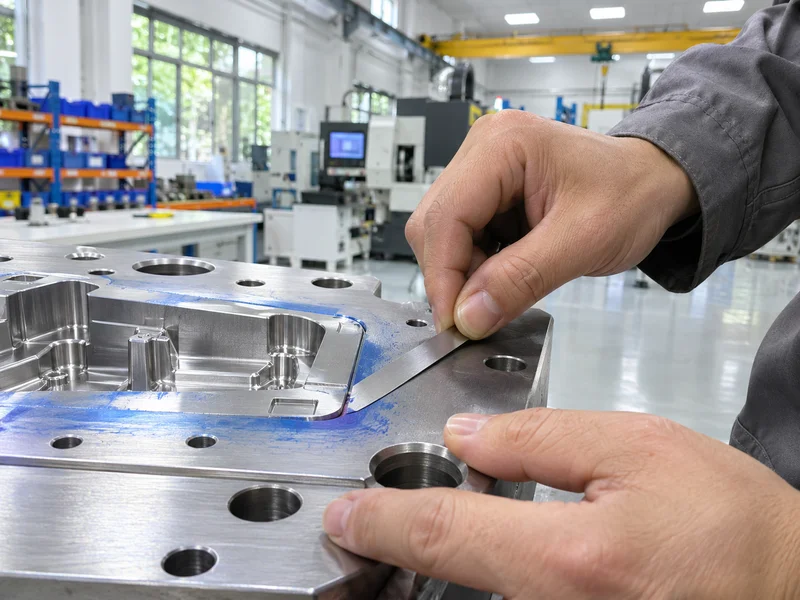
Inspection points:
- Insert seating: no gap under the insert, checked with feeler gauges or blue
- Parting line height: flush with the plate within the specified tolerance
- Shutoff contact: checked with bluing compound
- Ejector pin fit: pins move freely without flash gaps
- Cooling: leak test after connecting the circuits
- First-shot parts: key dimensions measured against the drawing
For example, a small chip under an insert can raise it enough to cause flash along the whole parting line. Cleaning the pocket and checking the seat avoids it. Our quality control and inspection process includes dimensional checks and CMM measurement when required.
Key Takeaway: A two-minute seat and shutoff check prevents a full run of flashed parts.
When Are Mold Bases for Short Production Runs Not the Right Choice?
Mold bases for short production runs are not the right choice when the part needs features that a shared base cannot provide well.
Choose a dedicated mold instead when:
- Volume is high and multi-cavity tooling is justified
- Cooling must be optimized for cycle time or warpage
- The part needs slides or lifters that do not fit standard pockets
- Hot runners are required for gate quality or material saving
- Cosmetic quality demands a fixed, fully tuned tool
For example, a high-gloss cover with a hot-runner valve gate usually needs its own mold. Our guide to multi-cavity injection molding explains when volume justifies more cavities.
Key Takeaway: Use shared bases for flexibility, and dedicated molds for volume and complex features.
FAQ
- Q: What is a mold base for short production runs?
- A standard or shared mold frame with removable cavity and core inserts, so new parts need only new inserts.
- Q: Is an aluminum mold base good for short runs?
- Yes, for one-off, low-wear runs. For reuse over many runs, a steel base lasts longer.
- Q: What is a master unit die (MUD)?
- A standard frame that accepts quick-change insert sets, often used for short runs and prototypes.
- Q: How are interchangeable inserts kept accurate?
- By machining every insert to the same datums and locating features, and recording their dimensions.
- Q: What should be checked when changing inserts?
- Seating, parting line height, shutoff contact, ejector fit, cooling leaks and first-shot dimensions.
Conclusion
Mold bases for short production runs cut tool cost when one base serves many inserts. Choose steel or aluminum from reuse and resin, match the base to real press data, and control insert interchangeability and fit. To plan a short-run tooling strategy, send your 3D model and 2D drawing to our engineers.