
TPU Injection Molding: Design, Drying and Mold Tips
TPU injection molding produces flexible, tough parts from thermoplastic polyurethane, such as seals, gaskets, cable strain reliefs, wheels and soft-touch covers. TPU combines rubber-like elasticity with excellent abrasion resistance and tear strength. However, it is moisture sensitive, flexible in the mold and prone to sticking, so both the part and the tool must be designed for it.
Many TPU problems come from treating it like a rigid plastic. For example, a TPU seal designed with almost no draft can tear when it is pulled from the core. Likewise, wet TPU can mold bubbly, weak parts that look fine but fail in a flex test. In this guide, we explain how to specify TPU injection molding: hardness, part geometry, fit, drying, mold design, overmolding and testing. For a comparison with other soft materials, see our guide to TPR vs TPE.
TPU injection molding uses thermoplastic polyurethane grades from about Shore 60A to 75D. TPU offers high abrasion and tear resistance, good oil and grease resistance and strong bonding to many rigid plastics. It must be dried thoroughly, usually to about 0.02% moisture or below, because moisture causes bubbles and loss of properties. Parts need generous draft, uniform walls and careful ejection, and dimensions must allow for higher shrinkage and flexibility than rigid plastics.
In short: choose the TPU hardness first, design for flexibility and ejection, and dry the material properly.
Key points:
- Hardness: from soft Shore A to semi-rigid Shore D.
- Drying: essential for strength and appearance.
- Design: draft, uniform walls and ejection area matter more than usual.
What Is TPU Injection Molding?
TPU injection molding is the injection molding of thermoplastic polyurethane, a thermoplastic elastomer made from hard and soft segments. The hard segments give strength; the soft segments give flexibility.
TPU types include:
- Polyester-based TPU: better oil, fuel and abrasion resistance
- Polyether-based TPU: better hydrolysis and microbial resistance, and low-temperature flexibility
- Aliphatic TPU: better UV and color stability, for clear or light-colored parts
For example, a cable strain relief used outdoors in wet conditions often uses polyether TPU. In contrast, a hydraulic wiper seal usually uses polyester TPU. We mold TPU and other elastomers as part of our plastic injection molding service.
Key Takeaway: Specify the TPU family, not only “TPU”. Polyester and polyether grades behave differently in service.
How Do You Specify Flexibility for TPU Injection Molding?
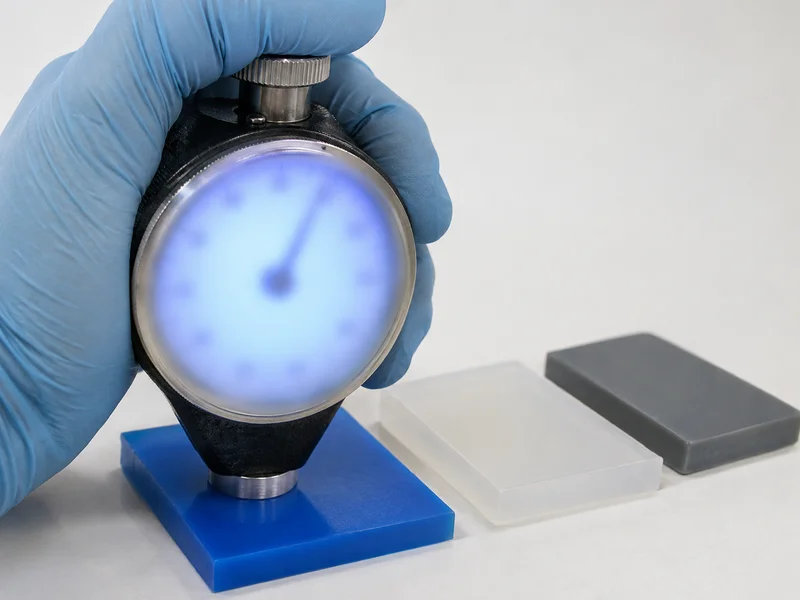
You specify flexibility for TPU injection molding by choosing a Shore hardness and confirming it with the part’s function.
| Hardness range (typical) | Feel | Typical parts |
|---|---|---|
| Shore 60A–75A | Soft | Grips, soft-touch covers, seals |
| Shore 80A–90A | Medium | Cable sleeves, gaskets, bellows |
| Shore 95A–60D | Firm | Wheels, rollers, wear pads |
| Shore 60D–75D | Semi-rigid | Gears, clips, protective housings |
Hardness alone does not define flexibility. Wall thickness, ribs and geometry also change how the part bends. For example, a Shore 85A bellows with thin walls feels softer than a Shore 70A plug with thick walls. Hardness is measured with standard methods, such as those from ASTM International.
Key Takeaway: Test the real geometry in two or three hardness grades. Samples are the reliable way to confirm feel.
What Geometry Works Best for TPU Parts?
The geometry that works best for TPU parts has uniform walls, generous draft and features that can stretch during ejection.
Design guidelines:
- Wall thickness: keep it uniform, typically about 1–4 mm.
- Draft: at least about 1–2°, more for textured or soft grades.
- Radii: generous inside corners reduce tearing and stress.
- Undercuts: soft TPU can often be stripped from small undercuts, unlike rigid plastics.
- Ribs: keep ribs thinner than the wall to avoid sink.
For example, a soft TPU cap with an internal bead can often be stripped off the core without a collapsible core, saving tool cost. However, harder grades above about Shore 60D behave more like rigid plastics. Our guide to draft angle guidelines explains the basics.
Key Takeaway: Use TPU’s flexibility to simplify the tool, but give it enough draft to eject without tearing.
How Do You Design Fit and Tolerances for TPU Parts?
You design fit and tolerances for TPU parts by allowing for higher shrinkage, flexibility and post-mold change.
Practical points:
- Shrinkage: typically about 0.5–2%, depending on grade and hardness.
- Tolerances: wider than for rigid plastics, especially on soft grades.
- Measurement: soft parts deform under caliper pressure, so use fixtures or optical methods.
- Interference fits: seals and grommets often rely on controlled interference.
- Conditioning: dimensions can change slightly in the first days after molding.
For example, a TPU grommet designed with 0.5 mm interference on a panel hole seals well, but 1.5 mm may make assembly too hard. Therefore, test fits on real parts before freezing the design. Our guide to injection molding tolerances explains how to set realistic tolerances.
Key Takeaway: Define how soft parts will be measured. Otherwise, inspection results will not agree.
Why Is Drying Critical in TPU Injection Molding?
Drying is critical in TPU injection molding because TPU absorbs moisture from the air, and wet material degrades in the barrel.
Effects of moisture:
- Bubbles and splay on the surface
- Lower strength and elongation
- Unstable viscosity and shot-to-shot variation
- Poor bonding in overmolding
TPU is commonly dried in a desiccant dryer to about 0.02% moisture or below, following the resin supplier’s data. Our guide to plastic resin drying explains dryer settings and checks.
Key Takeaway: Ask how the supplier controls TPU drying, such as dryer type, time and moisture checks.
How Is a Mold Designed for TPU Injection Molding?
A mold for TPU injection molding is designed for good venting, easy release and stable temperature.
Key mold features:
- Venting: TPU fills easily and traps air, so vents are important.
- Ejection: large ejector areas, stripper plates or air poppets for soft parts.
- Surface finish: a light texture or matte finish often releases better than a high polish.
- Gate: sized to avoid jetting and shear heating.
- Cooling: uniform, so soft parts do not stick or distort.
For example, a soft TPU gasket can be pushed out with air poppets instead of pins, which might punch through or leave marks. Our injection mold manufacturing team designs ejection for each grade.
Key Takeaway: Tell the toolmaker the exact TPU grade early. Ejection design depends on hardness.
Can TPU Be Overmolded Onto Rigid Plastics?
Yes, TPU can be overmolded onto many rigid plastics, such as PC, ABS and PC/ABS, with good chemical bonding. Bonding to PP and POM is weak without special grades or mechanical locks.
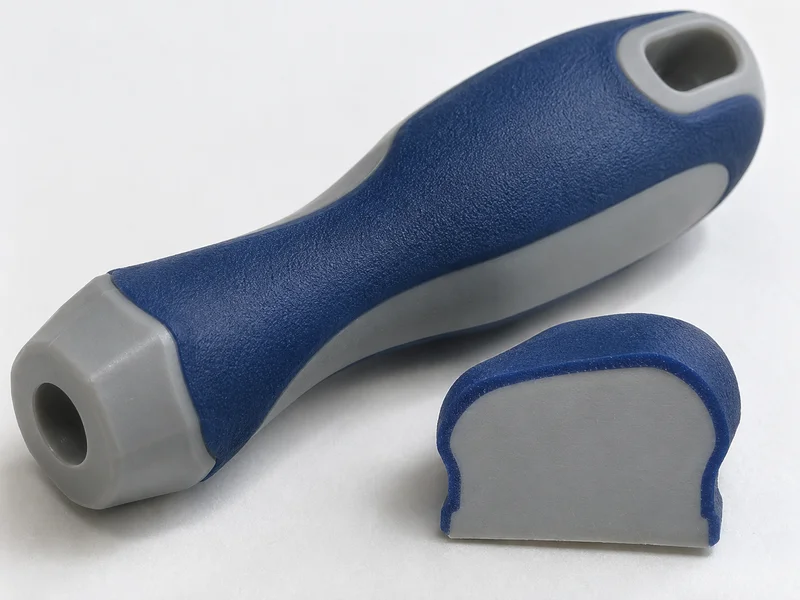
Good practice for overmolding:
- Choose a compatible pair from the resin supplier’s bonding data.
- Keep the substrate clean and dry.
- Mold onto a warm substrate where possible, as in two-shot molding.
- Add mechanical locks, such as holes or grooves, for critical bonds.
For example, a TPU grip on a PC/ABS handle can bond well in a two-shot injection molding process. Our guide to two-shot molding explains the process.
Key Takeaway: Confirm bond strength with a peel test on molded samples, not only with datasheets.
FAQ
- Q: What is TPU injection molding?
- It is the injection molding of thermoplastic polyurethane to make flexible, tough and abrasion-resistant parts.
- Q: What hardness can TPU be molded in?
- Typically from about Shore 60A to 75D, from soft to semi-rigid.
- Q: Does TPU need drying before molding?
- Yes. TPU is commonly dried to about 0.02% moisture or below to avoid bubbles and loss of strength.
- Q: What draft does TPU need?
- At least about 1–2°, with more for textured surfaces or very soft grades.
- Q: Can TPU be molded over PC or ABS?
- Yes. TPU bonds well to many rigid plastics, including PC, ABS and PC/ABS.
Conclusion
TPU injection molding gives flexible, durable parts when hardness, geometry, drying and mold design are chosen together. Specify the TPU family and hardness, design for draft and ejection, and test real samples for fit and feel. To review your TPU part, send your 3D model and 2D drawing to our engineers.