
Supplier Audit Checklist for Mold and Molding Suppliers
A supplier audit checklist for mold and molding suppliers helps you check whether a supplier can build your tools and make your parts consistently, before you place the order. A good checklist goes beyond certificates and tidy workshops. It looks at engineering, mold building, process control, inspection, traceability and how problems are handled.
Audits often miss the risks that matter. For example, an auditor may see a clean molding hall but never ask who designs the molds, how resin is dried or how a defect is contained. As a result, the first quality problem shows that no one owns it. In this guide, we give a practical supplier audit checklist for mold and molding suppliers, with what to ask, what evidence to request and which red flags to watch for. For early questions before an audit, see our list of questions to ask an injection molding company.
A supplier audit checklist for mold and molding suppliers should cover: company and capacity; engineering and DFM; mold design and mold making; mold trials and approval; process control and resin handling; inspection equipment and measurement; documentation such as FAI, control plan and PFMEA; traceability; nonconformance and 8D handling; mold maintenance; logistics and packaging; and communication. For each item, ask for evidence, such as a real trial report, a gauge list or a past 8D, rather than accepting a yes or no.
In short: audit what the supplier actually does, and ask to see real records for every important answer.
Key points:
- Evidence: ask for records, not promises.
- Ownership: know who designs, builds, molds and inspects.
- Problem handling: check containment, root cause and 8D practice.
What Should a Supplier Audit Checklist Cover?
A supplier audit checklist for mold and molding suppliers should cover every step from quote to delivery. Missing one step leaves a blind spot.
Main sections:
- Company, sites and capacity
- Engineering and DFM
- Mold design and mold making
- Mold trials and approval
- Process control and material handling
- Inspection and measurement
- Documentation and traceability
- Nonconformance and corrective action
- Mold maintenance and storage
- Packaging, logistics and communication
Use a simple scoring scale, such as 0–3 for each item, and record the evidence seen. Quality management principles behind such audits are described by standards bodies such as ISO.
Key Takeaway: Score with evidence. A high score without records is not a real score.
What Does a Supplier Audit Checklist Ask About Capacity?
A supplier audit checklist checks company structure and capacity by confirming which sites do which work, and how much capacity is really available for your project.
Ask for:
- Site roles: where mold design, mold making, molding and inspection happen
- Equipment list: machines, sizes and age, for each site used
- Capacity: free press hours in the tonnage range you need
- Key staff: project manager, mold designer, process engineer, quality lead
- Subcontracting: which processes go out, such as heat treatment or plating
For example, a supplier may build molds in one facility and mold parts through a partner network. That can work well, if roles and controls are clear. WOKE Molds builds molds in our own factory in Dongguan and molds parts in our own plant in Shenzhen, as described on our manufacturing capabilities page.
Key Takeaway: Know exactly where your mold and parts will be made, and who controls each step.
What Should You Check in Engineering and Mold Making?
In engineering and mold making, you should check how designs are reviewed, how molds are built and how changes are controlled.
Checklist items:
- DFM report: ask for a real example, with draft, wall, gate and undercut comments.
- Mold design review: who approves the design, and when.
- Simulation: when Moldflow or similar analysis is used.
- Standards: mold base and component standards used.
- Steel and certificates: which steels, and whether material certificates are available.
- Change control: how engineering changes are recorded and approved.
For example, ask to see a mold design with its revision history. A supplier that cannot show one may also lose track of your changes. Our engineering and DFM process shows the steps we follow after project kickoff.
Key Takeaway: Request one complete example: DFM, design, trial report and approved sample. It shows the real process.
How Do You Audit Mold Trials and Process Control?
You audit mold trials and process control by checking how the supplier sets, records and repeats the molding process.
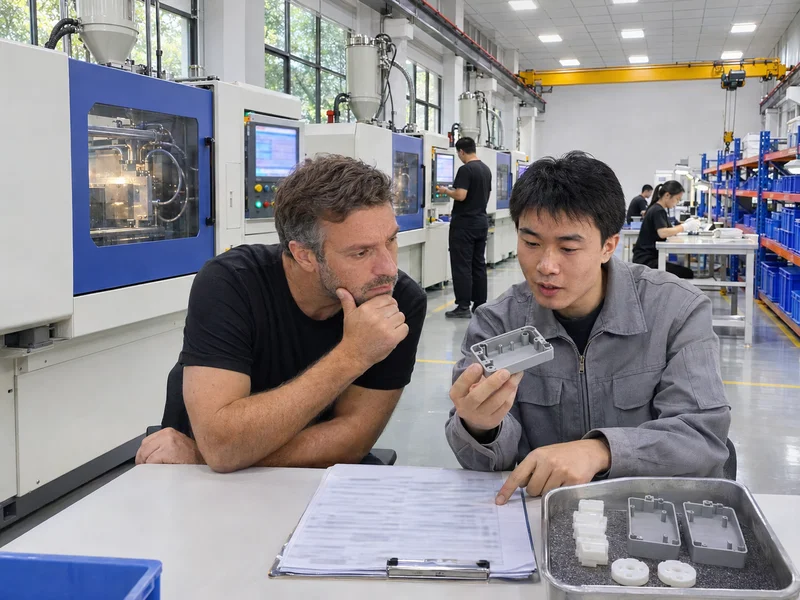
Questions to ask:
- Trial reports: what is recorded at T1, T2 and T3?
- Process sheets: are settings documented and controlled?
- Process studies: are fill, gate freeze or process window studies done when needed?
- Resin handling: how are dryers set and moisture checked?
- Regrind: is it allowed, and how is it controlled?
- Machine changes: how is the process transferred to another press?
For example, a supplier that records dryer temperature and time for every lot can trace a brittleness problem quickly. Our guide to decoupled molding explains process studies that support a stable process.
Key Takeaway: Ask to see a process sheet and dryer log for a running job. They show daily discipline.
How Do You Audit Inspection and Measurement?
In a supplier audit checklist, you audit inspection and measurement by checking the equipment, the methods and the records.

Checklist items:
- Equipment: CMM, profile projector, gauges and test devices
- Calibration: dates and records for key instruments
- Methods: how critical dimensions are measured and fixtured
- Sampling: first-article, in-process and final inspection plans
- Reports: example FAI, dimensional and inspection reports
For example, ask how a soft or thin part is held during CMM measurement. A good answer includes a fixture and a defined datum scheme. At our Dongguan factory, we use a CMM with a 1,200 × 1,000 × 800 mm measuring range. Our guides to CMM measurement and first article inspection reports explain what to expect.
Key Takeaway: Ask for a sample report on a similar part. It shows what you will actually receive.
How Do You Audit Nonconformance and Corrective Action?
You audit nonconformance and corrective action by asking how a real problem was handled, from detection to verified fix.
Look for:
- Containment: how suspect parts are quarantined and sorted
- Root cause: which tools are used, such as 5 Whys or fishbone
- Corrective action: what changed in the mold, process or inspection
- Verification: how the fix was proven
- Records: an example 8D report, with customer details removed
For example, a supplier that can show an 8D with a clear root cause and process change is more reliable than one that only says “operator retrained”. Our guide to the 8D report explains each step, and a control plan shows how checks are fixed into the process.
Key Takeaway: “Retraining” alone is rarely a root cause. Look for changes to the process or mold.
What Red Flags Should a Supplier Audit Checklist Catch?
A supplier audit checklist should catch red flags that predict quality, delivery or communication problems.
Common red flags:
- No records for trials, dryers or inspections
- Unclear site roles or hidden subcontracting
- Certificates presented as proof of capability, without process evidence
- No mold maintenance records
- Vague lead times or no project schedule
- Only one person who understands your project
- Slow or unclear answers during the audit itself
For example, a supplier that answers every technical question with a sales manager, and never with an engineer, may have weak engineering support. Our guide to mold maintenance explains what a good maintenance record looks like.
Key Takeaway: How the supplier handles the audit is evidence too. Clear, quick, documented answers matter.
FAQ
- Q: What should a supplier audit checklist include for a molding supplier?
- Company and capacity, engineering, mold making, trials, process control, inspection, documentation, corrective action, maintenance and logistics.
- Q: How do you score a supplier audit?
- Use a simple scale, such as 0–3 per item, and record the evidence seen for each score.
- Q: Are certificates enough to approve a supplier?
- No. Ask for records that show the process works, such as trial reports, inspection reports and 8Ds.
- Q: Can a supplier audit be done remotely?
- Partly. Video walkthroughs and document reviews help, but an on-site visit gives the best view of daily practice.
- Q: How often should suppliers be audited?
- Typically before approval, then periodically or after major quality problems or changes.
Conclusion
A supplier audit checklist for mold and molding suppliers works best when every answer is backed by a real record. Check site roles, engineering, trials, process control, inspection and problem handling, and watch for red flags. To start a project review with us, send your 3D model and 2D drawing to our engineers.