
TPR vs TPE: How to Pick the Best One Without Costly Mistakes
TPR vs TPE is often not a comparison of two different materials. TPE (thermoplastic elastomer) is the whole family of rubber-like plastics that can be melted and molded. TPR (thermoplastic rubber) is a trade name used mainly for styrenic TPEs, often based on SBS, which is one member of that family. So every TPR is a TPE, but most TPEs are not what suppliers call TPR.
The confusion has a real cost. For example, two quotes for a soft grip can both say “TPE”, while one uses a low-cost SBS compound and the other a heat-resistant SEBS or TPV grade. The cheaper part may become sticky or deform in a hot car. In this guide, we explain the difference between TPR vs TPE, compare the main TPE types and show how to specify the material before comparing quotes. For rubber alternatives, see our guide to thermoplastic elastomer vs silicone.
TPE (thermoplastic elastomer) is the family name for rubber-like plastics that can be melted, molded and recycled. ISO 18064 groups them into types such as TPS (styrenic), TPO (olefinic), TPV (vulcanizate), TPU (urethane), TPC (copolyester) and TPA (polyamide). TPR (thermoplastic rubber) is a common trade term, mainly for styrenic compounds based on SBS or SEBS. In TPR vs TPE quotes, ask for the base polymer, hardness, temperature range and bonding substrate, not only “TPE” or “TPR”.
In short: TPR is usually a styrenic TPE; specify the exact type and grade before comparing prices.
Key points:
- Family vs member: TPE is the family; TPR is a name for some styrenic grades.
- Performance range: SBS-based TPR is low cost; SEBS, TPV and TPU handle more heat and wear.
- Quotes: compare the base polymer, hardness and grade, not the label.
What Is the Difference Between TPR vs TPE?
The difference between TPR vs TPE is a difference between a specific trade term and a material family. TPE covers all thermoplastic elastomers. TPR is used, especially in footwear and consumer goods, for styrenic block copolymer compounds.
| Term | What it means | Typical base polymer |
|---|---|---|
| TPE | Family name for all thermoplastic elastomers | SBS, SEBS, TPO, TPV, TPU, COPE, PEBA |
| TPR | Trade term for thermoplastic rubber compounds | Mostly SBS, sometimes SEBS |
| TPE-S / TPS | Styrenic TPE | SBS or SEBS |
| TPV | Thermoplastic vulcanizate | Vulcanized EPDM in PP |
| TPU | Thermoplastic polyurethane | Polyester or polyether urethane |
The official naming is set by ISO in ISO 18064, which uses abbreviations such as TPS, TPO, TPV, TPU, TPC and TPA. TPR is not one of those standard type names.
Key Takeaway: Treat “TPR” as an incomplete description. Ask which TPE type and base polymer it is.
What Is TPR Material Made Of?
TPR material is usually made of a styrenic block copolymer, compounded with oil, fillers and sometimes PP. SBS (styrene-butadiene-styrene) is the most common base for low-cost TPR. SEBS (styrene-ethylene-butylene-styrene) is used for better heat and weather resistance.
Typical TPR characteristics:
- Soft, rubbery feel with good grip
- Low cost, especially SBS-based compounds
- Easy processing on standard injection molding machines
- Limited heat resistance, especially with SBS
- Moderate oil and UV resistance, depending on grade
As a result, TPR is common in shoe soles, toy parts, tool grips and household goods. It is less common in automotive, outdoor or high-temperature parts, where SEBS, TPV or TPU grades are preferred.
Key Takeaway: If a supplier quotes TPR, ask whether it is SBS or SEBS. The answer changes heat and weather performance.
How Do TPR vs TPE Types Compare in Performance?
TPR vs TPE types compare very differently in heat, wear, oil and weather resistance. The table shows typical behavior; exact values depend on grade.
| Type (typical) | Heat resistance | Wear resistance | Oil resistance | UV / weather | Relative cost |
|---|---|---|---|---|---|
| SBS-based TPR | Low | Fair | Poor | Poor | Lowest |
| SEBS (TPS) | Medium | Fair | Fair | Good | Low–medium |
| TPO | Medium | Fair | Fair | Good | Low–medium |
| TPV | High | Good | Good | Very good | Medium |
| TPU | Medium–high | Excellent | Very good | Fair–good | Medium–high |
| TPC (COPE) | High | Very good | Very good | Good | High |
For example, a soft grip on an indoor hand tool can use SEBS. A seal in an engine bay often needs TPV. A cable jacket or wear surface often needs TPU.
Key Takeaway: Pick the TPE type for the worst environment the part sees. Cost differences between types are smaller than failure costs.
Which Is Better for Overmolding: TPR or TPE?
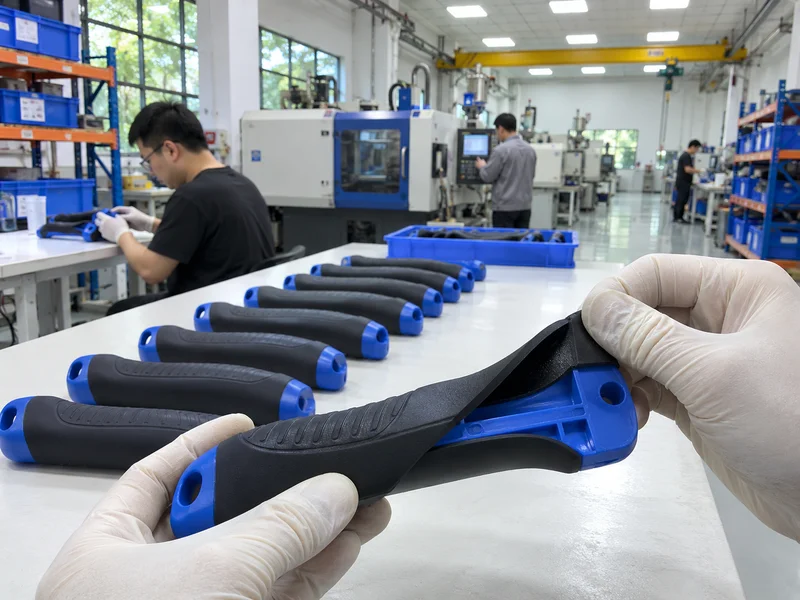
Neither TPR nor TPE is better for overmolding in general. Bonding depends on matching the elastomer grade to the substrate. Many TPE suppliers offer special grades that bond to specific rigid plastics.
| Substrate | Common bonding TPE type |
|---|---|
| PP | SEBS or TPV grades formulated for PP |
| ABS, PC, PC/ABS | Modified SEBS grades for engineering plastics |
| PA (nylon) | Special adhesion-modified grades |
| Metal | Usually needs primers or mechanical locks |
Standard TPR compounds often bond well to PP and poorly to engineering plastics. Therefore, specifying “TPR overmold on PC” without a bonding grade can lead to peeling. Our guides to overmolding and two shot molding explain both processes.
Bond strength is usually checked with a simple peel test on molded samples. If the elastomer tears before it separates from the substrate, the bond is good. If it peels cleanly, the grade, the substrate or the molding temperatures need to change. Mechanical locks, such as holes or undercuts in the substrate, can add security where chemical bonding is weak.
Key Takeaway: Always name the substrate when specifying an overmold elastomer. Bonding is grade-specific.
How Does Hardness Compare Between TPR and TPE?
Hardness ranges overlap almost completely between TPR and TPE. Both are available from very soft gel-like grades to semi-rigid grades, usually measured on the Shore A or Shore D scale.
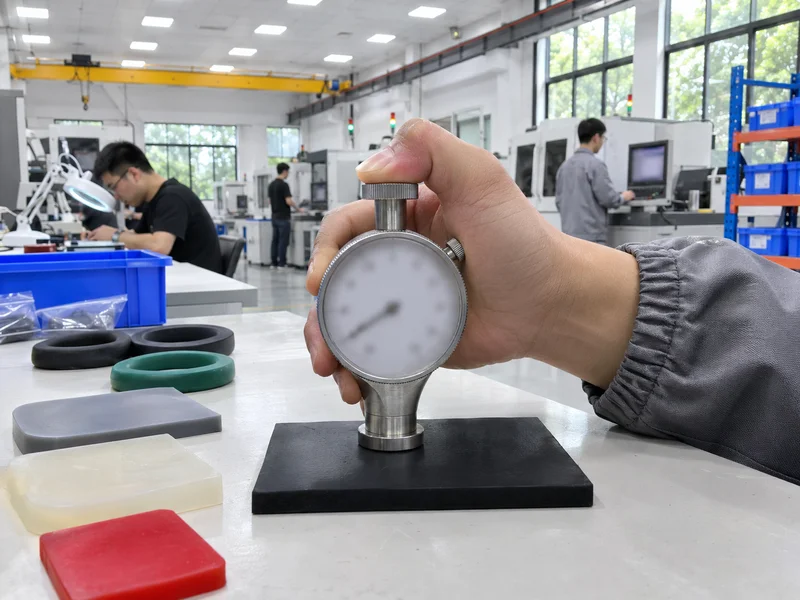
- Very soft (about Shore 0–30A): gel pads, cushions
- Soft (about Shore 30–60A): grips, handles, seals
- Medium (about Shore 60–90A): feet, bumpers, gaskets
- Hard (above about Shore 90A to Shore 50D): wheels, semi-rigid parts
Hardness is measured with standard test methods, such as those published by ASTM International and ISO. However, two compounds with the same hardness can feel and wear very differently.
Hardness also changes how a part feels in the hand. A Shore 40A grip feels soft and cushioned but wears faster, while a Shore 70A grip feels firmer and lasts longer. In addition, soft grades are more likely to feel sticky or attract dust. Therefore, many buyers approve two or three hardness samples before choosing the final grade.
Key Takeaway: Specify hardness with a tolerance, such as Shore 60A ± 5, and approve samples for feel.
How Do TPR and TPE Mold Differently?
TPR and TPE mold on standard injection molding machines, but different types need different conditions. Styrenic TPR molds at relatively low temperatures. TPU and TPC need drying and higher temperatures.
- SBS and SEBS (TPR, TPS): usually little or no drying; easy flow
- TPV: may need drying depending on grade; good flow
- TPU: must be dried; sensitive to moisture and overheating
- TPC: must be dried; higher processing temperatures
Soft elastomers also stick to the mold and stretch during ejection. Therefore, molds for soft TPE need suitable texture, ejection and venting. For TPU and other moisture-sensitive grades, see our guide to plastic resin drying.
Key Takeaway: Ask the supplier how the chosen grade is dried and ejected. Soft parts tear or stretch if the mold is not designed for them.
How Should You Specify TPR vs TPE Before Comparing Quotes?
You should specify TPR vs TPE by describing the material completely, so every supplier quotes the same thing.
A complete material specification includes:
- TPE type: SEBS, TPV, TPU or another type
- Hardness: for example, Shore 70A ± 5
- Temperature range: lowest and highest service temperature
- Chemicals: oils, cleaners, sweat or fuels the part touches
- Bonding substrate: for overmolded parts
- Color and finish: including UV stability if used outdoors
- Compliance: food-contact, RoHS or REACH, if required
For example, “TPE Shore 60A, SEBS, bonding grade for PC/ABS, black, −20 to 80 °C” gives far more comparable quotes than “TPR soft grip”. Our injection molding quote checklist lists the other data to include.
Key Takeaway: “TPE” or “TPR” alone is not a specification. Name the type, hardness and conditions.
TPR vs TPE: Which Should You Choose?
You choose between TPR vs TPE types by matching cost to the service conditions.
- Low-cost indoor grips, toys, footwear? SBS-based TPR or SEBS.
- Outdoor or UV-exposed parts? SEBS or TPV.
- Heat, oils or engine-bay use? TPV or TPC.
- High wear or abrasion? TPU.
- Overmolding on PC or ABS? A bonding-grade SEBS.
We mold TPE and TPU, including overmolding and two-shot parts, from T1 trial to volume production. For more on material choices, see our injection molding material selection guide.
Key Takeaway: Choose the TPE type by environment, then compare prices. Comparing “TPR” and “TPE” prices directly compares unknowns.
FAQ
- Q: Is TPR the same as TPE?
- TPR is a type of TPE. TPE is the family name; TPR is a trade term mainly for styrenic compounds based on SBS or SEBS.
- Q: Is TPR better than TPE?
- Not in general. SBS-based TPR is low cost but has limited heat and oil resistance, while other TPE types such as TPV and TPU perform better.
- Q: What is TPR material made of?
- Usually a styrenic block copolymer, such as SBS or SEBS, compounded with oil, fillers and sometimes PP.
- Q: Can TPE bond to plastic in overmolding?
- Yes, when the grade is formulated for the substrate, such as PP, ABS, PC or nylon.
- Q: How should I specify TPE for a quote?
- State the TPE type, hardness, temperature range, chemicals, bonding substrate, color and compliance needs.
Conclusion
TPR vs TPE is mostly a naming issue: TPR is usually a styrenic member of the TPE family. Specify the TPE type, hardness and service conditions before comparing quotes. To choose the right elastomer for your part, send your 3D model and 2D drawing to our engineers.