
Conformal Cooling: 9 Checks Before You Build Your Mold
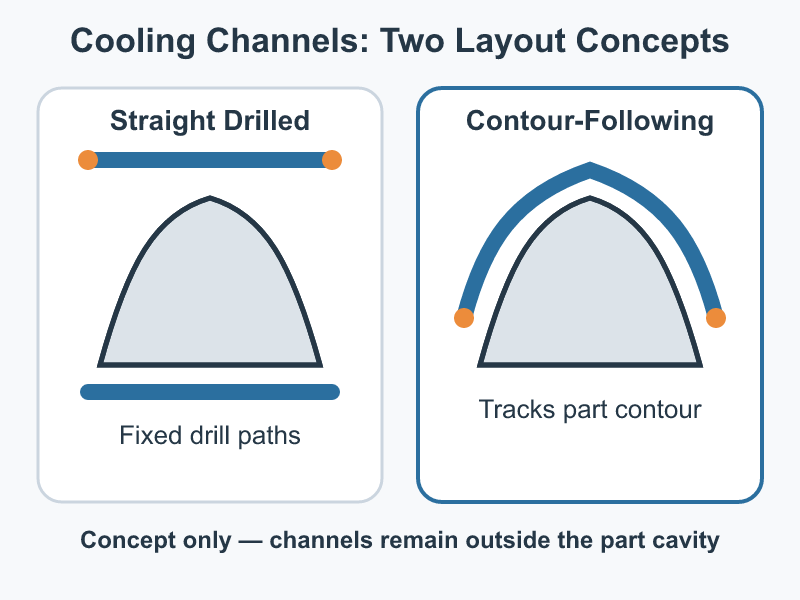
Conformal cooling is a mold-temperature-control approach that places coolant channels near and along difficult cavity or core contours. It can help a project manage local heat, warpage, and cooling consistency, but only when the channel geometry, insert material, coolant circuit, and molding process are engineered together.
The purchasing problem is that a complex channel can add cost and validation work without solving the actual constraint. Before ordering it, treat conformal cooling as one option within an injection mold manufacturing plan, not as an automatic upgrade.
Conformal channels follow the thermal demand of the molded geometry more closely than straight drilled lines can. Their value depends on measurable hot spots, a manufacturable insert, balanced flow, and a trial plan. The correct question is not whether the technology is advanced, but whether it removes a defined project risk.
In short:
Key points:
- Start with part geometry, resin, CTQs, and production constraints—not a preferred manufacturing method.
- Compare conventional drilling, local conformal inserts, and hybrid routes against the same thermal and commercial baseline.
- Accept the solution through documented flow, temperature, part-quality, trial, and maintenance evidence.
1. What does conformal cooling actually change inside a mold?
Conformal cooling changes the path between the coolant and the heat-loaded mold surface; it does not make mold material intrinsically more conductive. A contoured circuit can approach deep cores, ribs, bosses, or uneven cavity regions that straight drilling may miss. Heat still must move through the tool material into the coolant, then leave through a stable water circuit.
That distinction matters because channel geometry and material conductivity solve different problems. A poorly routed conformal channel in an unsuitable insert can still create weak flow, excessive pressure loss, leakage risk, or difficult cleaning. Conversely, a conventional circuit may work well when the thermal load is accessible and balanced.
| Design lever | What it changes | What it does not guarantee |
|---|---|---|
| Channel path | Distance and coverage near local heat | Uniform coolant flow |
| Insert material | Heat transfer and wear behavior | Good channel placement |
| Coolant conditions | Heat removal and turbulence behavior | A stable molding window |
| Part geometry | Location and intensity of heat | A feasible insert design |
Key Takeaway: Separate channel geometry, tool material, and coolant performance before attributing an outcome to conformal cooling.
2. When do conventional drilled channels become too limited?
Straight drilling becomes a constraint when accessible paths cannot cool the required region while respecting tool features and service access. Intersections and plugs are normal design choices; the concern is an unresolved thermal or maintenance limitation. Typical triggers include deep cores, tall ribs, thick-to-thin transitions, crowded slides, or a local area that remains hot after the basic cooling layout is optimized.
The engineering judgment is to keep drilled cooling when it meets the temperature and quality targets. It is easier to inspect, repair, and clean. Choose a local conformal insert when the hot spot is geometrically isolated; avoid converting an entire mold merely because additive manufacturing is available. The operational consequence of unnecessary complexity is higher tool cost and a more demanding maintenance program.
| Condition | Likely starting route | Decision evidence |
|---|---|---|
| Open geometry with direct drilling access | Conventional drilling | Stable surface temperature and part quality |
| One inaccessible thermal hot spot | Local conformal insert | Thermal map tied to the affected CTQ |
| Mixed accessible and hidden regions | Hybrid cooling | Circuit-by-circuit flow and pressure review |
Key Takeaway: Escalate from drilled cooling only when a defined geometric or thermal limitation remains.
3. What information is needed before conformal cooling design starts?
Detailed cooling design needs the part model, drawing, resin grade, critical-to-quality features, appearance zones, expected production conditions, and any mold standards before detailed cooling design starts. These inputs connect the thermal problem to an acceptance requirement rather than to a generic channel pattern.
At RFQ stage, WOKE Molds prioritizes a 3D product model and 2D drawing. Material, volume, tolerances, surface requirements, mold standard, and target timing are valuable when available. Formal engineering and DFM review normally follows project launch, and Moldflow is used according to project complexity and customer requirements.
The specification should also identify the molding machine interface, available coolant quality and temperature, manifold connections, and maintenance limits. If the resin is glass-filled, corrosive, high-temperature, or otherwise demanding, state the exact grade because it can affect steel, wear, surface treatment, gate, venting, and temperature-control choices.
Key Takeaway: Freeze the decision inputs and CTQs before asking a supplier to optimize channel geometry.
4. How should flow, heat, and finished-part quality be evaluated together?
Flow, heat, and finished-part quality should be evaluated as one linked system because a cooler simulation image alone does not prove an acceptable molded part. Review coolant velocity distribution, pressure loss, stagnant zones, mold-surface temperature, thermal balance, and the resulting dimensions, warpage, appearance, and cycle stability.
Moldex3D's conformal-cooling overview emphasizes coolant-flow behavior, pressure loss, stagnant flow, and geometry constraints. For the project team, those variables should become review questions: Can the plant supply the required flow? Are circuits balanced? Does the thermal result improve the CTQ that justified the insert?
Do not accept an average mold temperature without a location map. Compare the hottest and coldest relevant surfaces, then connect them to the drawing's injection molding tolerances and the inspection method. This helps identify whether the proposed change moves shrinkage or warpage to another critical feature.
Key Takeaway: Approve the concept only when hydraulic, thermal, and part-quality evidence point to the same decision.
5. Which manufacturing route makes the channel design verifiable?
The right manufacturing route is the one that can create, finish, inspect, pressure-test, and maintain the required channel and insert—not simply the one that can print a complex shape. Options may include conventional machining, additively manufactured metal inserts, joined constructions, or a hybrid of additive and subtractive processes.
3D Systems' conformal-cooling application guidance illustrates the use of localized conformal inserts rather than requiring an entire mold to be made additively. That is a useful procurement principle: isolate the hard-to-cool region, then retain conventional mold construction where it remains effective.
WOKE Molds evaluates conformal or 3D-printed cooling channels according to project needs, cost-benefit, and customer requirements. Agree how the insert will be produced and which records are included in the project.
The engineering judgment is to reject any route that cannot provide channel-definition evidence, accessible connections, leak testing, and finishing of critical mold surfaces. Hidden complexity without an inspection plan becomes a transfer and repair risk.
Key Takeaway: Select a manufacturing route by its inspection and serviceability plan, not by geometric novelty.
6. When does the extra tooling cost have a defensible business case?
The extra tooling cost is defensible when a specific production constraint has a measurable baseline and the proposed insert can be evaluated against it. There is no universal cycle-time saving or payback period; part geometry, resin, machine, coolant conditions, annual demand, reject causes, and maintenance all change the result.
Build the business case from a range rather than a promotional percentage. Include the incremental insert and validation cost, expected production volume, cost of the affected defect, press-hour value, planned tool life, spare strategy, and the confidence of the thermal evidence.
| Commercial input | Baseline to record | Acceptance question |
|---|---|---|
| Cooling-limited cycle | Current stable process, not a best shot | Is the same quality window maintained? |
| Thermal defect | Scrap or rework tied to a defined location | Does trial evidence close that defect mode? |
| Tooling premium | Insert, finishing, testing, and spares | Is the added scope transparent in the quote? |
| Maintenance burden | Water quality, cleaning, downtime, repair | Can the receiving plant support it? |
If demand or the baseline is uncertain, separate the potential quality benefit from an unproven production-cost payback. First check whether gate, packing, venting, ejection, or part design is the actual constraint. A project should not fund a cooling solution for a non-cooling problem.
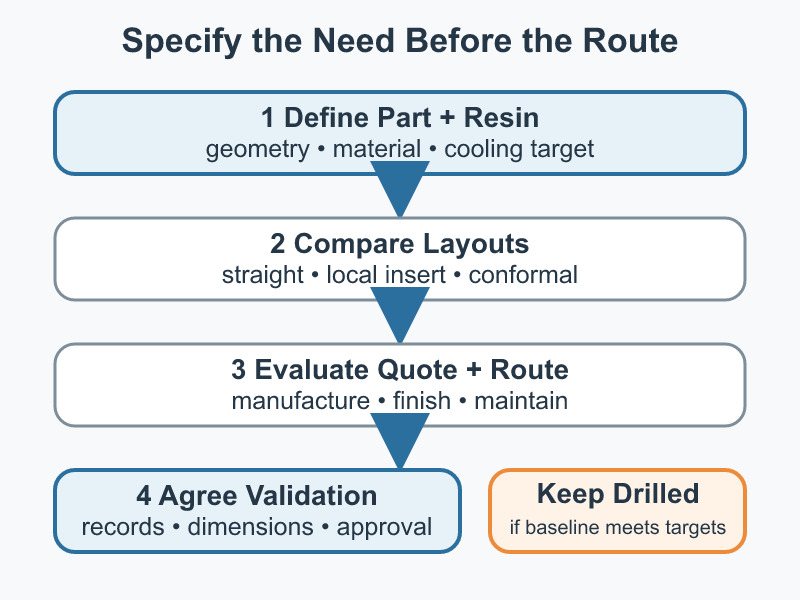
Key Takeaway: Fund conformal cooling only when the baseline, affected CTQ, cost boundary, and validation method are explicit.
7. What should T1 and later mold trials record?
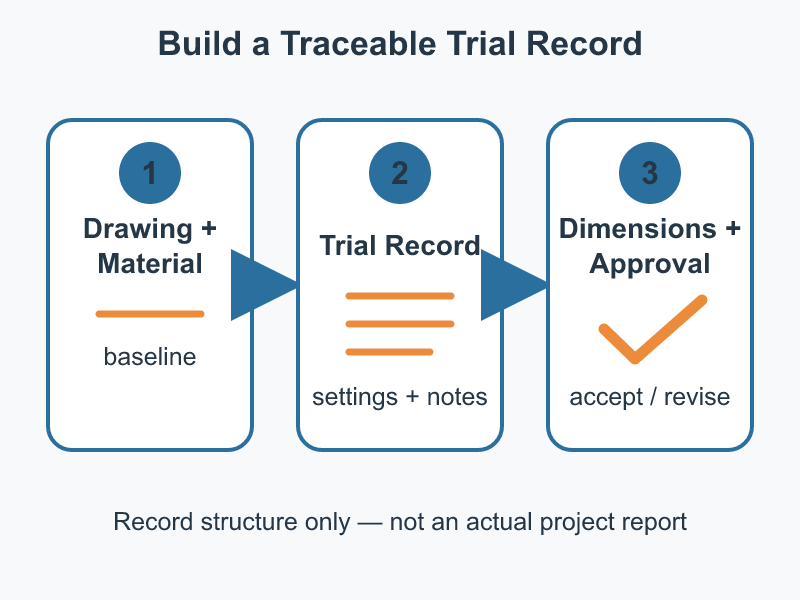
T1 and later trials should record the process settings, coolant conditions, circuit flow and pressure, mold temperatures, cycle stages, sample identity, dimensions, appearance, and open actions. The purpose is to distinguish a channel-design issue from changes in resin drying, packing, venting, machine setup, or measurement.
WOKE Molds's standard development flow includes design review, mold build, T1, samples and inspection, customer feedback, modification, and T2 or T3 as required. Reports such as full dimensional results, CMM data, material certificates, mold-trial reports, or other documents can be arranged according to the project and customer requirement; they are not all automatic for every job.
Record the same measurement locations across trials. If burns, short shots, or trapped gas appear while the process window changes, review injection mold venting instead of attributing every defect to temperature. A closed action log should show what changed, why, and which result confirmed closure.
Key Takeaway: Make every trial comparable by controlling inputs and linking temperature data to inspected parts.
8. What maintenance information must transfer with the mold?
The maintenance handoff must explain each circuit's path, connections, operating limits, test method, cleaning approach, and repair constraints. Hidden channels are difficult to diagnose after transfer, so the receiving molder needs more than an assembly drawing.
Ask for a circuit map, port identification, flow direction, pressure- or leak-test record, compatible coolant guidance, filtration and water-quality expectations, flushing method, and a spare or repair plan for the conformal insert. Also identify seals, plugs, manifolds, and any dissimilar materials that affect service.
WOKE Molds can coordinate technical support, problem analysis, mold modification, spares, return repair, and on-site engineering support when necessary and agreed for the project. Requested spare items are chargeable and should be identified in the quotation. Do not assume a fixed warranty or mold-life promise; steel, construction, volume, resin, and maintenance conditions must be matched to the actual requirement.
Key Takeaway: Treat circuit documentation and cleaning access as acceptance items, not after-sales extras.
9. What should a conformal cooling RFQ ask the supplier to prove?
A conformal cooling RFQ should ask the supplier to prove the need, chosen route, validation plan, cost boundary, and maintenance handoff. Send the geometry and CTQs first, then request a proposal that separates known facts, assumptions, optional analysis, and post-launch engineering work.
Use these nine checkpoints in the RFQ response:
- Defined hot spot or cooling limitation.
- Resin grade and relevant molding window.
- CTQs affected by the thermal condition.
- Conventional, local-insert, and hybrid options considered.
- Proposed channel and insert manufacturing route.
- Flow, pressure, thermal, and structural review method.
- Trial measurements and acceptance criteria.
- Maintenance, cleaning, repair, and spare strategy.
- Included scope, exclusions, timing assumptions, and change control.
WOKE Molds can assess the part model and drawing, then align the mold, molding, inspection, and manufacturing inputs around the selected route. The goal is a reviewable project plan, not an unsupported promise of universal performance.
Key Takeaway: Ask for an evidence chain that continues from RFQ through trial acceptance and plant handoff.
FAQ
- What is conformal cooling in injection molding?
- Conformal cooling uses coolant channels that follow difficult cavity or core contours more closely than straight drilled channels can, helping address defined local thermal conditions.
- Does conformal cooling always reduce cycle time?
- No. The result depends on part geometry, resin, mold material, channel design, coolant conditions, machine settings, and the process constraint measured during trials.
- Is additive manufacturing required for every conformal cooling design?
- No. Some channel layouts can use machined-and-joined insert construction or a hybrid route. Keep conventional drilled circuits where they meet the requirements; the entire mold need not be printed.
- What files are needed for a conformal cooling quotation?
- Start with the 3D part model and 2D drawing, then add the resin grade, CTQs, expected volume, appearance needs, mold standard, machine interface, and coolant conditions when available.
- How should a conformal cooling insert be tested?
- Test the circuit for integrity and hydraulic behavior, then compare controlled trial settings, mold temperatures, sample identity, dimensions, appearance, and open actions against agreed acceptance criteria.
- What should be included in the maintenance handoff?
- Include the circuit map, port labels, flow direction, operating limits, test record, coolant and filtration guidance, cleaning method, repair constraints, and the agreed spare strategy.
Conclusion
Conformal cooling is most useful when a known geometric hot spot is tied to a measurable part or production requirement. Keep the decision grounded in inputs, route verification, controlled trials, and maintenance readiness. To review a part and define the right RFQ scope, contact WOKE Molds.