
PA66 GF30: Properties, Moisture Effects and Molding
PA66 GF30 is polyamide 66 (nylon 66) reinforced with 30% glass fiber by weight. The glass makes it about two to three times stiffer than unfilled PA66 and raises its heat deflection temperature to around 250 °C, so it is one of the most used engineering plastics for structural and electrical parts such as connector housings, terminal blocks, brackets, fan parts and automotive under-hood components.
The grade has clear strengths and clear limits. For example, a terminal cover in this grade can have thin walls and snap fits that a thermoset cannot easily match, but its dimensions and strength change as it absorbs moisture, so tolerances should be set for the conditioned state. In this guide, we explain the main properties, how moisture changes them, how it is molded, design tips, electrical and flame-retardant grades, how it compares with PBT GF30 and BMC, and how to specify it. For the wider family, see our guide to glass filled nylon.
Typical values (dry as molded) are a density of about 1.35–1.37 g/cm³, tensile strength of about 180–190 MPa, tensile modulus of about 9–10 GPa, HDT at 1.8 MPa of about 250 °C and a melting point of about 260 °C. Conditioned at 23 °C and 50% RH, it absorbs roughly 1–1.5% water, and strength and stiffness drop noticeably while toughness rises. Molding shrinkage is low along the flow (about 0.3–0.5%) and higher across it (about 0.8–1.2%), which can cause warpage. Pellets are dried before molding, melt temperatures are around 280–300 °C and mold temperatures around 80–100 °C.
In short: strong, stiff and heat resistant, but design for moisture and fiber orientation.
Key points:
- Glass: 30% by weight.
- HDT: about 250 °C at 1.8 MPa.
- Watch: moisture and anisotropic shrinkage.
What Are the Main PA66 GF30 Properties?
The main properties combine strength, stiffness and heat resistance.
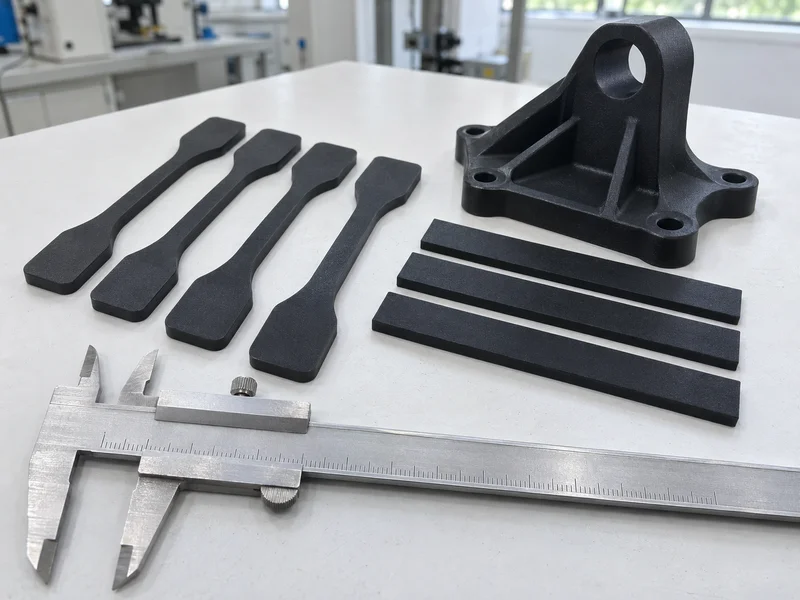
| Property | PA66 GF30 (dry) | PA66 unfilled (dry) |
|---|---|---|
| Density | 1.35–1.37 g/cm³ | 1.14 g/cm³ |
| Tensile strength | 180–190 MPa | about 80 MPa |
| Tensile modulus | 9–10 GPa | about 3 GPa |
| HDT at 1.8 MPa | about 250 °C | about 75 °C |
| Melting point | about 260 °C | about 260 °C |
| Water absorption (23 °C / 50% RH) | 1–1.5% | about 2.5% |
Values are typical; always use the datasheet of the exact grade. For example, the jump in HDT is why this grade is used near engines and motors. Our guide to heat deflection temperature explains the test.
Key Takeaway: Above all, glass fibers transform PA66 from a tough plastic into a structural one.
How Does Moisture Change the Material?
Moisture changes it because water acts as a plasticizer in polyamides.
- Strength and stiffness: drop as moisture rises
- Toughness: improves after conditioning
- Dimensions: parts grow slightly with water uptake
- Electrical: insulation resistance and dielectric values fall
- Time: thick parts take weeks to reach equilibrium
For example, a bracket that measures in tolerance straight from the press may grow by around 0.1–0.2% after conditioning. Test standards for conditioning are published by ISO, including ISO 1110 for accelerated conditioning of polyamides.
Key Takeaway: In other words, set tolerances and strength targets for the conditioned state.
How Is PA66 GF30 Molded?
It is molded by injection molding with careful drying and hot molds.
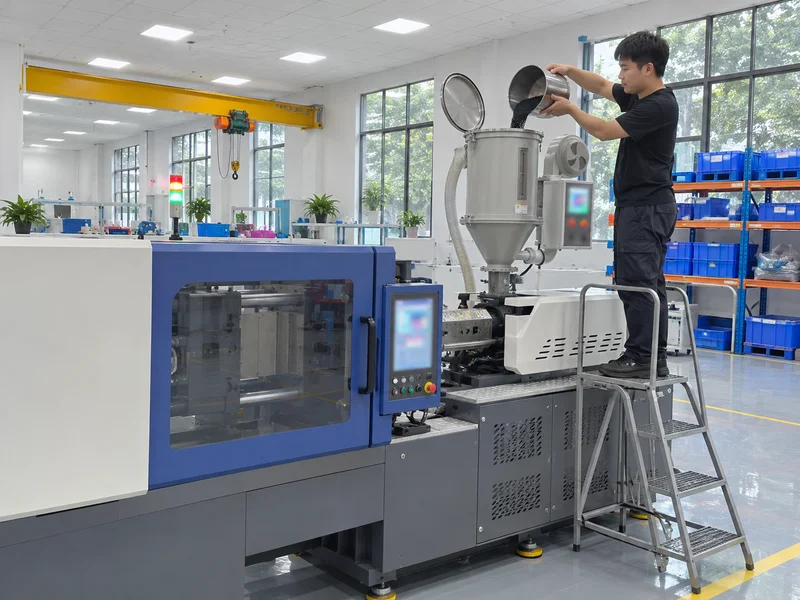
- Drying: about 80 °C for 2–4 hours, to below about 0.2% moisture
- Melt temperature: about 280–300 °C
- Mold temperature: about 80–100 °C for good surface and crystallinity
- Injection speed: fast, to avoid fiber marks on the surface
- Hardened steel: glass fibers wear gates and cavities
- Gate location: controls fiber orientation and warpage
For example, a cold mold can leave glass fibers visible on the surface and lower crystallinity, so the part warps after molding. Our guides to mold temperature controller use and plastic injection molding cover these settings.
Key Takeaway: For this reason, the grade needs dry pellets, hot molds and hardened tooling.
What Design Tips Apply to Glass-Filled Nylon Parts?
Design tips for these parts help control warpage, weld lines and fiber effects.
- Uniform walls: typically about 1.5–3 mm
- Ribs: about 50–60% of wall thickness
- Weld lines: weaker because fibers do not cross them; keep away from loads
- Draft: at least about 0.5–1°
- Radii: avoid sharp corners
- Gate: place to align fibers with load direction
For example, a weld line next to a screw boss can be the weakest spot of a housing, so moving the gate can double the boss strength. Our guide to injection molding gate types explains gate placement.
Key Takeaway: Overall, design around fiber orientation, not just wall thickness.
Which Grades Suit Electrical Parts?
Grades for electrical parts usually add flame retardants and high tracking resistance.
| Grade type | Key feature | Typical use |
|---|---|---|
| Standard grade | Strength, heat | Brackets, housings |
| FR grade (halogen-free) | UL 94 V-0, high CTI | Terminal blocks, connectors |
| Heat stabilized | Long-term heat aging | Under-hood, motor parts |
| Glow-wire grades | GWFI / GWIT ratings | Appliance parts |
For example, a terminal block in a distribution board often uses a halogen-free FR PA66 GF grade rated V-0 with a CTI of about 600 V. Our guides to UL 94 and comparative tracking index explain these ratings.
Key Takeaway: Equally, check the listing of the exact FR grade at your wall thickness.
How Does PA66 GF30 Compare With PBT GF30 and BMC?
It compares with PBT GF30 and BMC on strength, moisture, heat and tracking.
| Factor | PA66 GF30 | PBT GF30 | BMC |
|---|---|---|---|
| Strength and toughness | Highest | Good | Lower |
| Moisture uptake | High | Low | Very low |
| HDT | about 250 °C | about 205 °C | often above 200 °C |
| Dimensional stability | Fair | Good | Very good |
| Creep at high temperature | Moderate | Moderate | Very low |
| Snap fits and thin walls | Excellent | Good | Limited |
For example, PBT GF30 is often chosen over PA66 GF for connectors that must hold tight dimensions in humid conditions. Our guides to PBT injection molding and thermoset vs thermoplastic explain the alternatives.
Key Takeaway: As a rule, choose PA66 GF for strength and toughness, PBT for stability, BMC for heat and creep.
How Should PA66 GF30 Be Specified?
The grade should be specified with the grade, ratings and test conditions.
- Material: supplier and grade
- Additives: FR, heat stabilized, color
- Flame rating: UL 94 at thickness
- Electrical: CTI, if used as insulation
- Conditioning: dry or conditioned for tests
- Dimensions: state the measurement condition
For example, “PA66 GF30 FR (halogen-free), UL 94 V-0 at 0.75 mm, CTI ≥ 600 V, dimensions measured after conditioning per ISO 1110” is a clear callout. Our custom plastic enclosures page explains how materials are confirmed per project.
Key Takeaway: Finally, state whether dimensions and strength apply dry or conditioned.
FAQ
- Q: What is PA66 GF30?
- Nylon 66 reinforced with 30% glass fiber by weight.
- Q: What is the HDT of PA66 GF30?
- About 250 °C at 1.8 MPa.
- Q: Does glass-filled PA66 absorb water?
- Yes, roughly 1–1.5% at 23 °C / 50% RH, which lowers stiffness.
- Q: Is PA66 GF30 good for electrical parts?
- Yes, especially flame-retardant, high-CTI grades.
- Q: PA66 GF30 or PBT GF30?
- PA66 is stronger and tougher; PBT is more dimensionally stable in humidity.
Conclusion
PA66 GF30 is a strong, stiff, heat-resistant grade for structural and electrical parts, provided moisture and fiber orientation are designed for. Specify the grade and conditions. To quote molded glass-filled nylon parts, send your 3D model and 2D drawing to our engineers.