
Heat Deflection Temperature (HDT) of Plastics Explained
Heat deflection temperature (HDT) is the temperature at which a standard plastic test bar bends by a set amount under a fixed load, usually 0.45 MPa or 1.8 MPa, measured to ISO 75 or ASTM D648. It shows how a material holds its shape when warm and under load, which makes it one of the first numbers engineers compare when choosing plastics for parts near motors, heaters or electrical conductors.
Heat deflection temperature is a screening value, not a service limit. For example, a PA66 GF30 grade with an HDT around 250 °C at 1.8 MPa may still creep or lose stiffness at 150 °C under long-term load, while a BMC insulator with a similar HDT keeps its shape better because it is a thermoset. In this guide, we explain how HDT is measured, typical values for common plastics, what affects HDT, how it differs from other heat ratings, and how to use it when choosing materials. For material families, see our guide to thermoset vs thermoplastic.
Heat deflection temperature is measured by loading a test bar in three-point bending, heating it at a constant rate (typically 2 °C per minute) in an oil bath and recording the temperature at a standard deflection. ISO 75 Method A uses 1.80 MPa and Method B 0.45 MPa; ASTM D648 uses 0.455 MPa (66 psi) and 1.82 MPa (264 psi). Glass fibers raise HDT strongly in semi-crystalline plastics such as PA66, PBT and PPS. Thermosets such as BMC often show HDT above 200 °C. HDT does not predict long-term use temperature, creep or aging, so it is combined with RTI, creep data and part testing.
In short: use HDT to compare materials quickly, then confirm with long-term data and parts.
Key points:
- Standards: ISO 75, ASTM D648.
- Loads: 0.45 MPa and 1.8 MPa.
- Limit: short-term test, not a service rating.
How Is Heat Deflection Temperature Measured?
Heat deflection temperature is measured by heating a loaded bar until it bends a set amount.
- Specimen: molded bar, often 80 × 10 × 4 mm (ISO)
- Load: three-point bending at 0.45 MPa or 1.8 MPa stress
- Heating: oil bath at about 2 °C per minute
- Deflection: a standard deflection, for example 0.25 mm in ASTM D648
- Result: the temperature at that deflection
For example, a datasheet line “HDT 1.8 MPa: 205 °C” means the bar reached the set deflection at 205 °C under the higher load. Test methods are published by ISO (ISO 75) and ASTM (D648).
Key Takeaway: Above all, always check which load the datasheet used before comparing values.
What Is the Heat Deflection Temperature of Common Plastics?
The heat deflection temperature of common plastics varies widely by polymer and reinforcement.
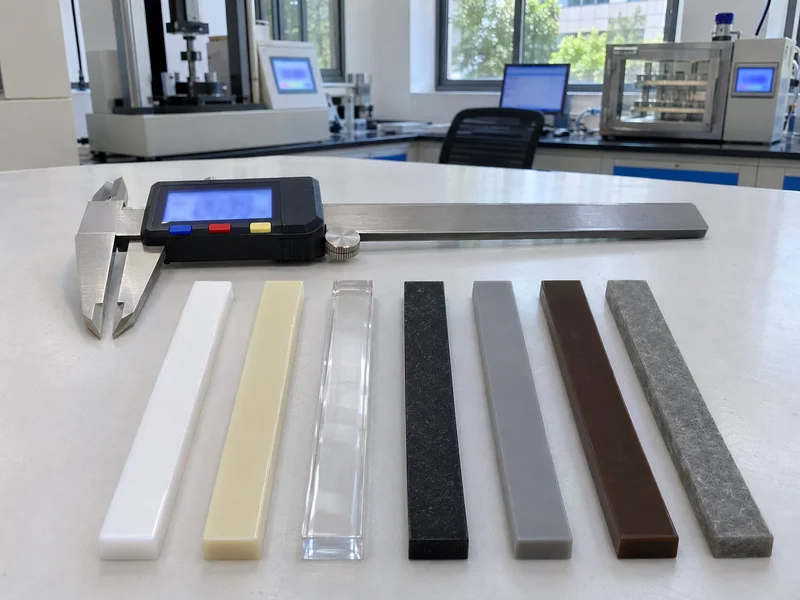
| Material | HDT at 1.8 MPa (approx.) |
|---|---|
| PP (unfilled) | 55–65 °C |
| ABS | 90–100 °C |
| PC | 125–140 °C |
| POM (copolymer) | 95–110 °C |
| PA66 (unfilled, dry) | 70–90 °C |
| PA66 GF30 | 240–255 °C |
| PBT GF30 | 200–215 °C |
| PPS GF40 | 260 °C or more |
| LCP (glass filled) | 260–300 °C |
| PEEK GF30 | about 315 °C |
| BMC (polyester, glass filled) | often above 200 °C |
Values are typical and grade dependent; always use the datasheet of the exact grade. For example, PA66 jumps from about 80 °C to about 250 °C when 30% glass is added. Our guides to glass filled nylon and PBT injection molding explain these grades.
Key Takeaway: In other words, glass fibers can raise HDT by more than 150 °C in some plastics.
What Affects Heat Deflection Temperature?
Several factors affect heat deflection temperature in materials and in molded parts.
- Polymer type: semi-crystalline vs amorphous
- Fillers and fibers: glass and mineral fillers raise HDT
- Moisture: wet PA shows lower stiffness and HDT
- Molding: crystallinity depends on mold temperature
- Fiber orientation: bars and parts can differ
- Annealing: can raise HDT in some semi-crystalline grades
For example, a PPS part molded in a cold mold may have lower crystallinity and lower heat resistance than one molded at the recommended high mold temperature. Our guide to mold temperature controller use explains mold temperature control.
Key Takeaway: For this reason, molding conditions can change how close a part comes to datasheet HDT.
How Is HDT Different From Other Heat Ratings?
Heat deflection temperature is different from other heat ratings because it is short-term and under one load.
| Rating | What it measures |
|---|---|
| HDT (ISO 75 / ASTM D648) | Short-term deflection under load |
| Vicat softening point | Needle penetration, no bending load |
| RTI (UL 746B) | Long-term thermal aging limit for a property |
| Continuous use temperature | Supplier estimate of long-term service |
| Glass transition (Tg) | Change from glassy to rubbery state |
| Melting point | Crystalline melting, thermoplastics only |
For example, a PBT GF30 grade may have HDT around 205 °C but an RTI around 140 °C for electrical properties. Our guide to what plastics are best for hot temperatures compares long-term limits.
Key Takeaway: Overall, use RTI or continuous use data for parts that stay hot for years.
How Should HDT Be Used When Choosing Materials?
Heat deflection temperature should be used as a first filter, followed by more detailed checks.
- Find the hot spot temperature of the part
- Screen grades with HDT well above that temperature
- Check long-term data: RTI, creep and heat aging
- Check electrical needs: CTI and flame rating
- Prototype and test under real heat and load
- Confirm the grade on the drawing
For example, a busbar support near copper running at 105 °C can be screened with HDT, then confirmed with RTI and a temperature-rise test on the assembly.
Key Takeaway: Equally, never design a long-term hot part on heat deflection temperature alone.
Why Do Thermosets Perform Well in HDT Tests?
Thermosets perform well in HDT tests because they are cross-linked and do not melt.
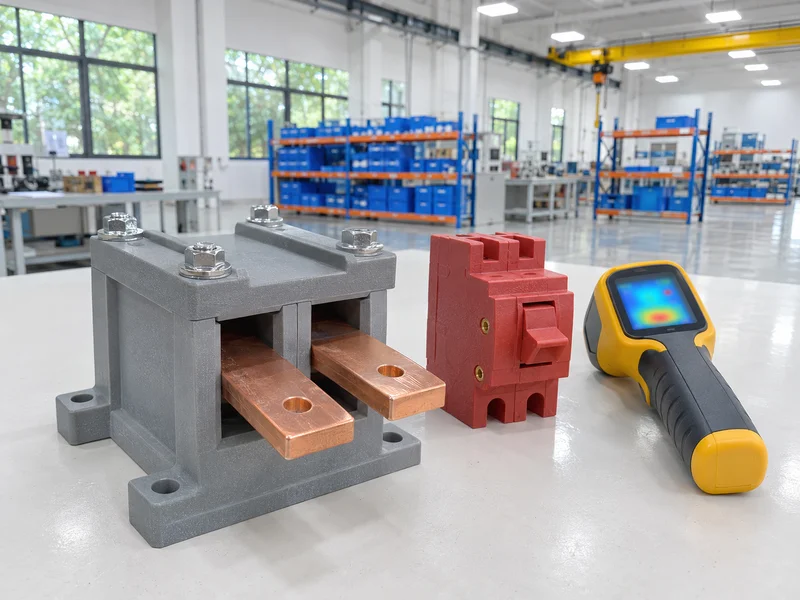
- Cross-linked network: no melting point
- Glass reinforcement: high stiffness
- Low creep: shape holds under load
- Fire behavior: chars instead of dripping
- Trade-off: more brittle than thermoplastics
For example, BMC breaker housings keep their shape during short overloads that could soften some thermoplastic parts.wokemolds.com/2026/09/13/busbar-insulator/”>busbar insulator design explain typical uses.
Key Takeaway: As a rule, consider thermosets when parts must hold shape near heat under load.
How Should HDT Be Shown on a Drawing or Specification?
Heat deflection temperature should be shown on a drawing or specification with the standard, load and value.
- Standard: ISO 75 or ASTM D648
- Load: 1.8 MPa or 0.45 MPa
- Minimum value: for example, HDT ≥ 200 °C at 1.8 MPa
- Grade name: exact resin and supplier when approved
- Other heat data: RTI or heat aging requirement if needed
For example, “Material: PBT GF30, UL 94 V-0, HDT ≥ 200 °C at 1.8 MPa per ISO 75” gives a clear basis for alternatives. Our plastic injection molding page explains how grades are confirmed for production.
Key Takeaway: Finally, include the load with every HDT value, or the number can be misread.
FAQ
- Q: What is heat deflection temperature?
- The temperature at which a loaded plastic bar bends a set amount.
- Q: Which standards measure HDT?
- ISO 75 and ASTM D648.
- Q: Does glass fiber increase HDT?
- Yes, strongly in semi-crystalline plastics like PA66 and PBT.
- Q: Is HDT the maximum use temperature?
- No, it is a short-term test; long-term limits come from RTI or aging data.
- Q: What is the HDT of BMC?
- Often above 200 °C, depending on the grade.
Conclusion
Heat deflection temperature is a fast way to compare how plastics hold shape under heat and load, but long-term ratings and part tests decide the final choice. State the standard and load with every value. To review material choice for a hot part, send your 3D model and 2D drawing to our engineers.