
Glass Filled Nylon: Fiber Orientation, Moisture and Fits
Glass filled nylon is nylon (PA6 or PA66) reinforced with short glass fibers, typically 15–50% by weight. The fibers raise stiffness, strength and heat resistance dramatically, which makes glass filled nylon one of the most widely used engineering plastics for brackets, housings, connectors and metal-replacement parts. However, the fibers also make the material anisotropic: it shrinks, warps and performs differently along and across the flow.
Most problems with glass filled nylon parts come from fiber orientation and moisture. For example, a long bracket can warp because it shrinks less along the flow than across it. Likewise, a press-fit bushing sized on a dry part can become loose or tight after the part absorbs moisture. In this guide, we explain how to plan fiber orientation, control dimensions, handle moisture conditioning and avoid surface fiber marks in glass filled nylon parts. For the base polymers, see our guide to nylon 6 vs nylon 66.
Glass filled nylon (for example PA66-GF30) is typically 2–3 times stiffer and much stronger than unfilled nylon, with a higher heat deflection temperature. Fibers align with the flow, so shrinkage is lower along the flow (often about 0.2–0.5%) than across it (often about 0.6–1.2%), causing warpage if flow is uneven. Strength across weld lines and transverse to flow is lower. Nylon absorbs moisture after molding, which changes dimensions and stiffness, so fits and tolerances must state the moisture condition. Fiber marks on the surface are reduced by higher mold temperature, suitable grades and textures.
In short: plan gates and flow for fiber orientation, define dimensions with a moisture condition, and manage surface appearance with process and texture.
Key points:
- Anisotropy: properties and shrinkage depend on fiber direction.
- Moisture: dimensions change after molding.
- Surface: fiber marks need process and tool measures.
What Is Glass Filled Nylon?
Glass filled nylon is a polyamide compound containing short chopped glass fibers. The fibers carry load, so the compound is much stiffer and stronger than plain nylon.
| Property (typical, dry as molded) | PA66 unfilled | PA66-GF30 |
|---|---|---|
| Tensile strength | about 80–85 MPa | about 180–200 MPa |
| Tensile modulus | about 3 GPa | about 9–10 GPa |
| Heat deflection (1.8 MPa) | about 70–90 °C | about 240–250 °C |
| Shrinkage | about 1.2–1.8% | about 0.2–1.2% (direction dependent) |
Values depend on the grade and are measured with standard methods such as those from ISO. We mold PA and PA+GF grades in our plastic injection molding service.
Key Takeaway: Glass fibers change nylon from a tough plastic into a stiff structural material, with direction-dependent behavior.
How Does Fiber Orientation Affect Glass Filled Nylon Parts?
Fiber orientation affects glass filled nylon parts because fibers align with the melt flow, and the part becomes stronger and shrinks less in that direction.
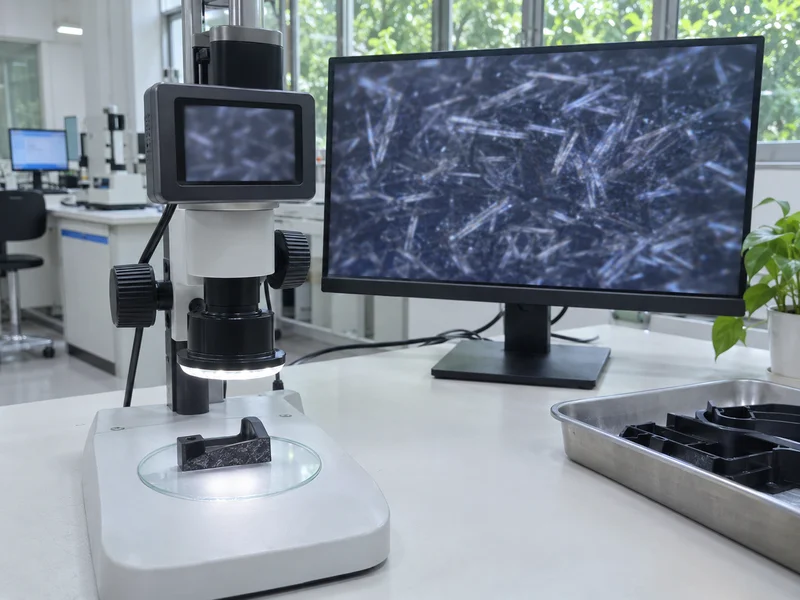
Effects:
- Strength: highest along the flow; lower across it.
- Shrinkage: low along the flow, higher across it.
- Warpage: uneven orientation causes uneven shrinkage.
- Weld lines: fibers do not cross the weld, so weld lines are weak.
For example, a bracket gated at one end has fibers running along its length, so it shrinks less in length than in width. If one side fills differently, it twists. Moldflow analysis can predict fiber orientation and warpage; our guide to mold flow analysis explains how.
Key Takeaway: Treat the gate location as a structural design decision in glass filled nylon.
How Do You Plan Fiber Orientation Across a Molded Part?
You plan fiber orientation across a molded part by choosing gate locations, flow paths and wall design that align fibers with the main loads and give even shrinkage.
Planning methods:
- Gate location: gate so flow runs along the main load path.
- Symmetry: balanced flow for symmetrical shrinkage.
- Weld lines: move them away from loaded areas or holes.
- Uniform walls: sudden thickness changes disturb orientation.
- Ribs: align ribs with flow where possible.
- Simulation: check orientation and warpage before cutting steel.
For example, moving a gate from the end of a long bracket to its center can reduce warpage significantly, because flow becomes symmetrical. Our guide to injection molding gate types helps select the gate.
Key Takeaway: Review gate location and weld lines with the toolmaker before the mold design is frozen.
How Does Moisture Change Glass Filled Nylon Dimensions?
Moisture changes glass filled nylon dimensions because nylon absorbs water from the air after molding, which makes it swell slightly and become less stiff.
Practical effects:
- Dimensional growth: often about 0.1–0.3% for glass-filled grades as they condition, less than for unfilled nylon.
- Stiffness loss: modulus drops noticeably when conditioned.
- Toughness gain: impact strength increases.
- Time: thin parts condition in days to weeks; thick parts take longer.
For example, a PA66-GF30 bracket measured fresh from the mold may grow slightly over the following weeks. If the drawing does not state the condition, measurements at different times will disagree. Our guide to plastic shrinkage explains post-mold changes.
Key Takeaway: Write “dry as molded” or “conditioned” next to critical dimensions on the drawing.
How Should Press Fits Be Toleranced in Glass Filled Nylon?
Press fits in glass filled nylon should be toleranced for both the dry and conditioned states, because interference changes as the part absorbs moisture.
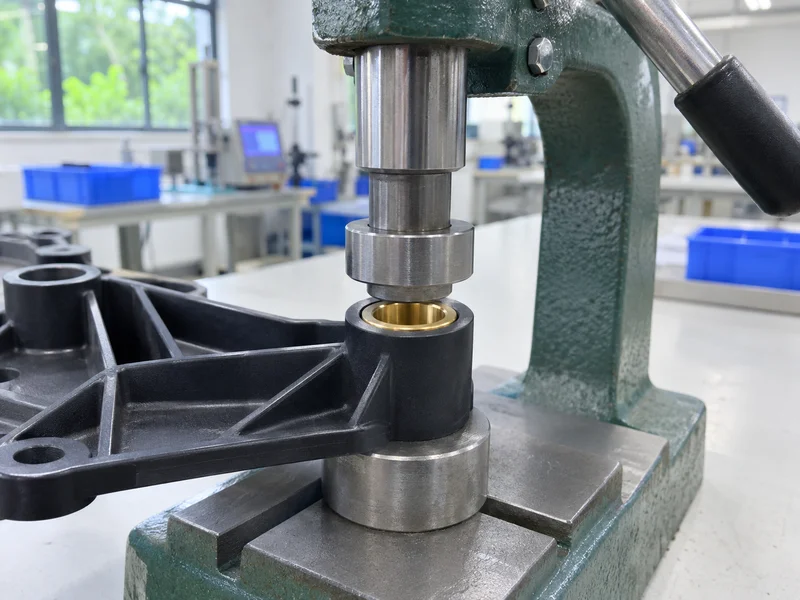
Guidelines:
- Check both states: dry gives maximum stiffness; conditioned gives growth and lower stiffness.
- Allow for creep: nylon relaxes under constant stress, reducing retention.
- Use features: ribs or crush ribs give more consistent press fits than plain bores.
- Test assemblies: measure push-in and push-out forces on conditioned samples.
For example, a metal bushing pressed into a dry PA66-GF30 boss may crack the boss if interference is high, while the same interference may feel loose after conditioning. Crush ribs reduce both risks. Our guide to injection molding tolerances covers how to set fits.
Key Takeaway: Validate press fits on conditioned parts. That is how they will be used.
How Do You Reduce Fiber Marks on the Surface?
You reduce fiber marks on the surface of glass filled nylon parts by improving the resin-rich skin layer through process, grade and tool choices.
Methods:
- Higher mold temperature: often about 80–100 °C for PA66-GF.
- Faster injection: keeps the skin forming against the hot steel.
- Surface-optimized grades: formulated for better appearance.
- Texture: a light texture hides fiber show.
- Lower glass content: where stiffness allows.
For example, a visible PA6-GF30 housing molded at 50 °C mold temperature may show a grey, fibrous surface, while at 90 °C it becomes much smoother. Our guide to injection molding surface finishes explains texture choices.
Key Takeaway: For visible glass filled nylon parts, agree mold temperature and texture early.
FAQ
- Q: What is glass filled nylon?
- Nylon reinforced with short glass fibers, typically 15–50%, for higher stiffness, strength and heat resistance.
- Q: Why does glass filled nylon warp?
- Fibers align with flow, so shrinkage differs along and across the flow; uneven flow causes warpage.
- Q: Does glass filled nylon absorb moisture?
- Yes, though less than unfilled nylon; it changes dimensions and stiffness.
- Q: Are weld lines weak in glass filled nylon?
- Yes. Fibers do not cross the weld line, so it can be much weaker than the surrounding material.
- Q: How do you reduce fiber marks?
- Use higher mold temperature, faster injection, surface grades or a light texture.
Conclusion
Glass filled nylon gives strong, stiff parts when fiber orientation, moisture and surface are planned. Choose gates for orientation, define dimensions with a moisture condition, validate fits on conditioned parts and manage appearance with process and texture. To review a glass filled nylon part, send your 3D model and 2D drawing to our engineers.