
Injection Mold Tooling Acceptance and Handover Checklist
Injection mold tooling is only finished when the mold makes approved parts on the press where it will run, and the buyer has everything needed to operate and maintain it. A mold that passed its trial at the toolmaker can still struggle on the receiving press if water circuits, hot runner settings, ejection or the process differ. Missing documents and spare parts then turn small problems into long stoppages.
Clear acceptance and handover rules prevent this. For example, a buyer who receives the mold with a process sheet, cooling map and spare ejector pins can sample it in a day. Without them, the same mold may take a week to set up. In this guide, we explain acceptance and handover for injection mold tooling: sampling on the receiving press, acceptance evidence, documentation handover and the spare parts bill of materials. For maintenance after handover, see our guide to mold maintenance.
Injection mold tooling acceptance on the receiving press confirms that the mold fits the press, all circuits and hot runner zones work, the process from the toolmaker’s trial can be reproduced, and parts meet the approved samples and drawing. Evidence includes a trial report, process sheet, dimensional report, cooling and hot runner maps and photos. The documentation handover should include final 2D/3D mold drawings, steel and hardness records, a spare parts bill of materials, a maintenance plan and packing records. Spare parts for wear items, such as ejector pins, springs, heaters and seals, should be agreed at quotation.
In short: accept the mold on your own press against agreed evidence, and receive the documents and spares to run it.
Key points:
- Receiving press: reproduce the approved process and parts.
- Documents: drawings, records and maps for every circuit.
- Spares: a bill of materials for wear parts.
What Does Injection Mold Tooling Acceptance Cover?
Injection mold tooling acceptance covers the mold itself, its performance on the press, and the parts it makes.
Acceptance areas:
- Mold build: dimensions, steel, finish, labeling and safety features
- Function: opening, ejection, slides, lifters, hot runner and cooling
- Process: a stable process within an agreed window
- Parts: dimensions, appearance and function against approved samples
- Documents and spares: complete and correct
For example, a mold may make good parts but have an unlabeled hot runner connector. That is an open acceptance item, because it will cause errors at every setup. Every export mold we ship is trialed and inspected before packing, and our standard mold quote includes up to 3 trials and 10-shot samples.
Key Takeaway: Write the acceptance checklist before the mold is built, so both sides work to it.
How Do You Sample Injection Mold Tooling on the Receiving Press?
You sample injection mold tooling on the receiving press by reproducing the toolmaker’s approved process, then confirming parts match the approved samples.
Steps:
- Check press fit: tie-bar space, mold height, locating ring, ejector pattern, clamping.
- Connect cooling using the port map and check flow per circuit.
- Connect the hot runner using the zone map and check every zone.
- Dry the material to the same conditions as the trial.
- Set the process using the process sheet, converted for the new machine.
- Run and measure parts against the approved samples and drawing.
For example, a press with a larger screw may need a different shot size setting to give the same fill. Converting by volume, not by percentage, avoids short shots. Our guide to scientific molding explains why process data in plastic terms transfers better.
Key Takeaway: Bring the approved samples to the receiving press. Comparing side by side ends most arguments.
What Acceptance Evidence Should Be Recorded?
Acceptance evidence should be recorded so that the result is clear and can be repeated later.
Evidence list:
- Press and setup data: machine, screw size, settings used
- Cooling record: flow and temperature per circuit
- Hot runner record: set and actual temperatures per zone
- Part results: dimensional report on critical features, appearance check
- Cycle time achieved
- Open issues with owners and due dates
- Sign-off by both parties
For example, if the acceptance report records 28 seconds cycle time and a stable process window, later disputes about cycle time have a clear baseline. Our guide to first article inspection reports explains dimensional report formats, and geometric tolerances on the drawing follow standards from ISO.
Key Takeaway: Close acceptance with a signed report and an open-issues list. Verbal approval is easily forgotten.
What Documentation Should Be Handed Over With Injection Mold Tooling?
Documentation handed over with injection mold tooling should let the owner run, maintain and repair the mold without the toolmaker.
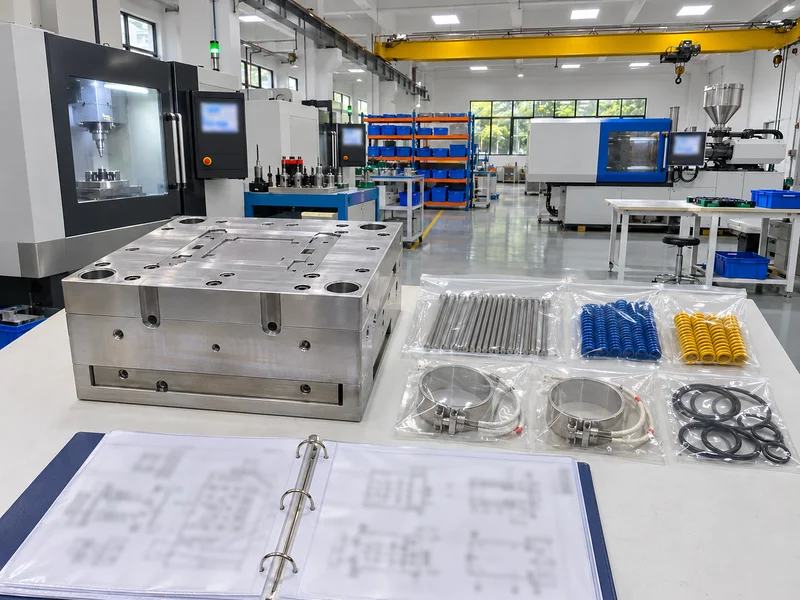
Typical handover package:
- Final mold drawings (2D assembly and key components) and 3D data as agreed
- Steel certificates and hardness map
- Cooling port map and hot runner zone map with wiring
- Process sheet from the approval trial
- Trial reports and dimensional reports
- Spare parts bill of materials
- Maintenance plan and lubrication points
- Packing list and photos
For example, a hardness map and component drawings let a local toolmaker make a replacement core without guessing. Our guide to injection mold steel material explains hardness maps.
Key Takeaway: Agree the documentation list in the purchase order. It is hard to collect after shipment.
What Should a Spare Parts Bill of Materials Include?
A spare parts bill of materials should include every wear or failure-prone part, with enough detail to order or make it.
Typical items:
- Ejector pins and sleeves, with sizes and standard part numbers
- Springs for ejector return and slides
- Hot runner heaters, thermocouples and tips
- O-rings and seals for cooling circuits
- Wear plates and gibs for slides
- Gate inserts and shutoff inserts for high-wear zones
Each line should list part number, standard (such as HASCO or DME), material, quantity in the mold and recommended spare quantity. Paid spare parts are available on request, and they cost less when ordered with the mold.
Key Takeaway: Order spares for parts that can stop production, especially heaters, pins and seals.
How Should Injection Mold Tooling Be Packed for Export?
Injection mold tooling should be packed so it arrives clean, dry and undamaged, ready for sampling.
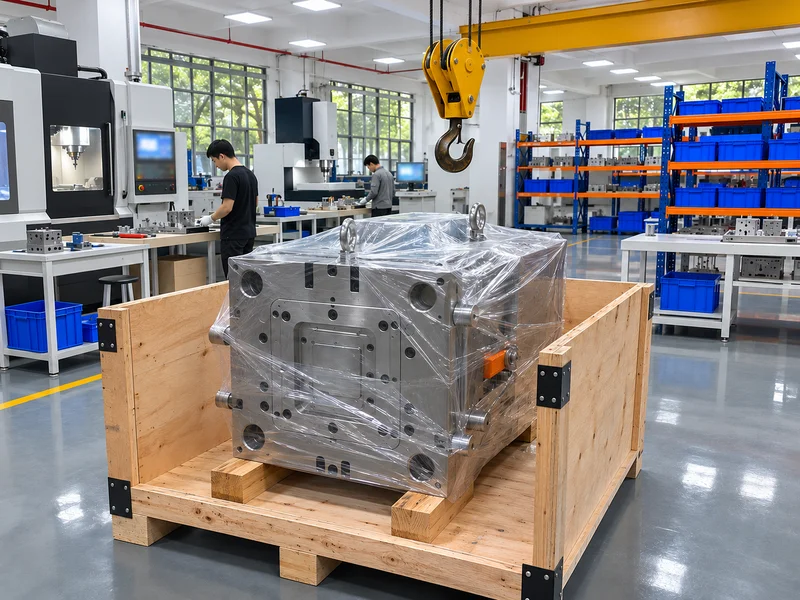
Packing practice:
- Anti-rust oil on all steel surfaces
- Cooling channels blown out and dried
- Vacuum packing against moisture
- Fumigated wooden case with secure fixing
- Safety strap holding mold halves closed
- Documents and spares packed with the mold
For example, water left in cooling channels can rust them during a long sea shipment, reducing flow at the first trial. Blowing out channels prevents it. Our export molds are packed with anti-rust oil, vacuum packing and fumigated wooden cases. Wooden cases are also treated to meet the ISPM 15 rules for export wood packaging.
Key Takeaway: Ask for packing photos before shipment. They help resolve any transport damage claims.
FAQ
- Q: What is injection mold tooling acceptance?
- Confirming that the mold works on the receiving press and makes parts that meet the approved samples and drawing.
- Q: What documents come with an injection mold?
- Typically drawings, steel and hardness records, cooling and hot runner maps, process sheet, trial reports and a spare parts list.
- Q: Why do molds behave differently on a new press?
- Differences in screw size, cooling connections, hot runner control and process conversion.
- Q: What spare parts should be ordered with a mold?
- Wear items such as ejector pins, springs, heaters, thermocouples, seals and high-wear inserts.
- Q: How should a mold be packed for export?
- With anti-rust oil, dried channels, vacuum packing and a fumigated wooden case.
Conclusion
Injection mold tooling is complete when it runs approved parts on your press and you have the documents and spares to keep it running. Agree acceptance evidence, documentation and spare parts at the order stage. To discuss a new mold project, send your 3D model and 2D drawing to our engineers.
Need support on your own project? Learn more about our injection mold manufacturing service or request a quote.