
304 Stainless Steel Versus 316 Stainless Steel: How to Pick the Best One and Save Money
304 stainless steel versus 316 stainless steel is the most common stainless choice for machined parts. Both are austenitic, non-magnetic when annealed, weldable and easy to finish. The key difference is molybdenum: 316 contains about 2–3%, which gives it much better resistance to chlorides, such as salt water, de-icing salts and many cleaning chemicals. 304 has no molybdenum and costs less.
Choosing 316 everywhere wastes money, but choosing 304 in the wrong place leads to pitting and rust stains. For example, a 304 bracket on a coastal installation may show rust spots within months, while 316 stays clean. Indoors, however, 304 performs very well for decades. In this guide, we compare 304 stainless steel versus 316 stainless steel for machined parts: chemistry, corrosion, strength, machining, finishing, cost and how to choose. For the low-carbon variants, see our guide to 316L SS vs 316 SS.
304 stainless steel versus 316 stainless steel: 304 contains about 18% chromium and 8% nickel; 316 contains about 16–18% chromium, 10–14% nickel and 2–3% molybdenum. The molybdenum gives 316 a pitting resistance equivalent number (PREN) of about 24–26 compared with about 18–20 for 304, so 316 resists chlorides, seawater and many chemicals much better. Mechanical properties and machinability are similar, with both typically around 205 MPa minimum yield when annealed. 316 usually costs noticeably more. Choose 304 for indoor and mild environments; 316 for marine, chloride, food processing and chemical exposure.
In short: 304 for general indoor use; 316 wherever chlorides or aggressive cleaning are present.
Key points:
- Molybdenum: 316 has 2–3%; 304 has none.
- Corrosion: 316 resists chlorides and pitting much better.
- Cost: 304 is cheaper and widely stocked.
What Is the Difference Between 304 Stainless Steel Versus 316 Stainless Steel?
The difference between 304 stainless steel versus 316 stainless steel is mainly the addition of molybdenum and slightly more nickel in 316.
| Property (typical, annealed) | 304 | 316 |
|---|---|---|
| Chromium | 18–20% | 16–18% |
| Nickel | 8–10.5% | 10–14% |
| Molybdenum | — | 2–3% |
| PREN (approx.) | 18–20 | 24–26 |
| Yield strength (min) | about 205 MPa | about 205 MPa |
| Tensile strength (min) | about 515 MPa | about 515 MPa |
| Density | about 7.9 g/cm³ | about 8.0 g/cm³ |
| Magnetic (annealed) | Essentially no | Essentially no |
Composition limits come from specifications such as those published by ASTM International.
Key Takeaway: The chemistry difference is small, but it changes chloride corrosion resistance a lot.
How Does Corrosion Resistance Compare in 304 Stainless Steel Versus 316 Stainless Steel?
Corrosion resistance in 304 stainless steel versus 316 stainless steel is similar in mild environments, but 316 is much better where chlorides are present.
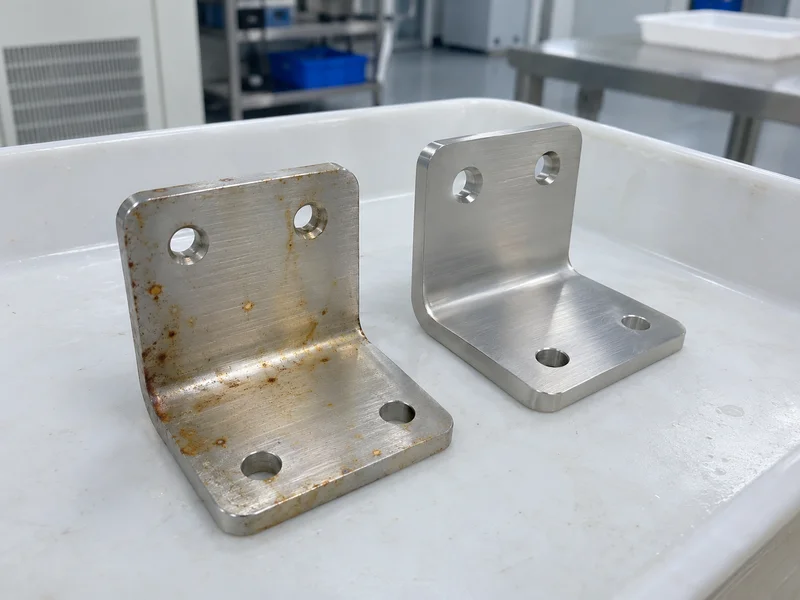
Environment guide:
- Indoor, dry: both perform well.
- Outdoor, inland: both usually fine; 304 may stain in polluted air.
- Coastal or marine: 316 strongly preferred.
- De-icing salts: 316 preferred.
- Food processing with chlorinated cleaners: 316 common.
- Swimming pool atmospheres: special grades often needed; neither is ideal.
For example, a 304 handrail near the sea often shows “tea staining”, light brown surface rust. The same rail in 316 stays bright longer. Surface finish matters too: smoother finishes resist staining better.
Key Takeaway: If salt or chlorides reach the part, choose 316.
How Do Strength and Machinability Compare for 304 Stainless Steel Versus 316 Stainless Steel?
Strength and machinability are very similar for 304 stainless steel versus 316 stainless steel.
Strength:
- Annealed: similar minimum yield and tensile strength.
- Cold-worked bar: both gain strength.
- Elevated temperature: 316 keeps strength slightly better.
Machinability:
- Both work harden, so tools must keep cutting without rubbing.
- Both produce stringy chips, needing chip control.
- 316 is slightly gummier for some operations.
- 303 is a free-machining alternative to 304 when corrosion needs are low.
For example, a part with many small tapped holes may be cheaper in 303, but 303 has lower corrosion resistance and is not suitable for welding. Our CNC turning and CNC milling services machine 303, 304 and 316.
Key Takeaway: Machining cost is similar for 304 and 316. Choose by corrosion needs.
How Do Finishing and Passivation Affect Performance?
Finishing and passivation affect performance because a clean, smooth surface resists corrosion better in both grades.
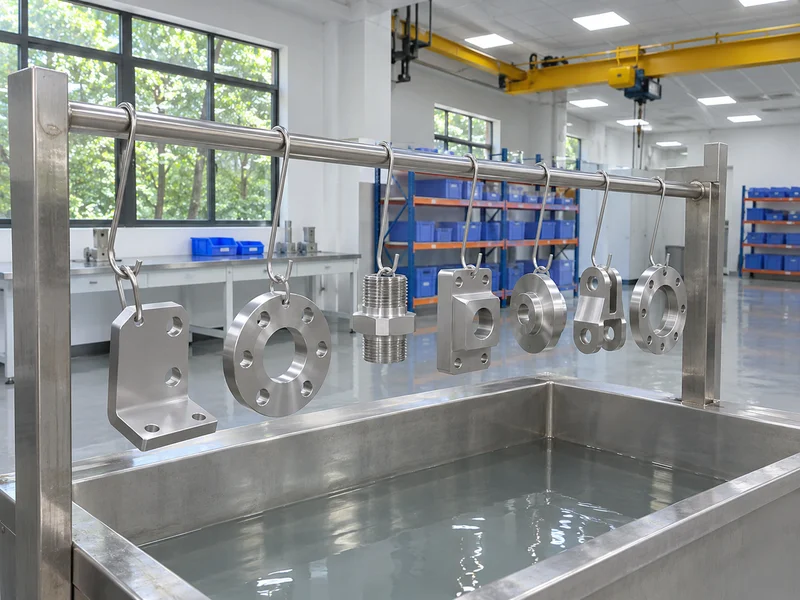
Finishing options:
- Passivation: removes free iron and strengthens the passive layer.
- Electropolishing: smooths the surface and improves cleanability.
- Bead blasting: gives a uniform matte look, but can trap contamination if not cleaned.
- Brushing or polishing: for appearance and cleanability.
For example, a machined 316 part with embedded iron particles from tooling can still show rust spots until it is passivated. Passivation and electropolishing are available through our qualified finishing suppliers.
Key Takeaway: Specify passivation for machined stainless parts in corrosive service. Machining can leave iron on the surface.
What Does 304 vs 316 Cost?
In 304 stainless steel versus 316 stainless steel pricing, 316 usually costs noticeably more, mainly because of its molybdenum and higher nickel content.
Cost factors:
- Raw material: 316 typically costs more per kilogram; the gap varies with nickel and molybdenum prices.
- Machining: similar for both.
- Availability: both widely stocked in bar, plate and tube.
- Finishing: same processes for both.
For example, for a small machined part, the material is often a small share of total cost, so upgrading to 316 adds little. For a large plate part, the material difference matters more. Our quality control and inspection process can supply mill certificates on request.
Key Takeaway: For small machined parts, 316 often costs little more. For large parts, choose carefully.
304 or 316 Stainless Steel for a Machined Part?
You choose 304 or 316 stainless steel for a machined part by the environment and cleaning chemicals it will meet.
- Indoor equipment, dry environment? 304.
- Outdoor inland, low pollution? 304 usually, 316 for long life.
- Coastal, marine or de-icing salt exposure? 316.
- Food, pharma or chemical contact with chlorides? 316.
- Many small threads, low corrosion need? Consider 303.
- Welded assembly in corrosive service? 316L.
For example, a machine guard bracket indoors is a 304 part, while a boat fitting is a 316 part. Our guide to titanium strength vs aluminum compares lighter corrosion-resistant options.
Key Takeaway: Choose 316 for chlorides and 304 for everything else.
FAQ
- Q: What is the main difference between 304 and 316 stainless steel?
- 316 contains 2–3% molybdenum, which improves resistance to chlorides and pitting.
- Q: Is 316 stronger than 304?
- Their room-temperature strength is similar; 316 is slightly better at elevated temperature.
- Q: Is 316 worth the extra cost?
- In marine, chloride or chemical environments, yes. Indoors, 304 is usually enough.
- Q: Are 304 and 316 magnetic?
- Both are essentially non-magnetic when annealed but can become slightly magnetic after cold work or machining.
- Q: Which is easier to machine, 304 or 316?
- They are similar; 316 is slightly gummier. 303 is easier but less corrosion resistant.
Conclusion
304 stainless steel versus 316 stainless steel comes down to chloride exposure. Choose 304 for indoor and mild environments, 316 for marine, chloride and chemical service, and passivate machined parts. To review material for your part, send your 3D model and 2D drawing to our engineers.