
Splay in Injection Molding: How to Diagnose the Cause
Splay in injection molding appears as silver or white streaks on the part surface, usually pointing in the direction of flow from the gate. It is one of the most common cosmetic defects. The usual cause is moisture in the resin, but similar marks also come from shear heating, degraded material, trapped air or contamination, and each cause needs a different fix.
Treating every streak as a drying problem wastes time. For example, a PC part may still show streaks after hours of drying, because the real cause is a gate that overheats the melt. Likewise, a part with silver marks only after a color change may be contaminated, not wet. In this guide, we explain how to recognize splay in injection molding, how to separate moisture splay from shear and contamination marks, and how to fix each cause. For general defects, see our guide to injection molding defects and troubleshooting.
Splay in injection molding is silver streaking caused by gas or volatiles at the flow front that are smeared onto the mold surface. Moisture splay is the most common form and appears across the part, often near the gate, in hygroscopic resins such as PC, PA, PBT and PET; it is fixed by proper drying and moisture checks. Shear splay appears near gates or restrictions at high injection speed. Degradation splay comes from overheating or long residence time. Contamination marks come from foreign resin or additives. Testing a dried sample, changing speed and checking residence time separates the causes.
In short: confirm the cause before fixing it. Moisture, shear, heat and contamination all create similar streaks.
Key points:
- Moisture splay: fix by drying and checking moisture content.
- Shear splay: fix gates and injection speed.
- Contamination: fix purging and material handling.
What Does Splay in Injection Molding Look Like?
Splay in injection molding looks like silvery, white or dull streaks on the surface, often in a fan shape spreading from the gate in the flow direction.
Typical features:
- Streaks aligned with flow
- Silver or white color, most visible on dark or glossy parts
- Rough or dull texture at the streaks
- Bubbles beneath the surface in severe cases
For example, a black glossy PC cover with silver streaks near the gate is a classic case. However, the same appearance can have different causes, so location and pattern matter. Our guide to plastic resin drying explains the most common fix.
Key Takeaway: Record where the streaks start and how they spread. The pattern points to the cause.
How Do You Identify Moisture Splay?
You identify moisture splay by its pattern and by testing the resin’s moisture content.
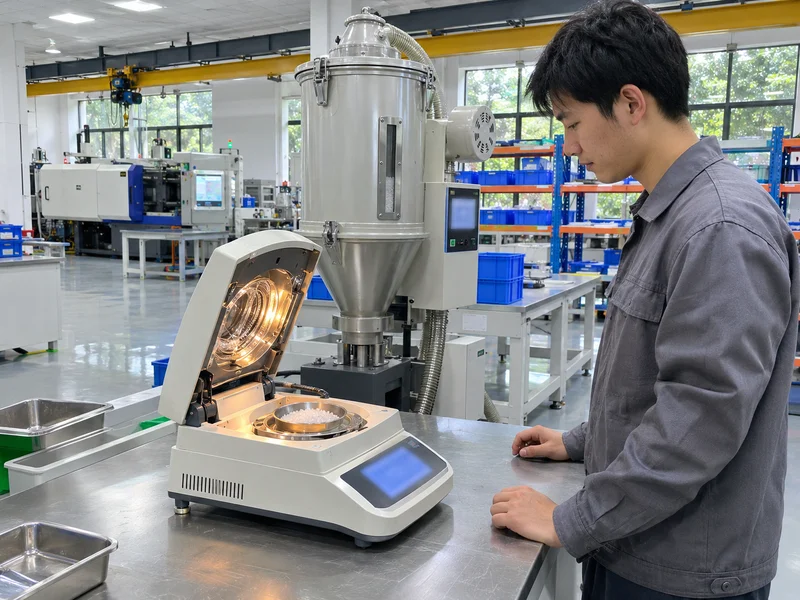
Signs of moisture splay:
- Hygroscopic resin, such as PC, PA, PBT, PET or ABS
- Streaks across much of the part, not only at one spot
- Worse after a dryer problem or material change
- Bubbles or foaming in a purge shot
- Improves when properly dried material is used
Checks:
- Moisture analyzer reading against the supplier’s limit
- Dryer settings: temperature, time and dew point
- Hopper residence time and handling
For example, PC usually needs drying to about 0.02% moisture. If a moisture test shows 0.08%, the streaks are almost certainly moisture splay. Resin suppliers publish drying requirements, and material test methods are described by bodies such as ASTM International.
Key Takeaway: Measure moisture before changing the process. It confirms or rules out the most common cause.
How Do You Separate Shear Splay From Moisture Splay?
You separate shear splay from moisture splay by changing injection speed and checking where the streaks appear.
Signs of shear splay:
- Streaks start at the gate or at a sharp restriction
- Resin is properly dried, confirmed by measurement
- Streaks reduce at lower injection speed
- Small gates or sharp corners in the flow path
Fixes:
- Reduce injection speed at the gate, using a speed profile
- Enlarge or radius the gate
- Smooth runner and gate transitions
- Lower melt temperature slightly if shear heating is high
For example, a small pin gate on a thick PC part may show streaks only in the first few millimeters after the gate. Profiling the speed slower at the start often removes them. Our guide to injection molding gate types explains gate sizing.
Key Takeaway: If streaks change with injection speed, suspect shear before moisture.
How Do You Recognize Degradation and Contamination Marks?
You recognize degradation and contamination marks by their link to temperature, residence time or material changes.
Degradation signs:
- Brown or yellow tint with the streaks
- Worse after machine stops or with a large barrel for a small shot
- Black specks appearing too
Contamination signs:
- Streaks after a color or material change
- Random location, not linked to the gate
- Different gloss or color in the streak
- Foreign particles visible under magnification
For example, silver streaks that appear after switching from ABS to PC may come from ABS left in the barrel. Purging thoroughly fixes it. Our guide to decoupled molding explains how shot size and residence time interact.
Key Takeaway: Check residence time and the last material change when streaks appear suddenly.
What Is a Fast Way to Diagnose Splay in Injection Molding?
A fast way to diagnose splay in injection molding is a short sequence of tests, each ruling out one cause.
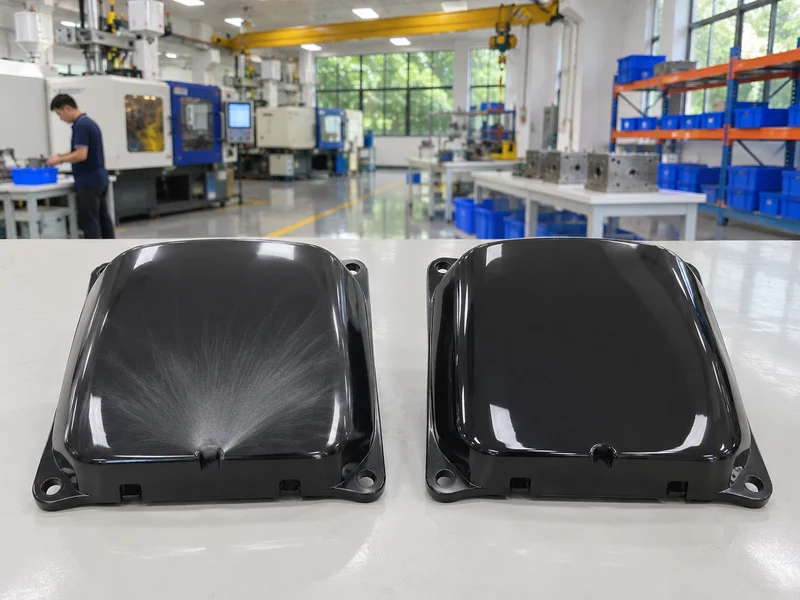
Diagnostic sequence:
- Measure moisture of the resin at the hopper.
- Mold with freshly dried material from a known good dryer.
- Reduce injection speed by about 20–30% at the start of fill.
- Lower melt temperature by about 10 °C and check residence time.
- Purge thoroughly and check for contamination.
- Check venting and mold surface for condensation or oil.
For example, if streaks disappear in step 2, moisture was the cause. If they remain until step 3, shear is the cause. Recording results makes the fix permanent. Our quality control and inspection process records process changes during trials.
Key Takeaway: Change one variable at a time. Several changes together hide the real cause.
How Do You Prevent Splay in Production?
You prevent splay in production by controlling drying, process windows, purging and mold condition.
Prevention steps:
- Dryer control: log temperature, time and dew point.
- Moisture checks at defined intervals for sensitive resins.
- Hopper management: avoid overfilling with dried resin that sits too long.
- Process window: injection speed and melt temperature within validated limits.
- Purging procedure for material and color changes.
- Mold care: avoid condensation by keeping the mold above the dew point.
For example, a cold mold in a humid workshop can collect condensation, causing streaks that look like splay. Raising mold temperature above the dew point stops it. Our guide to control plan shows how to put these checks into a plan.
Key Takeaway: Put drying and purging checks in the control plan. Most splay returns when those slip.
FAQ
- Q: What causes splay in injection molding?
- Most often moisture in the resin, but also shear heating, degradation, contamination or condensation.
- Q: How do you fix moisture splay?
- Dry the resin to the supplier’s limit and confirm with a moisture measurement.
- Q: What is the difference between splay and silver streaks?
- They are the same defect; “silver streaks” describes how splay looks.
- Q: Can injection speed cause splay?
- Yes. High speed through small gates can overheat the melt and cause shear splay.
- Q: Which plastics are most prone to splay?
- Hygroscopic resins such as PC, PA, PBT, PET and ABS.
Conclusion
Splay in injection molding has several causes that look alike. Measure moisture first, then test speed, temperature and contamination one at a time, and lock the fix into drying and purging controls. To review a cosmetic defect on your part, send your 3D model and 2D drawing to our engineers.