
UL 94 Ratings Explained: V-0, V-1, V-2, 5VA and 5VB
UL 94 is the UL standard for flammability of plastic materials used in parts of devices and appliances. It ranks how a small plastic test specimen burns after a flame is applied, from HB (slow horizontal burning) to V-2, V-1 and V-0 (vertical burning that stops quickly) and 5VB and 5VA (resistance to a larger flame). The rating always belongs to a specific material grade, color and thickness, which is why datasheets list it as, for example, “V-0 at 1.5 mm”.
In practice, designers use these ratings to choose plastics for housings, connectors, terminal blocks and insulators. For example, a terminal block in a distribution board is often required to be V-0, while an internal clip far from live parts may only need HB. In this guide, we explain what the ratings mean, how the tests work, V-0 vs V-1 vs V-2, the 5V ratings, how thickness and color affect results, and how to call out the rating on a drawing. For material options, see our guide to flame retardant plastics.
UL 94 includes a horizontal burning test (HB), a 20 mm vertical burning test (V-0, V-1, V-2) using a 50 W flame applied twice for 10 seconds, and a 500 W, 125 mm flame test (5VA, 5VB). V-0 requires each afterflame to stop within 10 seconds, a total of 50 seconds or less for five specimens, and no flaming drips that ignite cotton below. V-1 allows 30 seconds per flame and 250 seconds total, still without igniting drips. V-2 has the same limits as V-1 but allows burning drips. Ratings are tied to minimum thickness and are recorded by UL for each listed material. The equivalent IEC test is IEC 60695-11-10.
In short: V-0 stops fastest without burning drips, and the rating only applies at the listed thickness.
Key points:
- Scale: HB, V-2, V-1, V-0, 5VB, 5VA.
- Tied to: grade, color, thickness.
- Equivalent: IEC 60695-11-10 / -20.
What Do the UL 94 Ratings Mean?
First, the ratings describe how quickly a specimen stops burning and whether it drips.
| Rating | Test | Meaning |
|---|---|---|
| HB | Horizontal | Burns slowly; low burning rate |
| V-2 | Vertical, 20 mm flame | Stops burning; burning drips allowed |
| V-1 | Vertical, 20 mm flame | Out within 30 s, no igniting drips |
| V-0 | Vertical, 20 mm flame | Self-extinguishes within 10 s; no igniting drips |
| 5VB | Vertical, 125 mm flame | Bars pass; plaque may burn through |
| 5VA | Vertical, 125 mm flame | No burn-through of plaque |
For example, many electrical enclosures specify 5VA for outer walls and V-0 for internal parts. UL publishes the standard and material listings at UL Solutions.
Key Takeaway: Above all, V-0 is not the top of the UL 94 scale; 5VA covers larger flames.
How Is the Vertical Burning Test Done?
The vertical test is done by flaming a vertical bar twice and timing how long it burns.
- Specimen: 125 × 13 mm bar at the stated thickness
- Conditioning: 48 h at 23 °C / 50% RH, and 7 days at 70 °C for one set
- Flame: 20 mm blue flame, applied for 10 s
- First afterflame: timed after removal
- Second flame: applied again for 10 s
- Second afterflame and afterglow: timed
- Drips: checked for igniting cotton 300 mm below
For example, a set of five V-0 bars might burn 2–4 seconds each time and never ignite the cotton. Our guide to glass filled nylon explains how fillers change burning.
Key Takeaway: In other words, the test checks both burning time and drips.
What Is the Difference Between UL 94 V-0, V-1 and V-2?
Specifically, the difference between V-0, V-1 and V-2 is in burning time and dripping.
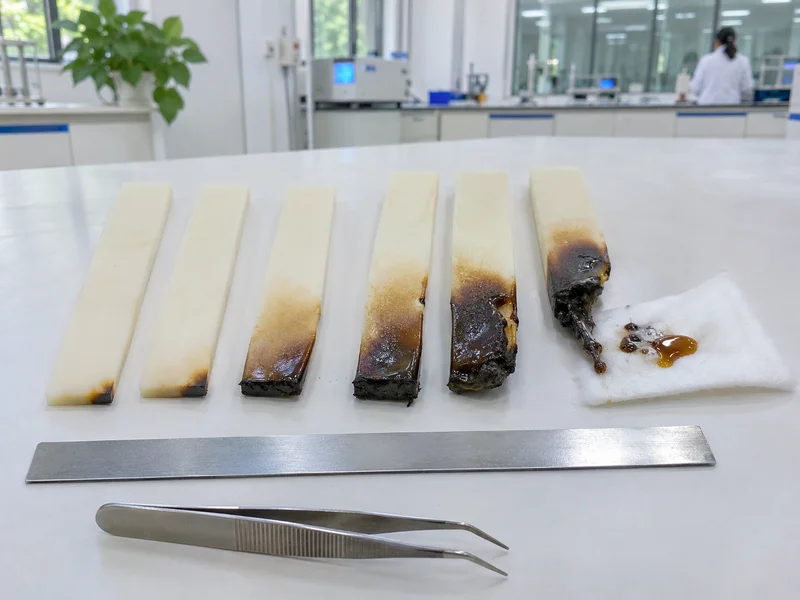
| Criterion | V-0 | V-1 | V-2 |
|---|---|---|---|
| Each afterflame | ≤ 10 s | ≤ 30 s | ≤ 30 s |
| Total afterflame (5 bars) | ≤ 50 s | ≤ 250 s | ≤ 250 s |
| Afterflame + afterglow after 2nd flame | ≤ 30 s | ≤ 60 s | ≤ 60 s |
| Burning drips ignite cotton | No | No | Allowed |
| Burn to clamp | No | No | No |
For example, a PP grade may reach V-2 easily because burning drips are allowed, but needs much more flame retardant to reach V-0. Our guide to heat deflection temperature covers another key datasheet value.
Key Takeaway: For this reason, V-2 materials are not suitable where drips could ignite things below.
What Are the 5VA and 5VB Ratings?
By contrast, the 5VA and 5VB ratings test resistance to a larger 125 mm flame, applied five times.
- Flame: about 500 W, 125 mm, five 5-second applications
- Bars: must stop burning within 60 s, no igniting drips
- Plaques: flat plates also tested
- 5VB: plaque may develop a hole
- 5VA: no hole allowed
For example, an outer enclosure that must contain a fire inside the product may require 5VA at its wall thickness. Our guide to custom plastic enclosures explains enclosure material choice.
Key Takeaway: Overall, 5V ratings matter for enclosures that must contain fire.
How Do Thickness and Color Affect the Rating?
Similarly, thickness and color matter because the rating is recorded only for the tested conditions.
- Thickness: thinner walls burn more easily; a V-0 at 3 mm may be V-2 at 0.8 mm
- Color: pigments can change burning; listings may be for “all colors” or specific ones
- Filler and grade: each grade has its own listing
- Regrind: too much regrind can change behavior
- Part design: thin ribs may be thinner than the rated thickness
For example, a part with a 1.0 mm wall should use a grade rated V-0 at 1.0 mm or thinner, not one rated V-0 only at 1.5 mm. Our guide to PBT injection molding shows typical rated thicknesses.
Key Takeaway: Equally, match the listed thickness to the thinnest wall of the part.
Which Materials Reach V-0?
In addition, many materials reach V-0 in flame-retardant grades.
| Material | Typical rating |
|---|---|
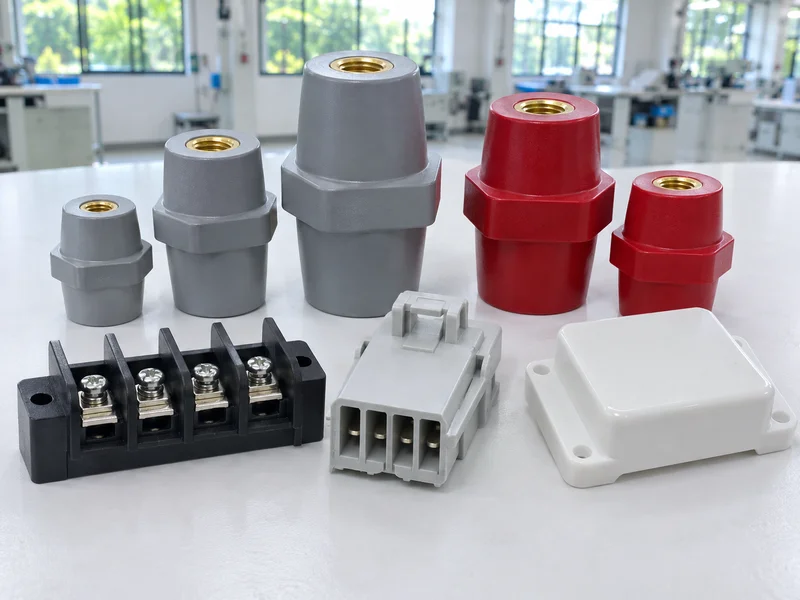
| BMC / DMC (FR grades) | V-0, often 5VA at thickness |
| PA66 GF FR | V-0 |
| PBT GF FR | V-0 |
| PC / PC-ABS FR | V-0 |
| PPS | V-0 inherently |
| LCP | V-0 inherently |
| ABS (standard) | HB |
For example, BMC busbar supports are usually made in flame-retardant grades that combine V-0 with high tracking resistance.
Key Takeaway: As a rule, check the yellow card listing of the exact grade, not the polymer family.
How Should UL 94 Be Called Out on a Drawing?
Therefore, the rating should be called out on a drawing with the rating, thickness and material grade.
- Rating: for example V-0
- Thickness: at or below the thinnest wall
- Grade: supplier and grade name
- Color: if the listing depends on color
- Evidence: supplier listing or material certificate
- Other fire tests: glow wire if required by the product standard
For example, “Material: PBT GF30 FR, UL 94 V-0 at 0.8 mm, color black, supplier listing required” is a clear callout. Our plastic injection molding page explains how grades are confirmed before production.
Key Takeaway: Finally, the rating comes from the material listing, not from the molder.
FAQ
- Q: What is UL 94?
- A UL standard that rates the flammability of plastic materials.
- Q: What does UL 94 V-0 mean?
- The specimen stops burning within 10 seconds with no burning drips.
- Q: In UL 94, which is better, V-0 or V-2?
- V-0; V-2 allows longer burning and burning drips.
- Q: Is 5VA better than V-0?
- It is a tougher test with a larger flame, often used for enclosures.
- Q: Does UL 94 depend on thickness?
- Yes. Each rating applies at a stated minimum thickness.
Conclusion
UL 94 ratings tell you how a plastic grade behaves in a small flame at a given thickness and color. Therefore, match the listing to the thinnest wall of your part. To review material choice for a flame-rated molded part, send your 3D model and 2D drawing to our engineers.