
How to Estimate Injection Molding Cost?
Injection molding cost is an estimate of a defined production plan, not a standard price attached to a CAD file. The same component can produce different quotations when suppliers assume different resins, cavity counts, trial requirements, inspection records or delivery responsibilities.
This guide explains how to build and challenge an estimate. For reading a supplier's line items, use the quote-comparison guide. For changes to the part or mold concept, use the design-to-cost guide.
1. Define what the estimate must answer
A development budget, a tooling purchase decision and a repeat-order price answer different questions. Record the decision before collecting numbers. Otherwise, a low production price may be compared with a proposal that also includes tool development and validation.
| Decision | Cost boundary | Output to request |
|---|---|---|
| Approve development | Engineering, tooling, trials and initial acceptance work | Project budget with assumptions and exclusions |
| Select a production route | Tooling plus accepted-part production over a stated quantity | Comparable scenarios using the same requirements |
| Place a repeat order | Released material, setup, conversion, inspection, packing and delivery | Price for the actual release quantity and scope |
| Review a design change | Revised tooling, process, inspection and approval work | Change quotation against a controlled revision |
Define whether the comparison ends at the supplier's factory or at the receiving location. Transport, duties, taxes and local handling should be included only where the agreed quotation basis includes them. A delivery term does not make every destination expense disappear.
2. Establish a common technical baseline
Start with the controlled model and drawing, revision, units, intended resin grade, appearance zones, critical dimensions, forecast and release quantity. Identify the receiving press when the mold will run at another plant. Record missing information as an assumption requiring confirmation.
Use the exact resin grade where it is approved. A family name such as PC or PP does not define additives, reinforcement, processing behavior, density or application requirements. Likewise, a general tolerance statement does not identify which dimensions require additional tooling or measurement effort.
The molding RFQ checklist explains the files and requirements to send. An early estimate can still be useful with incomplete inputs, provided its uncertainty is visible and it is not presented as a firm quotation.
3. Separate one-time and recurring costs
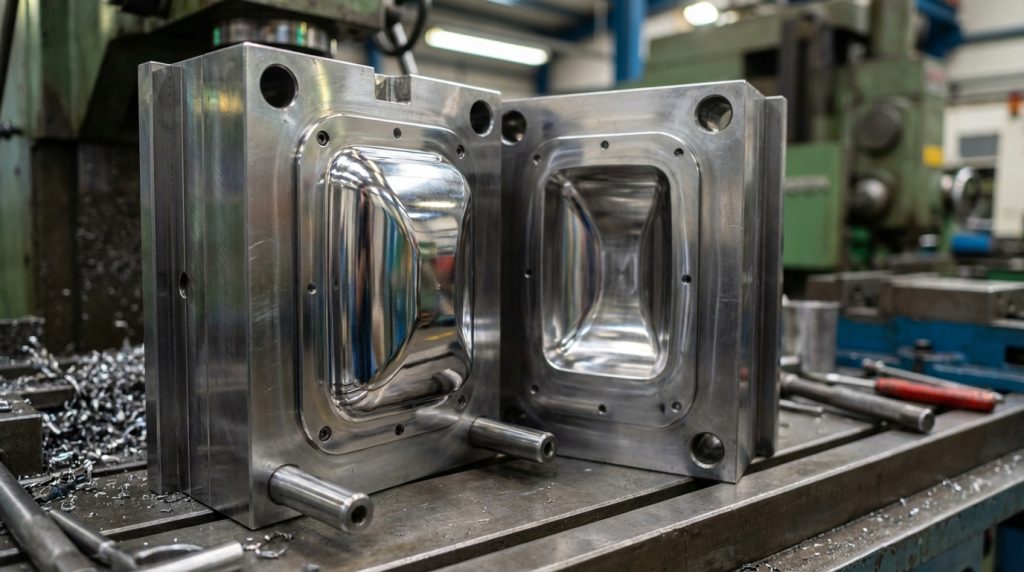
One-time costs can include project engineering, the mold, specified components, initial trials and the agreed acceptance package. Recurring costs can include resin, molding conversion, setup, secondary operations, inspection, packaging and delivery. A supplier may bundle several items, so ask what each price includes before adding them again.
For a stated program quantity, a planning model is:
Relevant program cost = agreed one-time costs + release/setup costs + accepted-part production costs + separately scoped delivery and other costs.
Allocated cost per accepted part = relevant program cost ÷ accepted quantity used in the comparison.
These equations define an allocation, not a promise that a tool will last for the chosen quantity. Maintenance, replacement tooling, design changes and additional approvals require their own assumptions. Do not divide by an ambitious lifetime volume merely to make the tooling share look small.
For repeat purchasing, keep the production unit price separate from the allocated development cost. This allows procurement to see both the order price and the broader program economics.
4. Connect part production to the mold and machine
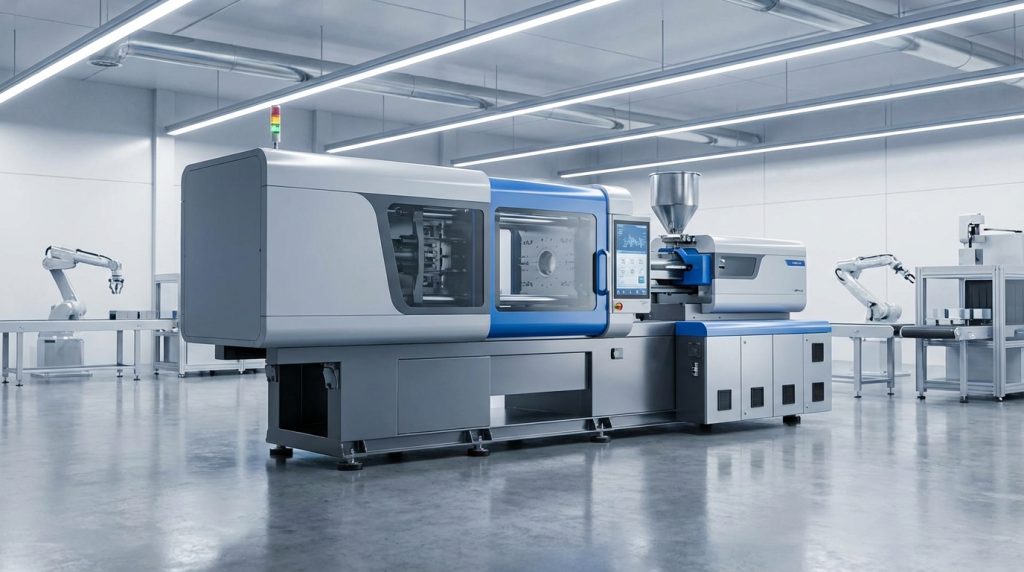
Part mass, runner material, cycle time, usable cavities and production yield affect the estimate together. Increasing cavity count can raise output per cycle, but it may also change mold size, press requirements, feed control, cooling, inspection and maintenance.
For identical parts, a simple machine-time allocation is:
Machine-time cost per accepted part = hourly machine rate × cycle seconds ÷ 3,600 ÷ accepted parts per cycle.
The factor 3,600 converts seconds to hours. Accepted parts per cycle must reflect the cavities actually operating and the accepted output, not just the nominal cavity count. Check whether the hourly rate already includes labor or overhead before adding those items separately.
A family mold needs component-specific planning. Different components may have different demand, cycle constraints and acceptance rates. Its output cannot always be treated as interchangeable identical parts. The multi-cavity versus family mold comparison explains the tooling distinction.
5. Make uncertainty visible instead of inventing precision
Use a base case and alternative scenarios for unresolved inputs. Change an assumption for a reason, record the resulting estimate, and identify the evidence needed to replace it. Avoid universal percentage uplifts for complexity or automatic savings attributed to DFM.
| Uncertain input | Why it matters | Evidence that improves the estimate |
|---|---|---|
| Resin grade and additives | Material price, mass, processing and wear assumptions | Approved grade and supplier information |
| Cooling and cycle | Machine time and available output | Reviewed cooling concept and documented trials |
| Cavity plan | Tool investment, press fit and output | Layout, machine-interface review and cavity-specific checks |
| Acceptance scope | Inspection, sampling and documentation work | Controlled drawing and agreed quality plan |
| Release pattern | Setup, material purchasing and inventory exposure | Forecast plus realistic order quantities |
An initial cycle estimate should be identified as an estimate. Trial results may change it. Similarly, an assumed scrap allowance is a model input, not a statement of WOKE Molds's demonstrated performance.
6. Review the complete scope with the supplier
Ask the supplier to explain the assumptions behind the largest cost drivers. Check tool construction, component standards, engineering responsibilities, trial material, correction scope, acceptance records, requested spares and delivery terms. Requested spares should be identified and priced for the project.
Xometry's technical cost overview also describes how tooling, material, cycle, cavitation and other services affect pricing. Published supplier examples help explain a method; they are not WOKE Molds prices or guarantees.
WOKE Molds designs and builds molds in our own factory in Dongguan. Formal DFM normally follows project kickoff, with further analysis and validation defined by the agreed scope. Contact the team with the part files, quantity basis and open assumptions to discuss the next quotation inputs.
Frequently asked questions
Can I obtain an estimate before the design is final?
Yes. Identify the revision and unresolved features, then request an assumption-based budget. Requote material changes, critical geometry, acceptance requirements and other changes that affect the production plan before committing to manufacture.
Does a higher annual volume automatically justify more cavities?
No. Compare demand with usable press capacity, cycle, handling, mold complexity and maintenance. A larger tool that is poorly utilized can add investment without solving the actual production constraint.
Should tooling cost be included in the part price?
It can be shown separately or allocated for a clearly stated planning comparison. Keep ownership, payment terms and the quantity used for allocation explicit so the same tooling cost is not counted twice.
Why do estimates change after mold trials?
Trials provide evidence about filling, cooling, ejection, dimensional results and process stability. When those findings change an assumed cycle, operation or inspection requirement, the cost model may also need updating.
Is the lowest estimated cost always the best purchase?
No. Compare the same deliverable and acceptance basis. A price that excludes necessary tooling provisions, validation or receiving-site responsibilities may not represent the lowest cost of obtaining accepted parts.
Need support on your own project? Learn more about our plastic injection molding service or request a quote.