
Plastic CNC Prototype: How to Get the Best Parts Fast
A plastic CNC prototype is a test part machined from a solid block or rod of engineering plastic, instead of being 3D printed or molded. It uses real production-grade material, holds tighter tolerances than most printed parts and needs no tooling. As a result, it suits functional tests, fit checks and small batches before a mold is built.
The catch is that a machined part is not a molded part. For example, a machined POM gear can pass a wear test, while the molded version later shows sink and shrinkage that the prototype never revealed. In this guide, we explain when a plastic CNC prototype is the right choice, which plastics machine well, what tolerances are realistic and how to source one. For metal and plastic machining options, see our CNC machining services.
A plastic CNC prototype is machined from solid engineering plastic stock, such as POM, nylon, PEEK, ABS, PC or acrylic, using CNC milling or turning. It offers real material properties, good accuracy and smooth surfaces without tooling cost, and suits functional testing and low quantities. However, machined parts do not show molding effects such as shrinkage, sink, weld lines or fiber orientation, so they cannot fully validate a design for injection molding.
In short: machine the prototype to test function and fit; use prototype tooling to test moldability.
Key points:
- Real material: machined parts use solid engineering plastics, not printing resins.
- No tooling: cost is driven by machining time, not by a mold.
- Limits: machined parts do not show molding defects or molded-in stress.
What Is a Plastic CNC Prototype?
A plastic CNC prototype is a part cut from solid plastic stock on a CNC mill or lathe. The machine follows a CAM program generated from your 3D model, so the part matches the design closely.
Typical uses include:
- Functional tests of gears, bushings, seals and mechanisms
- Fit checks with mating parts and assemblies
- Bridge parts while a production mold is being built
- Low-volume parts where a mold is not justified
- Fixtures, jigs and test equipment components
Because the stock is extruded or cast engineering plastic, the material properties are close to those of the real resin. However, they are not identical to a molded part, which is covered later in this guide.
Key Takeaway: Use a plastic CNC prototype when the material must behave like the real thing.
When Should You Choose a Plastic CNC Prototype Over 3D Printing?
You should choose a plastic CNC prototype over 3D printing when material properties, accuracy or surface finish matter more than speed or geometric freedom.
| Factor | Plastic CNC prototype | 3D printing |
|---|---|---|
| Material | Solid engineering plastics | Printing resins and powders |
| Strength | Close to bulk material | Often lower, direction-dependent |
| Accuracy | Good, especially on machined features | Varies by process |
| Surface | Smooth, machined | Layer lines, depending on process |
| Internal features | Limited by tool access | Very flexible |
| Best quantity | About 1–50 parts | 1–10 parts for fast iteration |
For example, a sliding bushing in POM must have real friction and wear behavior, so it should be machined. A complex housing for an early design review can be printed overnight.
Key Takeaway: Print for shape and speed. Machine for function, wear, heat and accuracy.
Which Plastics Work Best for a Plastic CNC Prototype?
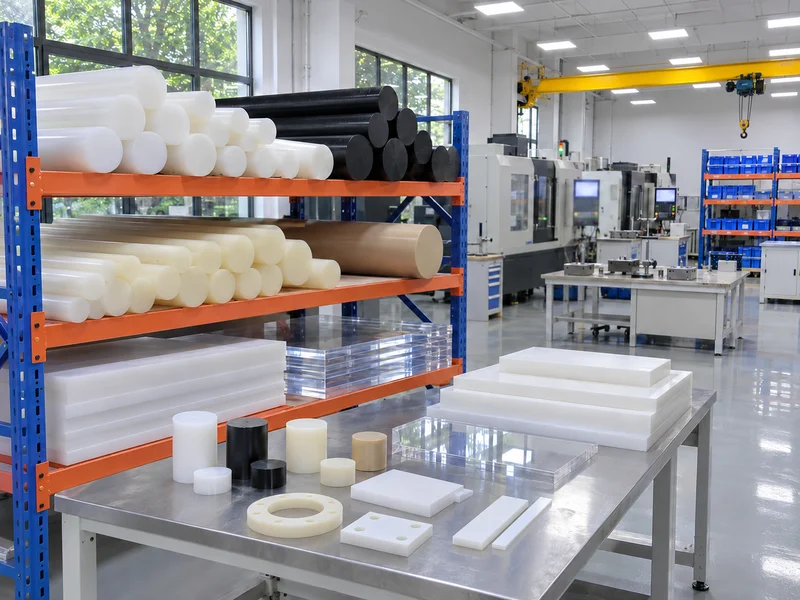
The plastics that work best for a plastic CNC prototype are stiff, stable and cut cleanly. Soft or gummy plastics machine poorly and lose accuracy.
| Plastic | Machinability | Typical prototype use |
|---|---|---|
| POM (acetal) | Excellent | Gears, bushings, precision parts |
| PEEK | Good, costly | High-temperature and chemical parts |
| Nylon (PA) | Good; moisture affects size | Wear parts, structural parts |
| ABS | Good | Housings, enclosures |
| PC | Good; can stress crack | Clear or tough housings |
| Acrylic (PMMA) | Good; brittle | Clear covers, light guides |
| PP and PE | Fair; soft and gummy | Chemical parts, low accuracy |
POM is often the easiest choice for precise mechanical prototypes. Our comparison of Delrin vs nylon explains the difference between the two most common choices.
Key Takeaway: If the production resin machines poorly, machine a similar grade and note the difference in the test plan.
What Tolerances Can a Plastic CNC Prototype Hold?
A plastic CNC prototype can hold general tolerances such as ISO 2768 class m without difficulty, and tighter tolerances on selected features. However, plastics move more than metals, so tolerances must allow for the material.
Plastic-specific factors:
- Thermal expansion: plastics expand several times more than aluminum with temperature.
- Moisture: nylon grows as it absorbs water, so dimensions change after machining.
- Stress relief: internal stress in stock can warp parts after material is removed.
- Clamping: soft plastics deform under clamping force and spring back.
- Heat from cutting: high heat can melt, smear or distort the surface.
As a result, tight tolerances on plastic parts are best measured at a stated temperature and condition. Machine capability is not the same as finished-part tolerance, which is controlled per drawing.
Key Takeaway: Tighten tolerances only on functional features, and state the measurement condition for nylon and other moisture-sensitive plastics.
How Is a Plastic CNC Prototype Machined Differently From Metal?
A plastic CNC prototype is machined with sharper tools, lighter clamping and more attention to heat than a metal part. Plastic does not carry heat away like aluminum, so heat stays at the cut.
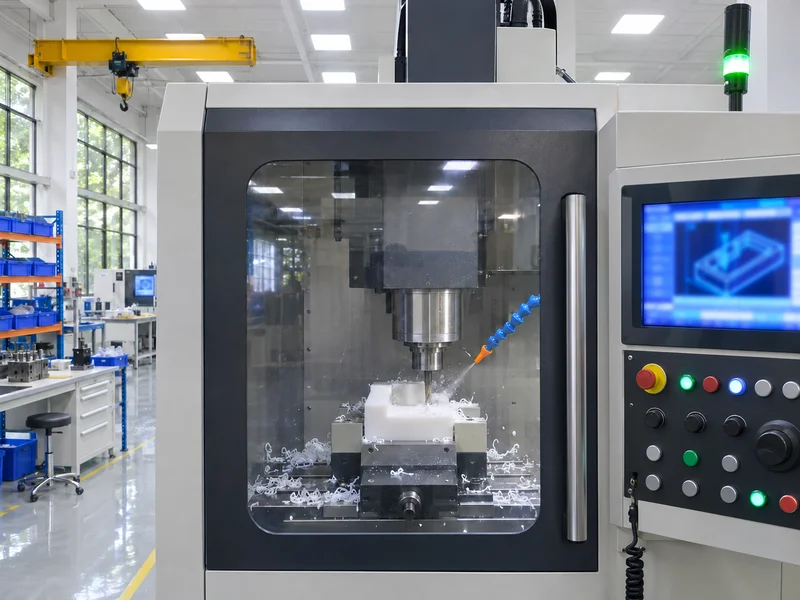
- Sharp tools with polished flutes reduce heat and burrs.
- Higher feeds and moderate speeds keep the chip moving and the part cool.
- Air or suitable coolant removes chips without attacking the plastic.
- Low clamping force with soft jaws prevents deformation.
- Roughing, rest and finishing let stress-relieved material settle before final cuts.
- Deburring removes fine plastic burrs from edges and holes.
Some plastics, such as PC, can stress crack with certain coolants. Therefore, the coolant must be compatible with the material. Our CNC milling and CNC turning pages describe the processes we use.
Key Takeaway: Ask how the supplier controls heat and clamping on plastic parts. Both affect accuracy more than machine precision.
What Can a Plastic CNC Prototype Not Tell You?
A plastic CNC prototype cannot tell you how the part will behave as a molded part. Molding creates effects that machining never produces.
Molding effects a machined prototype does not show:
- Shrinkage and warpage from cooling in the mold
- Sink marks at thick sections and bosses
- Weld lines where flow fronts meet
- Fiber orientation in glass-filled grades
- Molded-in stress and its effect on cracking
- Draft and ejection issues
For example, a machined nylon bracket can pass a load test, while the molded glass-filled version is weaker across a weld line. Therefore, when moldability matters, a prototype tooling or rapid tooling step is often worth it.
A practical approach is to build the test plan in two stages. First, a plastic CNC prototype proves fit, function and wear. Then, molded samples from the first mold trial prove shrinkage, appearance and strength at weld lines.
Key Takeaway: Use machined prototypes to prove function. Use molded samples to prove the production part.
How Much Does a Plastic CNC Prototype Cost?
A plastic CNC prototype costs mainly machining time, material and setup. There is no mold cost, so it is cost-effective for small quantities.
Main cost drivers:
- Machining time: deep pockets, thin walls and fine details take longer.
- Setups: each side or angle can need a new setup.
- Material: PEEK and other high-performance plastics cost far more than POM or ABS.
- Tolerances: tight tolerances need slower finishing and more inspection.
- Quantity: setup and programming are shared across more parts.
In general, simpler geometry and standard tool sizes reduce cost. Multi-axis machining can reduce setups on complex parts, as explained in our guide to 4 axis CNC.
Key Takeaway: Simplify non-functional features on the prototype. It saves time without changing what you are testing.
How Do You Source a Plastic CNC Prototype?
You source a plastic CNC prototype by sending complete technical data and stating what the prototype must prove. That lets the supplier choose the right material, method and inspection.
A complete request includes:
- 3D model (STEP preferred)
- 2D drawing with critical dimensions and tolerances
- Material, including the production resin and acceptable substitutes
- Quantity and required date
- Purpose, such as fit check, wear test or bridge production
- Inspection, such as a dimensional report on critical features
We machine engineering plastics such as PEEK, POM and nylon, as well as metals, from prototype to production. When the project continues to a mold, we can carry the same model into mold design and plastic injection molding.
Key Takeaway: Tell the supplier what the prototype must prove. The answer decides material, tolerance and cost.
FAQ
- Q: What is a plastic CNC prototype?
- It is a test part machined from solid engineering plastic stock using CNC milling or turning, without any tooling.
- Q: Is CNC machining better than 3D printing for plastic prototypes?
- For functional tests with real material properties and tight tolerances, yes. For fast shape checks and complex internal features, 3D printing is often better.
- Q: Which plastic is easiest to CNC machine?
- POM (acetal) is one of the easiest, because it is stiff, stable and cuts cleanly.
- Q: Can a machined prototype validate an injection molded part?
- Only partly. It shows function and fit, but not shrinkage, sink, weld lines or fiber orientation.
- Q: How many parts suit CNC prototyping?
- Typically from one to a few dozen parts, before mold tooling becomes more economical.
Conclusion
A plastic CNC prototype gives real material behavior and good accuracy without tooling, which makes it ideal for functional tests and small batches. Use it to prove function, then use molded samples to prove the production part. To get a prototype plan and quote, upload your 3D model and 2D drawing for our engineers to review.