
Chemical Conversion Coating vs Anodizing: How to Pick the Best One and Save Money
Chemical conversion coating vs anodizing is a common choice for machined aluminum parts. A chemical conversion coating (often called chem film, chromate or trivalent passivation) forms a very thin film that resists corrosion and stays electrically conductive. Anodizing grows a much thicker, harder oxide layer that resists wear and corrosion and can be dyed, but it is an electrical insulator and adds measurable thickness.
The right choice depends on what the surface must do. For example, an enclosure that must ground to a frame or seal against EMI usually needs a conductive conversion coating on its contact faces. A handle or cover that must resist scratches and look good usually needs anodizing. In this guide, we compare chemical conversion coating vs anodizing on aluminum: what each is, conductivity, corrosion, wear, thickness, appearance, cost and how to specify them, including masking. For aluminum grades, see our comparison of 6061 T6 aluminum vs 7075 T6.
Chemical conversion coating vs anodizing: a conversion coating (for example to MIL-DTL-5541 Type II, trivalent chromium) forms a film well under 1 µm thick that keeps aluminum electrically conductive, provides moderate corrosion resistance and a good paint base, but offers little wear resistance. Anodizing (for example MIL-A-8625 Type II, about 5–25 µm, or Type III hard anodize, about 25–75 µm) forms an insulating, hard oxide that greatly improves wear and corrosion resistance and can be dyed. Choose conversion coating for grounding, EMI and paint base; anodizing for wear, appearance and corrosion.
In short: conversion coating for conductivity and paint adhesion; anodizing for wear, color and stronger corrosion protection.
Key points:
- Conductivity: conversion coating conducts; anodizing insulates.
- Thickness: conversion coating is negligible; anodizing adds microns.
- Wear: anodizing, especially hard anodizing, is far better.
What Is the Difference Between Chemical Conversion Coating vs Anodizing?
The difference between chemical conversion coating vs anodizing is how the layer forms and how thick and hard it is.
| Feature (typical) | Chemical conversion coating | Anodizing (Type II) | Hard anodizing (Type III) |
|---|---|---|---|
| Process | Chemical dip, no current | Electrolytic oxidation | Electrolytic, colder, higher current |
| Thickness | well under 1 µm | about 5–25 µm | about 25–75 µm |
| Electrical | Conductive | Insulating | Insulating |
| Wear resistance | Low | Medium | High |
| Corrosion resistance | Moderate | Good | Good |
| Color | Clear or yellow/iridescent | Clear or dyed colors | Grey to dark, limited colors |
| Dimensional change | Negligible | Small, measurable | Significant |
Specifications such as MIL-DTL-5541 and MIL-A-8625 are widely used; general coating terms are also covered in standards from ISO.
Key Takeaway: The two finishes solve different problems. Start with what the surface must do.
When Should You Choose Chemical Conversion Coating?
You should choose chemical conversion coating when the part must stay electrically conductive, be painted, or keep tight dimensions.
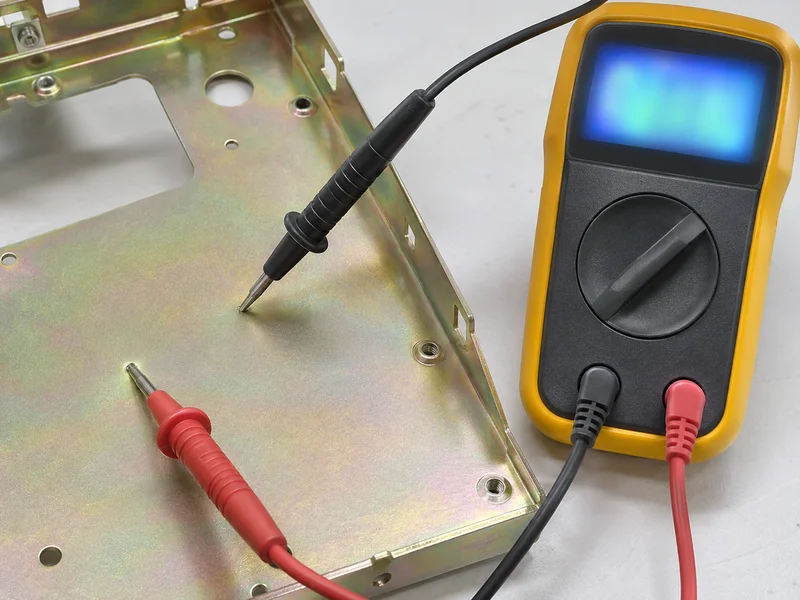
Typical uses:
- Electrical grounding surfaces and bonding points
- EMI shielding enclosures where panels must contact
- Base for paint or powder coat
- Precision parts where added thickness is not acceptable
- Internal parts with light corrosion exposure
For example, an electronics chassis may be chem-filmed overall, then painted on the outside, so internal contact faces stay conductive. Modern trivalent chromium conversion coatings are used to meet RoHS restrictions on hexavalent chromium, published on EUR-Lex.
Key Takeaway: Use conversion coating where conductivity or paint adhesion matters more than wear.
What Is Alodine and How Is It Specified?
Alodine is a widely used trade name for chromate and chromate-free conversion coatings on aluminum, so “alodine”, “chem film” and “chemical conversion coating” usually mean the same type of finish.
| Callout | Meaning | Typical use |
|---|---|---|
| MIL-DTL-5541 Type I | Hexavalent chromium chemistry | Legacy parts, restricted under RoHS and REACH |
| MIL-DTL-5541 Type II | Non-hexavalent (trivalent or chromate-free) | New designs, RoHS compliant |
| Class 1A | Maximum corrosion protection | Bare or painted parts |
| Class 3 | Low electrical resistance | Grounding and bonding surfaces |
| Typical thickness | about 0.25–1 µm | No practical dimensional change |
For example, a drawing note “alodine per MIL-DTL-5541, Type II, Class 3” asks for a chromate-free, low-resistance conversion coating for electrical bonding areas. The specification is published by the US Department of Defense through ASSIST Quick Search.
Key Takeaway: In other words, write the specification, type and class, not only the trade name.
When Should You Choose Anodizing?
You should choose anodizing when the part needs wear resistance, stronger corrosion protection, electrical insulation or a colored finish.
Typical uses:
- Cosmetic parts in black, blue, red or clear
- Handles, knobs and covers that are touched and scratched
- Outdoor parts needing better corrosion resistance
- Sliding or wearing surfaces (hard anodizing)
- Electrically insulating surfaces
For example, a black anodized 6061 cover looks uniform and resists fingerprints and scratches, while a hard-anodized guide rail resists wear from sliding parts. Anodizing and hard anodizing are part of our CNC machining services through our qualified finishing suppliers.
Key Takeaway: Use anodizing for appearance, wear and stronger protection.
How Do Chemical Conversion Coating vs Anodizing Affect Dimensions and Fits?
Each finish affects dimensions differently, which matters for fits, threads and precision bores.
- Conversion coating: negligible change; fits are unaffected.
- Type II anodizing: roughly half of the coating grows outward, half penetrates; a 10 µm coating adds about 5 µm per surface.
- Hard anodizing: about 50% growth outward; a 50 µm coating adds about 25 µm per surface, or 50 µm on a diameter.
- Threads: anodizing can tighten threads; mask or machine oversize.
For example, an H7 bore that will be hard anodized must be machined oversize to finish in tolerance after coating. Otherwise, the mating pin will not fit. Our guide to tolerance for slip fit explains fit tolerances.
Key Takeaway: State whether dimensions apply before or after anodizing. It avoids rejected fits.
How Do You Combine Both Finishes on One Part?
You combine both finishes on one part by masking areas for one finish while applying the other, or by sequencing the processes.
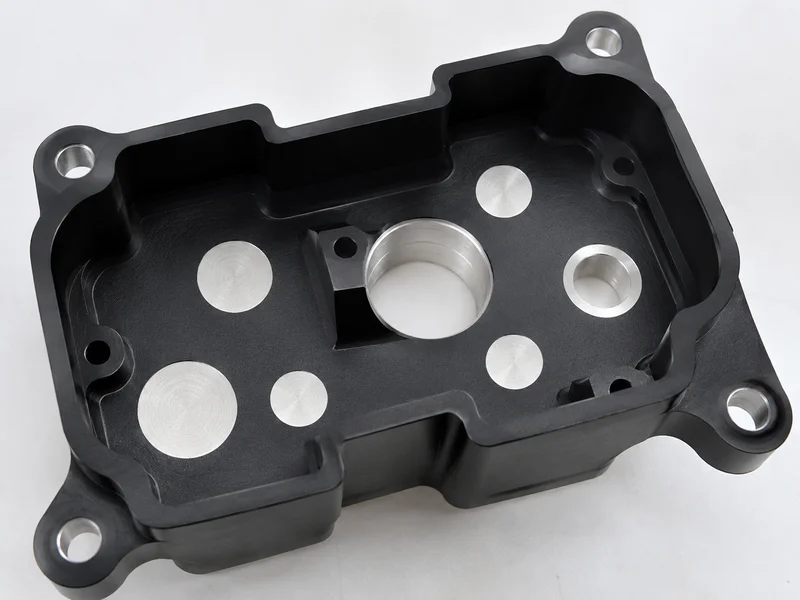
Common approaches:
- Anodize overall, mask contact pads, then chem-film the pads for conductivity
- Chem-film overall, then paint outer surfaces
- Mask threads and bores during anodizing
- Machine contact faces after anodizing, then apply conversion coating
For example, a black anodized enclosure with grounding points can have the grounding pads masked during anodizing, then conversion coated, so they stay conductive and protected. Masking areas must be shown on the drawing.
Key Takeaway: Show masked areas on the drawing with dimensions. Masking is a common source of errors.
How Do Cost and Lead Time Compare?
Cost and lead time usually favor chemical conversion coating, because it is a simpler, faster process.
- Conversion coating: low cost, short process.
- Type II anodizing: moderate cost; color matching may add time.
- Hard anodizing: higher cost, longer process.
- Masking: adds cost for both, depending on complexity.
For example, a batch of internal brackets may be conversion coated quickly at low cost, while a cosmetic cover with color matching and masking adds both time and cost. We do not publish fixed finishing prices; they are quoted with the part.
Key Takeaway: Use anodizing only where it adds value. Internal parts often need only conversion coating.
How Should You Specify Chemical Conversion Coating vs Anodizing?
You should specify chemical conversion coating vs anodizing with the standard, type, class, color, thickness and masking.
Specification items:
- Finish standard and type, such as “chem film per MIL-DTL-5541 Type II, Class 3” or “anodize per MIL-A-8625 Type II, Class 2, black”
- Thickness range for anodizing
- Masking areas with dimensions
- Dimension status: before or after finish
- Appearance standard for cosmetic parts
For example, “Hard anodize MIL-A-8625 Type III, 50 µm ± 10 µm, mask Ø10H7 bores” leaves no doubt. Our quality control and inspection process includes coating thickness checks when specified.
Key Takeaway: Name the standard, type and class. “Anodize” alone is not a complete specification.
FAQ
- Q: What is the difference between chemical conversion coating and anodizing?
- Conversion coating is a very thin, conductive chemical film; anodizing is a thicker, hard, insulating oxide grown electrically.
- Q: Is chem film conductive?
- Yes. Conversion coatings keep aluminum electrically conductive.
- Q: Does anodizing change part dimensions?
- Yes. Type II adds a few microns per surface; hard anodizing adds much more.
- Q: Which gives better corrosion protection?
- Anodizing generally gives better corrosion and wear protection.
- Q: Can a part have both finishes?
- Yes, using masking, for example anodizing with conversion-coated grounding pads.
Conclusion
Chemical conversion coating vs anodizing depends on whether the surface must conduct, wear, look good or resist stronger corrosion. Choose conversion coating for conductivity and paint, anodizing for wear and appearance, and specify standards, thickness and masking clearly. To review finishing for your part, send your 3D model and 2D drawing to our engineers.