
Clear Plastic Injection Molding: Materials and Light Pipes
Clear plastic injection molding makes transparent and translucent parts such as lenses, light pipes, covers, windows, display parts and containers. Clear parts show every defect: flow lines, bubbles, specks, haze, scratches and stress. Color and appearance must also be controlled, because a tinted lens or a colored light pipe that drifts from lot to lot is easy to see.
Optical quality comes from the whole chain, not only the material. For example, a PC lens molded in an unpolished mold will look hazy no matter how clear the resin is, and a tiny black speck from a dirty barrel can reject a whole lot. In this guide, we explain what to specify for clear plastic injection molding: materials, light pipe design, mold polish, processing, color approval, pigment and masterbatch control, color change purging and visual inspection criteria. For transparent materials, see our comprehensive list of transparent polymers.
Clear plastic injection molding uses transparent resins such as PC, PMMA, PETG, clarified PP, COC and transparent PA. Optical quality needs well-dried, clean resin, highly polished cavities (often SPI A1–A2), gates sized and placed to avoid jetting and flow lines, uniform walls, slow controlled cooling to reduce stress, and dust-controlled handling. Light pipes need smooth surfaces, gradual bends and polished ends. Colored and tinted clear parts need approved color standards, controlled masterbatch dosing, trial matrices for colorants, documented purging for color changes and written visual inspection criteria with viewing distance, lighting and defect limits.
In short: clear parts need clean material, polished tools, controlled processing, defined color standards and written visual criteria.
Key points:
- Materials and tools: clear resins, polished cavities, careful gating.
- Color control: standards, dosing and purging.
- Inspection: defined lighting, distance and defect limits.
Which Materials Are Used in Clear Plastic Injection Molding?
The materials used in clear plastic injection molding differ in clarity, toughness, heat and chemical resistance.
| Material (typical) | Light transmission | Strengths | Limits |
|---|---|---|---|
| PMMA (acrylic) | about 92% | Best clarity, scratch resistant, UV stable | Brittle |
| PC | about 88–90% | Very tough, heat resistant | Scratches, needs UV grade outdoors |
| PETG | about 88–90% | Tough, easy to process | Lower heat resistance |
| Clarified PP | Translucent to clear | Low cost, chemical resistant | Not optical grade |
| COC/COP | about 91–92% | Low moisture, optical, medical | Higher cost |
For example, a light guide uses PMMA for clarity, while a protective cover that may be hit uses PC. Light transmission is measured by methods such as ASTM D1003 from ASTM International. We mold PC and PMMA in our plastic injection molding service.
Key Takeaway: Choose PMMA for clarity, PC for toughness. Then design around the chosen resin.
How Should Light Pipes Be Designed?
Light pipes should be designed so light travels by total internal reflection with minimal loss.
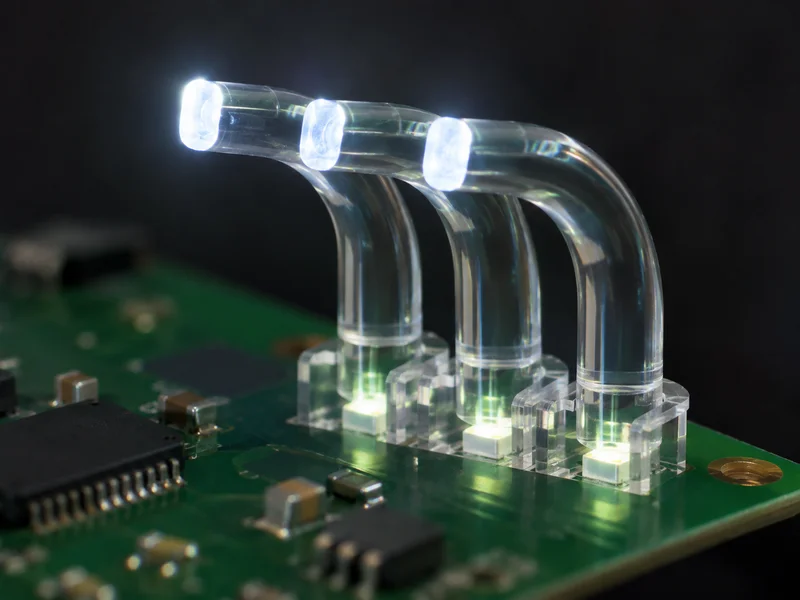
Design guidelines:
- Polished surfaces along the pipe
- Gradual bends, with bend radius ideally several times the pipe thickness
- Uniform cross-section
- Polished or textured exit faces, depending on the desired light spread
- Gates away from optical surfaces
- Draft on non-optical faces only, where possible
For example, a light pipe with a sharp 90° bend will leak light at the bend, while a gentle curve carries it to the indicator. Our guide to jetting injection molding explains gate marks that can spoil light pipes.
Key Takeaway: Treat light pipe surfaces as optical surfaces. Polish and bend radius decide brightness.
What Mold and Process Does Clear Plastic Injection Molding Need?
Clear plastic injection molding needs a highly polished mold and a clean, controlled process.
Mold requirements:
- High polish: often SPI A1–A2 on optical faces
- Corrosion-resistant, polishable steel, such as S136 or NAK80
- Gates sized and placed to avoid jetting and flow lines
- Good venting to prevent burns
- Uniform cooling to limit stress
Process requirements:
- Thorough drying of PC, PMMA and PETG
- Clean material handling, closed conveying
- Moderate injection speed and controlled packing
- Higher mold temperature for lower stress, within limits
For example, a PC lens molded with high pack pressure may show stress patterns under polarized light. Lowering pack and raising mold temperature reduces them. Our guide to injection mold steel material explains polishable steels.
Key Takeaway: Ask for the planned polish level and steel for clear parts. They cap optical quality.
How Is Color Approved for Clear and Tinted Parts?
Color for clear and tinted parts is approved against physical standards, under defined lighting, before production starts.
Color approval process:
- Define the color target, such as a master sample or color reference.
- Run a colorant trial matrix with several dosing levels.
- Measure color with a spectrophotometer where possible.
- Approve samples under agreed light sources.
- Retain approved samples as production standards.
For example, a smoke-tinted PC cover may be trialed at three masterbatch ratios, then approved at the one that matches the reference. Color measurement methods are described in standards from ISO and CIE.
Key Takeaway: Keep signed color standards for clear and tinted parts. Memory is not a standard.
How Do You Control Pigment, Masterbatch and Color Changes?
You control pigment, masterbatch and color changes with fixed dosing, change control and documented purging.
Controls:
- Masterbatch dosing: gravimetric or calibrated volumetric dosers, with checks
- Pigment substitution: never without approval and new samples
- Lot records: link resin and masterbatch lots to production lots
- Color change purging: a written procedure with purge compound and shot count
- Hopper and dryer cleaning between colors
For example, changing from black to clear PC may need extensive purging, because black traces show as specks. A purge record shows when the machine is clean enough. Our quality control and inspection process records material lots when traceability is required.
Key Takeaway: Treat a pigment change like a design change. It needs new approval.
What Visual Inspection Criteria Should Clear Plastic Injection Molding Use?
Clear parts should have written visual inspection criteria that define how, where and what to inspect.
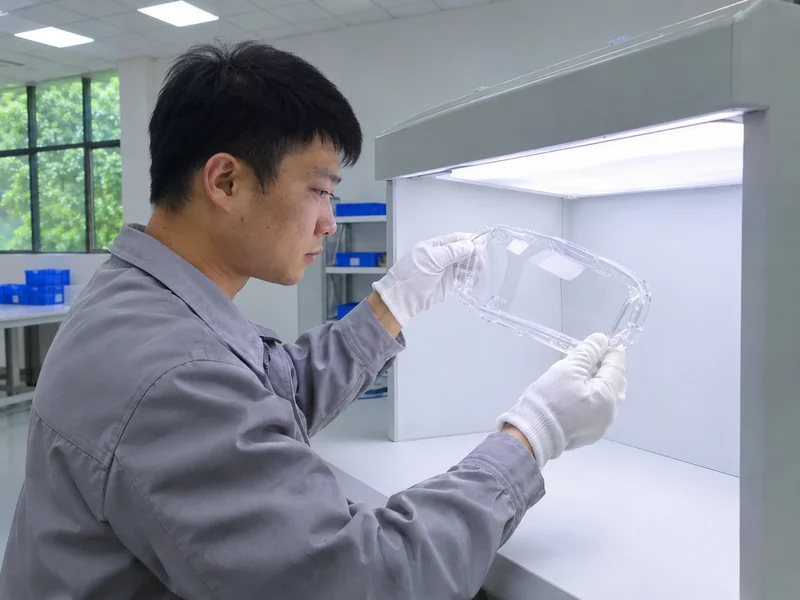
Criteria items:
- Viewing distance, such as 300–500 mm
- Lighting, such as a light box or defined lux level
- Viewing time, such as a few seconds per surface
- Surface zones, such as A (critical), B (visible) and C (hidden)
- Defect limits, such as specks, bubbles, scratches, flow lines by size and count
- Limit samples for borderline defects
For example, “Zone A: no specks larger than 0.1 mm, no scratches visible at 400 mm under light box” is measurable. Without such criteria, inspectors will disagree. Our guide to splay in injection molding explains one common cosmetic defect.
Key Takeaway: Agree visual criteria and limit samples before production. Clear parts make every defect visible.
How Do You Protect Clear Parts After Molding?
You protect clear parts after molding by handling them in clean conditions and packing them to avoid scratches.
Protection steps:
- Gloves and clean handling
- Robot or careful manual removal to avoid scratches
- Protective film on critical faces
- Separators or trays in packing
- Clean, dust-controlled packing area
For example, a lens packed loose in a bag may arrive scratched, while the same lens in a formed tray arrives perfect. Packing should be agreed with the part.
Key Takeaway: Define packing for clear parts in the specification. Many defects happen after molding.
FAQ
- Q: What plastics are used for clear injection molding?
- Common ones are PMMA, PC, PETG, clarified PP and COC/COP.
- Q: Why are clear molded parts hazy?
- Often due to poor mold polish, moisture, contamination or processing issues.
- Q: What mold finish is used for clear parts?
- High polish, often SPI A1–A2, on optical faces.
- Q: How is color controlled on tinted clear parts?
- By approved color standards, controlled masterbatch dosing and documented purging.
- Q: How are clear parts inspected?
- Against written criteria with defined lighting, viewing distance, zones and defect limits.
Conclusion
Clear plastic injection molding needs the right resin, a polished mold, clean and controlled processing, strict color control and written visual criteria. Specify all of them before tooling. To review a clear or tinted part, send your 3D model and 2D drawing to our engineers.