
Large Part CNC Machining: Datums, Setups and Distortion
Large part CNC machining often costs more and holds tolerances less easily than buyers expect. Every extra 100 mm of length adds handling, thermal growth, clamping distortion and inspection effort, while the accurate features on the part usually take up only a small share of its size. As a result, the best result for a big part often comes from planning it differently, or from splitting it into smaller precision parts.
Many projects start as one large machined piece because it looks simple in CAD. For example, a 900 mm frame with two precision bearing seats may be easier to machine, inspect and fix as a stiff base plus two smaller precision bearing blocks, located with dowel pins. In this guide, we explain how to approach large part CNC machining when precision matters: what counts as large, why accuracy gets harder with size, when to split a part, how to choose datums, how to limit setups and distortion, and where WOKE Molds fits. We focus on small and medium precision parts, and we review larger parts case by case. For materials, see our guide to metals for large CNC machined parts.
Large part CNC machining gets the best result when precision is concentrated where it matters. Size increases thermal growth, residual-stress movement, clamping distortion, setup count and inspection difficulty, so tight tolerances become slower and more expensive to hold over long distances. Effective approaches are to split a large part into smaller precision modules joined with dowel pins and screws, machine functional datums first, group features to minimize setups, use stress-relieved stock with balanced roughing, and confirm how the part will be measured before quoting. Small and medium parts usually reach tighter, more repeatable tolerances at lower cost.
In short: for big parts, keep tight tolerances on small, well-located features, and consider splitting the part into precision modules.
Key points:
- Size costs accuracy: heat, stress and setups grow with part size.
- Split when useful: smaller precision modules are easier to machine and inspect.
- Datums first: machine and measure from the features that locate the part.
What Counts as Large Part CNC Machining?
Large part CNC machining is relative: a part is “large” when it uses most of a machine’s travel, needs lifting equipment or no longer fits standard inspection in one setup.
Typical signs:
- Machine travel: the part uses most of the X, Y or Z travel.
- Weight: the part cannot be loaded safely by hand.
- Setups: it needs several re-clampings to reach all faces.
- Inspection: it needs a special measuring setup.
In contrast, most precision parts, such as housings, brackets, manifolds, fixtures and connector blocks, fit within a few hundred millimeters. They can be clamped rigidly, machined in few setups and measured in one CMM setup. Our CNC machining services are built around these small and medium precision parts.
Key Takeaway: Size alone is not the problem. The problem is tight tolerances spread over long distances.
Why Is Precision Harder in Large Part CNC Machining?
Precision is harder in large part CNC machining because small physical effects grow with length and mass.
The main effects:
- Thermal growth: a 1,000 mm aluminum part grows about 0.23 mm with a 10 °C rise, while a 200 mm part grows about 0.05 mm.
- Residual stress: removing material releases stress, so long parts bow more.
- Clamping distortion: long, thin parts deflect under clamps and spring back.
- Setup error: each re-clamping adds alignment error between features.
- Inspection: long distances are harder to measure at stable temperature.
For example, holding ±0.02 mm between two holes 50 mm apart is routine, but holding it between holes 800 mm apart needs controlled temperature, careful process planning and longer inspection. Therefore, place tight tolerances only on features that need them. Our guide to GD&T position tolerance explains how to tolerance hole patterns by function.
Key Takeaway: Tight tolerance over a short distance is cheap; over a long distance it is expensive.
Should You Split a Large Part Into Smaller Precision Parts?
You should consider splitting a large part into smaller precision parts when only a few features need tight tolerances, or when the part is too heavy or long to machine and inspect efficiently.
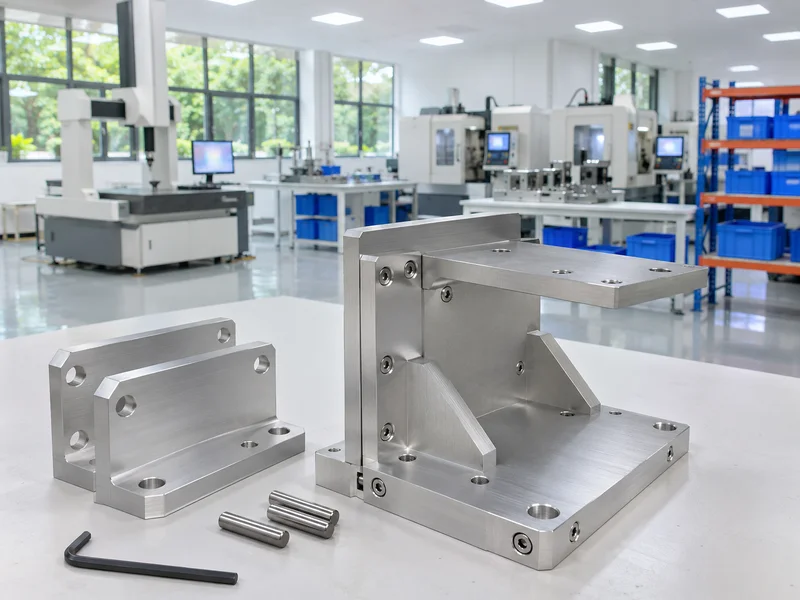
Benefits of splitting:
- Tighter tolerances on each smaller module
- Fewer setups per part and lower scrap risk
- Easier inspection in one CMM setup
- Replaceable wear areas, such as bearing blocks or guides
- Parallel machining of modules, which can shorten lead time
How to split well:
- Keep precision features together on one module, such as both bearing seats.
- Locate modules with dowel pins, and use screws only for clamping.
- Machine mating faces flat and square to the dowel holes.
- Tolerance the interface, not the overall envelope.
For example, a long machine base may become a simple structural frame plus two precision-machined rail blocks and a sensor bracket. Each module is machined accurately, then doweled in place. Our engineering and DFM review often suggests this kind of split.
Key Takeaway: Split the part where precision is needed, and let the rest be simple.
How Should Datums Be Selected for Large Part CNC Machining?
Datums for large part CNC machining should be selected from the features that locate the part in its assembly, and machined first.
Datum selection guidelines:
- Primary datum: the main mounting face
- Secondary and tertiary: locating holes, pins or edges used in assembly
- Machine datums early: in the first setup
- Use the same datums for machining and inspection
- Avoid rough or cast surfaces as final datums
For example, a bracket that mounts on its bottom face and locates on two dowel holes should use those as A, B and C. Every later setup and measurement then picks up the same references. The same rule applies to medium-size precision parts. Our guide to CMM measurement explains datum alignment.
Key Takeaway: Machine the datums first. Every later setup and measurement depends on them.
How Do You Limit Setups and Distortion?
You limit setups and distortion by grouping features by direction, using multi-axis access and removing material evenly from stable stock.
Setup methods:
- Group features by machining direction.
- Use 4- or 5-axis machines to reach several faces in one clamping.
- Move features to accessible faces where design allows.
Distortion methods:
- Stress-relieved stock, such as 6061-T651 plate or normalized steel
- Rough both sides, then unclamp and rest before finishing
- Finish with light clamping and light passes
- Measure at a stable temperature
For example, a medium-size aluminum housing with features on five faces can often be finished in one or two setups on a 5-axis machine, instead of four or five on a 3-axis machine. Our Dongguan factory includes a Makino 5-axis machining center, and our guide to 5-axis milling explains multi-face access. Machine capability is not finished-part tolerance; finished tolerances depend on the part, material and process.
Key Takeaway: Count setups during the quote. It predicts both cost and accuracy.
How Do You Handle STEP File and Drawing Mismatches?
You handle STEP file and drawing mismatches by resolving them before programming and stating which document governs.
Common mismatches:
- Hole sizes or threads differ between model and drawing.
- Features appear in only one document.
- Revisions of model and drawing do not match.
Edge breaks belong in a general note, such as “break sharp edges 0.2–0.5 mm”; dimension chamfers only where they have a function. General tolerances such as ISO 2768 cover non-critical features. For example, a drawing showing M6 threads while the model has plain Ø5 holes needs a decision before machining.
Key Takeaway: Put “drawing governs” or “model governs” on the drawing.
Where Does WOKE Molds Fit?
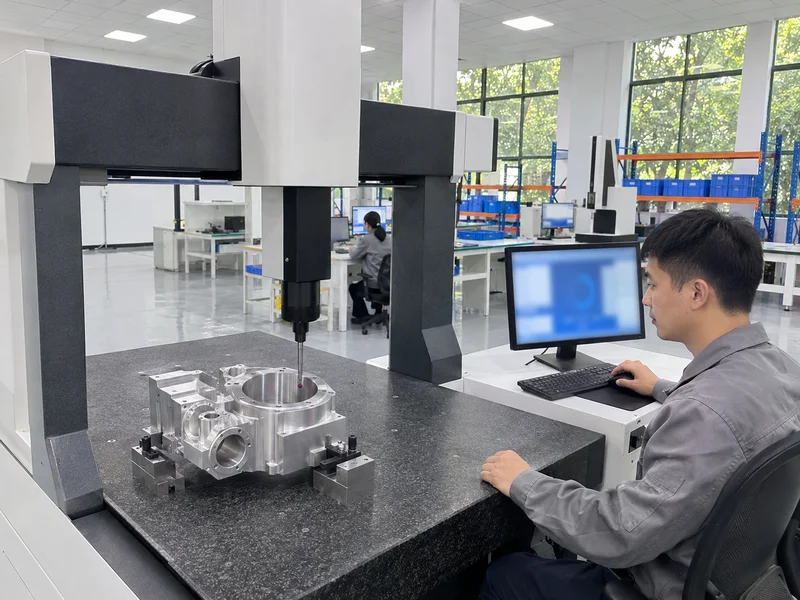
WOKE Molds focuses on small and medium precision CNC machined parts, such as housings, brackets, manifolds, fixtures, connector and sensor blocks, and machined parts for molds and assemblies.
What this means for a project:
- Best fit: precision parts that can be clamped rigidly and measured in one setup
- Large parts: reviewed case by case; we tell you early if a part is outside our focus
- Split designs: we can machine the precision modules of a larger assembly
- Evidence: dimensional reports supplied on request
For example, if your machine frame is large but its accuracy depends on rail blocks and bearing housings, we can quote those precision modules. Our quality control and inspection process measures them from the functional datums.
Key Takeaway: Send the full assembly. We will say which parts fit our precision focus.
FAQ
- Q: What is large part CNC machining?
- Machining parts that use most of a machine’s travel, need lifting equipment or need special inspection setups.
- Q: Why are tight tolerances harder on large parts?
- Thermal growth, residual stress, clamping distortion and setup error all increase with size.
- Q: Should a large part be split into smaller parts?
- Often yes, when only some features need tight tolerances. Doweled precision modules are easier to machine and inspect.
- Q: How should datums be chosen?
- From the features that locate the part in its assembly, machined in the first setup.
- Q: Does WOKE Molds machine large parts?
- Our focus is small and medium precision parts. Larger parts are reviewed case by case.
Conclusion
Large part CNC machining gives the best result when precision is placed only where it is needed. Split big parts into precision modules where possible, machine datums first, minimize setups and plan inspection early. To review your part or assembly, send your 3D model and 2D drawing to our engineers.