
Threaded Holes: Callouts, Depth, Tapping vs Thread Milling
Threaded holes are among the most common features on machined parts, and among the most often under-specified. A callout like “M6” leaves out thread class, depth, whether the hole is blind or through, how deep the drill goes, and whether a chamfer or insert is needed. Each missing detail can lead to stripped threads, bottomed screws, broken taps or leaks.
Clear specification and the right machining method avoid most problems. For example, a blind M6 hole with a full-depth thread called to the bottom of the drill cannot be tapped, because the tap’s lead needs space. Likewise, mixing NPT and BSPT pipe threads causes leaks even when the fittings screw in. In this guide, we explain how to specify threaded holes on a machined drawing, including blind hole depth, thread milling vs tapping, deep holes, cross-hole deburring, NPT vs BSPT, reaming vs boring and thread inserts in aluminum. For general machining, see our CNC machining services.
Threaded holes should be specified with thread designation and class (for example M6 × 1 – 6H), thread depth (full-thread length), drill depth for blind holes, countersink or chamfer, and through or blind status. For blind holes, the drill should extend about 3–5 thread pitches beyond the full-thread depth when tapping. Thread milling suits large, hard or high-value parts and gives better control; tapping is faster for common sizes. Pipe threads must state the standard (NPT vs BSPT/BSPP), as they are not interchangeable. Thread inserts are used in aluminum and plastics for strength and wear.
In short: give thread size, class, depth and drill depth, choose tapping or thread milling, and name pipe thread standards explicitly.
Key points:
- Callout: size, pitch, class, thread depth and drill depth.
- Method: tapping for speed; thread milling for control.
- Standards: NPT and BSPT are not interchangeable.
How Should Threaded Holes Be Called Out on a Drawing?
Threaded holes should be called out with every detail needed to make and inspect them.
A complete callout includes:
- Thread designation: size and pitch, such as M6 × 1
- Tolerance class: such as 6H for internal metric threads
- Thread depth: full-thread length, such as ↧12
- Drill depth: for blind holes, such as Ø5.0 ↧16
- Chamfer or countersink: such as 90° × Ø7
- Through or blind
For example, “M6 × 1 – 6H ↧12, drill Ø5.0 ↧16, chamfer 90° × Ø6.5” is complete. Metric thread standards come from ISO, such as ISO 965 for tolerances.
Key Takeaway: Always state thread depth and drill depth separately for blind threaded holes.
How Deep Should Blind Threaded Holes Be?
A blind threaded hole should be deep enough for the required thread engagement plus space for the tap’s lead and chips.
Guidelines:
- Thread engagement: about 1–1.5 × diameter in steel, about 2 × in aluminum and softer metals
- Drill depth: about 3–5 pitches deeper than the full-thread depth for tapping
- Thread milling: needs less extra depth, often 1–2 pitches
- Avoid unnecessary depth: deeper threads add time and tap risk
For example, an M8 × 1.25 thread needing 12 mm full thread in aluminum may need a 16–18 mm drill depth for tapping. Calling a 12 mm drill depth would leave incomplete threads at the bottom.
Key Takeaway: Do not call full threads to the bottom of blind threaded holes. Leave room for the tap.
Thread Milling vs Tapping: Which Is Better?
Thread milling vs tapping depends on size, material, quantity and risk.
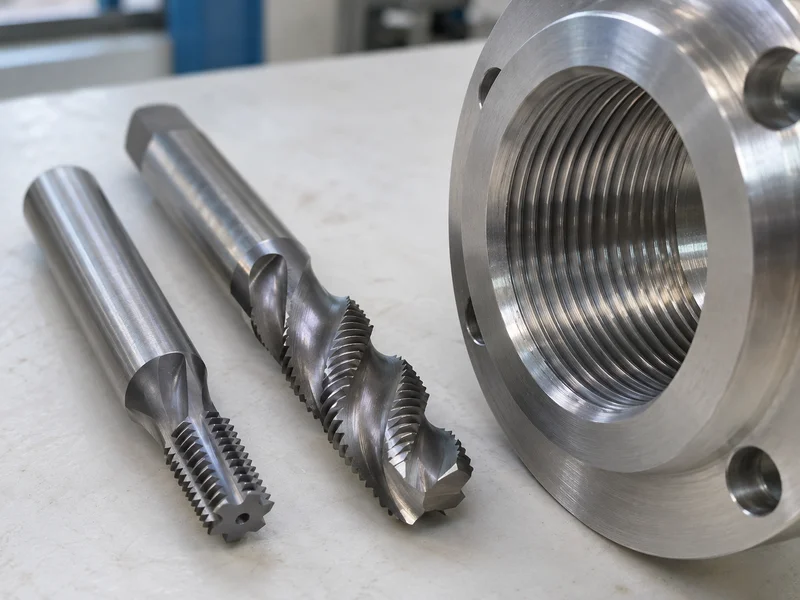
| Factor | Tapping | Thread milling |
|---|---|---|
| Speed for common sizes | Faster | Slower |
| Hard materials | Higher breakage risk | Better |
| Large threads | Needs large taps and torque | One tool covers many sizes |
| Blind holes | Needs extra depth | Threads closer to bottom |
| Tool breakage | Broken tap can scrap the part | Easier to remove broken cutter |
| Thread fit adjustment | Fixed by tap | Adjustable in the program |
For example, M3–M10 threads in aluminum are usually tapped for speed, while an M30 thread in a high-value stainless part is often thread milled for safety. Our CNC milling service chooses the method per part.
Key Takeaway: Thread mill large threads, hard materials and expensive parts. Tap common sizes in easy materials.
How Do You Machine Deep Threaded Holes and Deburr Cross Holes?
You machine deep holes with suitable drills and chip control, and deburr cross holes with tools that reach the intersection.
Deep holes:
- Peck drilling to clear chips
- Through-coolant drills for depths beyond about 5–10 × diameter
- Gun drilling for very deep, straight holes
- Pilot holes to guide long drills
Cross-hole deburring:
- Back-deburring tools that reach the intersection
- Brush or ball tools for internal edges
- Abrasive flow or thermal deburring for complex manifolds
- Inspection with borescopes for critical passages
For example, a hydraulic manifold with intersecting channels must be deburred at every intersection, or burrs can break off and damage valves. Our guide to large part CNC machining explains planning for complex parts.
Key Takeaway: Specify burr-free intersections on hydraulic and pneumatic parts. Hidden burrs cause failures later.
What Is the Difference Between NPT and BSPT Threads?
The difference between NPT and BSPT threads is their standard, thread angle and pitch, so they are not interchangeable even when sizes look similar.
| Feature | NPT (American) | BSPT (British, tapered) |
|---|---|---|
| Standard | ASME B1.20.1 | ISO 7-1 (EN 10226) |
| Thread angle | 60° | 55° |
| Crest/root | Flat | Rounded |
| Taper | 1:16 | 1:16 |
| Sealing | Thread with sealant | Thread with sealant |
BSPP (parallel) threads seal with a washer or O-ring, not on the thread. For example, a 1/4 NPT fitting may screw a few turns into a 1/4 BSPT port, but it will leak. Always name the standard on the drawing.
Key Takeaway: Write “NPT” or “BSPT/BSPP” explicitly. Never write only “1/4 pipe thread”.
When Should You Ream or Bore Precision Holes?
You should ream precision holes for fast, repeatable sizes in standard diameters, and bore them for larger, non-standard or very accurate holes.
- Reaming: fast, good finish, fixed size; follows the drilled hole’s position.
- Boring: adjustable size, corrects position and straightness, slower.
- Both: often used for H7 bores.
For example, a Ø10H7 dowel hole is typically drilled and reamed, while a Ø52H7 bearing bore is bored to size. If position is critical, boring corrects drill wander that reaming cannot. Our guide to tolerance for slip fit explains fit tolerances.
Key Takeaway: Bore when position or straightness is critical; ream when speed and size repeatability matter.
When Should Thread Inserts Be Used in Machined Aluminum?
Thread inserts should be used in machined aluminum when threads are assembled often, carry high loads, or are short.
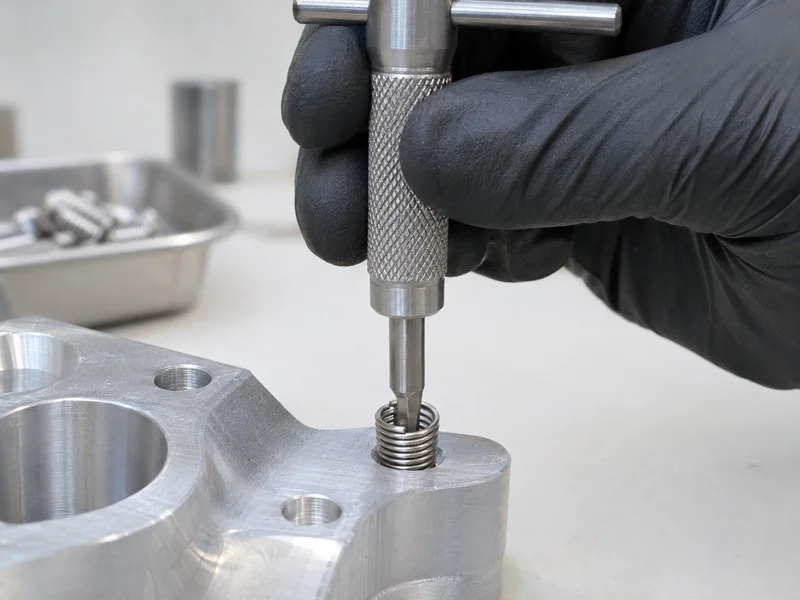
Common insert types:
- Wire thread inserts (helical coil)
- Key-locking inserts
- Self-tapping solid inserts
Use them when:
- Assembly is frequent, such as service panels
- High torque or vibration is present
- Thread length is limited
- Steel screws would wear aluminum threads
For example, a maintenance cover on an aluminum housing that is opened monthly should use wire thread inserts to prevent thread wear. Our guide to machining acetal covers inserts in plastics.
Key Takeaway: Specify inserts where threads will be reused. Repairing stripped aluminum threads costs more.
FAQ
- Q: How do you call out a threaded hole?
- With thread size, pitch, class, thread depth, drill depth for blind holes, chamfer and through/blind status.
- Q: How deep should a tapped blind hole be drilled?
- About 3–5 pitches deeper than the full-thread depth.
- Q: Is thread milling better than tapping?
- For large, hard or high-value parts, yes. Tapping is faster for common sizes in easy materials.
- Q: Are NPT and BSPT interchangeable?
- No. They have different thread angles and forms and will leak if mixed.
- Q: When should thread inserts be used in aluminum?
- For frequent assembly, high torque, vibration or short threads.
Conclusion
Threaded holes work reliably when the drawing gives the full callout, the machining method suits the thread and material, and pipe thread standards are explicit. Plan drill depths, deburr intersections and use inserts where threads are reused. To review threaded features on your part, send your 3D model and 2D drawing to our engineers.