
Warpage Plastic Parts: Causes and How to Diagnose Them
Warpage plastic parts bend, twist or bow after molding, so flat faces are not flat and mating parts do not fit. Warpage comes from uneven shrinkage: one area of the part shrinks more than another, and the difference pulls the part out of shape. The drivers are well known, but finding which one controls a particular part takes a structured approach.
Many warpage fixes treat symptoms. For example, a fixture that holds a warped part flat while it cools may hide the problem until the part relaxes in a hot car. In contrast, finding that one mold half runs 15 °C hotter and fixing the cooling solves it permanently. In this guide, we explain how to find the driver behind warpage plastic parts: cooling, wall thickness, fiber and molecular orientation, packing and material, plus how to measure and fix it. For shrinkage basics, see our guide to plastic shrinkage.
Warpage plastic parts result from differential shrinkage. The main drivers are differential cooling (core and cavity, or local hot spots), non-uniform wall thickness, orientation of fibers or polymer chains (shrinkage differs along and across flow), non-uniform packing (areas near and far from the gate), and material choice (semi-crystalline and fiber-filled resins warp more). Diagnosis compares warp direction with mold temperatures, gate location and fiber orientation, often supported by simulation. Fixes include balancing cooling, uniforming walls, moving or adding gates, adjusting pack profiles, adding ribs and changing materials or fillers.
In short: warpage is uneven shrinkage; find whether cooling, walls, orientation, packing or material drives it, then fix that driver.
Key points:
- Root cause: differential shrinkage.
- Drivers: cooling, walls, orientation, packing, material.
- Fix the driver: not the symptom.
What Causes Warpage in Plastic Parts?
Warpage in plastic parts is caused by different amounts of shrinkage in different areas or directions of the part.
The five main drivers:
- Differential cooling: hotter areas shrink more later.
- Wall thickness variation: thick areas shrink more than thin areas.
- Orientation: fibers and polymer chains make shrinkage directional.
- Packing differences: areas far from the gate get less pack and shrink more.
- Material: semi-crystalline and fiber-filled resins shrink more and less evenly.
For example, a box-shaped part with a hot core often bows its walls inward, because the inside surfaces shrink more. Our guide to practical mold cooling explains core cooling.
Key Takeaway: Every warpage has at least one of five drivers. Identify which one first.
How Does Cooling Cause Warpage Plastic Parts?
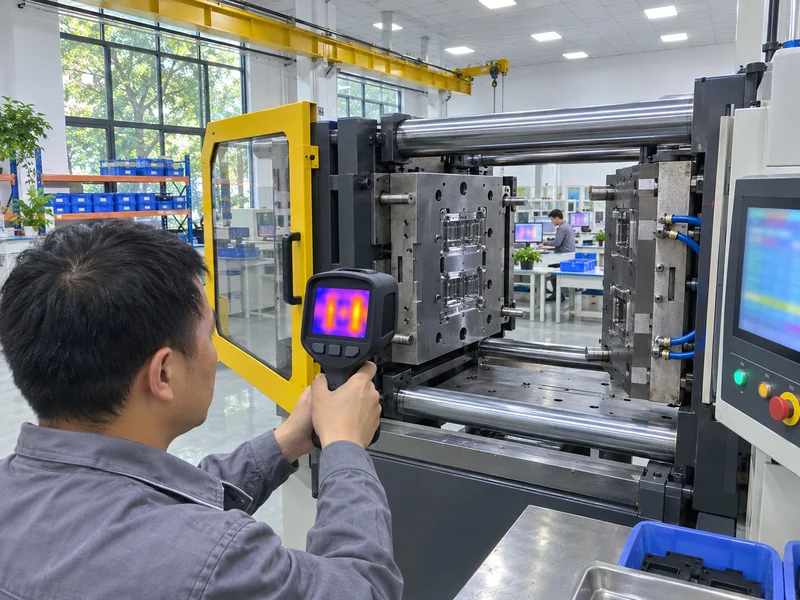
Cooling causes warpage plastic parts when one side or area of the mold is hotter, so that side shrinks more after ejection and bends the part toward it.
Signs:
- Bowing toward one face, typically the hotter side
- Corner pull-in on boxes with poorly cooled cores
- Warp changes when mold temperatures are adjusted
Fixes:
- Balance core and cavity temperatures
- Add cooling to cores, slides and thick areas
- Use baffles, bubblers or conformal cooling in deep cores
- Check flow and circuits per the cooling record
For example, measuring core and cavity surfaces and finding a 12 °C difference explains why a lid bows. Improving core cooling flattens it. Our guide to mold cooling channel design explains cooling records.
Key Takeaway: Measure mold surface temperatures on both halves. Unequal cooling is a frequent cause.
How Do Wall Thickness and Packing Cause Warpage?
Wall thickness and packing cause warpage because thick areas and areas with less pack pressure shrink more.
Wall thickness effects:
- Thick sections shrink more than thin ones
- Sudden thickness changes create stress at transitions
- Ribs thicker than walls pull surfaces
Packing effects:
- Near the gate: higher pressure, less shrinkage
- Far from the gate: lower pressure, more shrinkage
- Early gate freeze: distant areas lose packing
For example, a long flat part gated at one end may shrink more at the far end, causing a curve along its length. Adding a second gate or moving the gate to the center evens the packing. Our guide to scientific molding explains packing studies.
Key Takeaway: Keep walls uniform and gate so packing reaches all areas evenly.
How Does Fiber Orientation Cause Warpage?
Fiber orientation causes warpage because glass-filled and other fiber-filled resins shrink less along the fibers than across them.
Effects:
- Low shrinkage along the flow, higher across it
- Twist when flow direction changes across the part
- Different warp in different regions with different flow paths
Fixes:
- Gate location for consistent orientation
- Balanced flow across symmetrical parts
- Lower fiber content or mixed fillers (glass plus mineral)
- Ribs aligned to resist the warp direction
For example, a PA66-GF30 cover gated at one corner may twist diagonally. Gating at the center or along one edge makes orientation more uniform. Our guide to glass filled nylon explains fiber orientation planning.
Key Takeaway: For filled resins, gate location is a warpage control, not just a filling choice.
How Do You Diagnose the Driver Behind Warpage Plastic Parts?
You diagnose the driver behind warpage by measuring the warp, comparing it with possible causes and testing one change at a time.
Diagnostic steps:
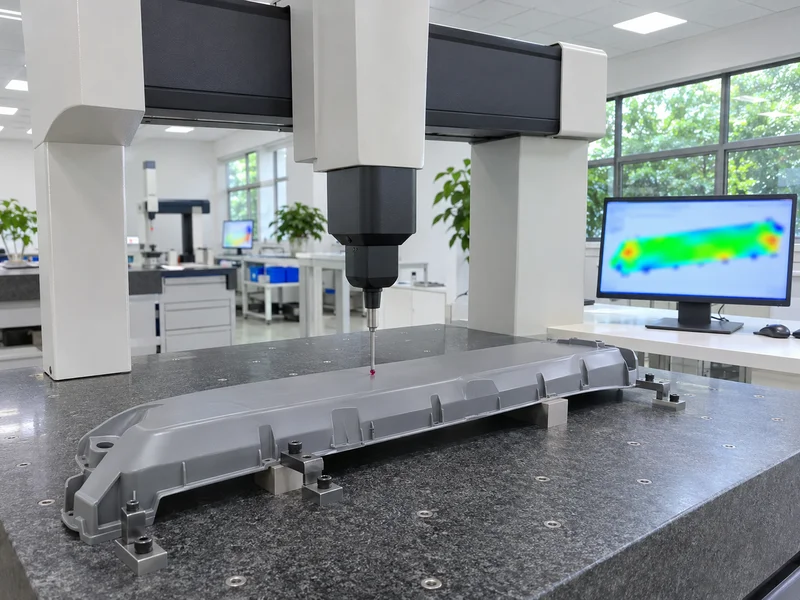
- Measure warpage consistently, such as flatness on a surface plate or CMM.
- Map the warp direction: bow, twist, corner pull-in.
- Measure mold surface temperatures on core and cavity.
- Check wall thickness in the model at warp areas.
- Check gate location and flow direction, using simulation if available.
- Run controlled tests: change mold temperature, pack pressure or cooling time one at a time.
For example, if changing core temperature by 10 °C changes the bow significantly, cooling is the main driver. If not, look at orientation or packing. Simulation tools can predict warpage contributions; our guide to mold flow analysis explains them.
Key Takeaway: Change one variable at a time and measure. Warpage diagnosis needs data.
How Do You Fix Warpage Plastic Parts?
You fix warpage plastic parts by correcting the identified driver, in the tool, the design or the process.
| Driver | Typical fixes |
|---|---|
| Cooling | Balance temperatures, add cooling, conformal cooling |
| Wall thickness | Core out thick areas, uniform walls |
| Orientation | Move or add gates, change filler mix |
| Packing | Adjust pack profile, larger gates, extra gates |
| Material | Lower-shrink grade, amorphous resin, mineral filler |
Additional measures:
- Ribs to stiffen against warp
- Pre-warp the tool (compensate the geometry) when the warp is stable and predictable
- Post-mold fixtures only as a temporary or secondary measure
For example, a stable 0.5 mm bow can sometimes be compensated by machining the mold slightly curved the opposite way. Our injection mold manufacturing team uses steel-safe adjustments after trials.
Key Takeaway: Prefer root-cause fixes. Use tool compensation only for stable, well-understood warp.
How Should Warpage Be Specified and Measured?
Warpage should be specified as a flatness or profile tolerance with a defined measuring method and condition.
Specification items:
- Flatness or profile tolerance on the critical surface
- Measuring method: free state or restrained in a fixture
- Conditioning time after molding
- Temperature and humidity for measurement
- Number of samples per cavity
For example, “flatness 0.3 mm, free state, measured 24 hours after molding at 23 °C” is clear. Flatness tolerances follow GD&T rules defined by ISO in ISO 1101. Our quality control and inspection process measures flatness by CMM or surface plate.
Key Takeaway: State free-state or restrained measurement. The result differs greatly between them.
FAQ
- Q: What causes warpage in plastic parts?
- Differential shrinkage from uneven cooling, wall thickness, orientation, packing or material.
- Q: Which plastics warp the most?
- Semi-crystalline and fiber-filled resins, such as PP, PE, POM and glass-filled PA.
- Q: How do you reduce warpage?
- Balance cooling, keep walls uniform, gate for even flow and packing, and choose lower-shrink materials.
- Q: Can the mold be adjusted to compensate for warpage?
- Yes, for stable, predictable warp, by pre-warping the tool geometry.
- Q: How is warpage measured?
- As flatness or profile, on a surface plate or CMM, in a defined state and condition.
Conclusion
Warpage plastic parts are caused by uneven shrinkage, and lasting fixes target the driver: cooling, walls, orientation, packing or material. Measure carefully, test one variable at a time and specify flatness with a clear method. To review a warpage problem, send your 3D model and 2D drawing to our engineers.