
Machining Polycarbonate: Tooling, Crazing and Tolerances
Machining polycarbonate gives clear, tough parts without a mold, which makes it popular for covers, windows, light guides, fixtures and prototypes. However, polycarbonate is not as forgiving as aluminum. It is sensitive to heat, internal stress and certain chemicals, so a part that looks perfect on the machine can craze or crack days later.
Most problems come from three areas: heat at the cutting edge, stress left in the part, and contact with incompatible coolants or cleaners. For example, a clear PC window cleaned with an alcohol-based solvent after machining may develop fine cracks around drilled holes. In this guide, we explain machining polycarbonate for fit, edges and inspection, and we compare it with other plastics buyers often specify: PTFE, UHMW-PE, nylon and glass-filled grades. For the wider process, see our guide to CNC plastic machining.
Machining polycarbonate works best with sharp, polished cutting tools, moderate speeds, light finishing passes and good chip evacuation, using air or water-based coolant compatible with PC. Avoid solvents and some oils that cause stress cracking. Stress-relieving annealing before finishing, and sometimes after, reduces crazing. Realistic tolerances depend on part size and wall thickness; PC moves less than PTFE or UHMW-PE but more than metals. Clear surfaces need polishing or vapor-free finishing methods and should be inspected for crazing, haze and edge chips.
In short: keep PC cool, unstressed and away from incompatible chemicals, and define how clear edges and fits will be checked.
Key points:
- Heat: sharp tools and light passes prevent melting and stress.
- Chemicals: use PC-compatible coolant and cleaners only.
- Stability: PC is more stable than PTFE, UHMW or nylon.
Why Is Machining Polycarbonate Different From Machining Metal?
Machining polycarbonate is different because the material is soft, insulating and stress-sensitive. Heat does not leave through the chips as it does with metal, so it builds up at the cutting edge.
Key differences:
- Low thermal conductivity: heat stays in the cut zone.
- Glass transition near 145–150 °C: the surface can smear or gum.
- Notch sensitivity: sharp internal corners concentrate stress.
- Stress cracking: internal stress plus chemicals cause crazing.
- Elastic recovery: the material springs back slightly after cutting.
Therefore, tool geometry and cutting heat matter more than raw machine power. Our guide to CNC milling plastic explains general plastic milling parameters.
Key Takeaway: Treat polycarbonate as a heat- and stress-sensitive material, not as a soft metal.
How Should You Set Up Tools and Coolant for Machining Polycarbonate?
You should set up tools and coolant for machining polycarbonate to cut cleanly, clear chips and avoid chemical attack.
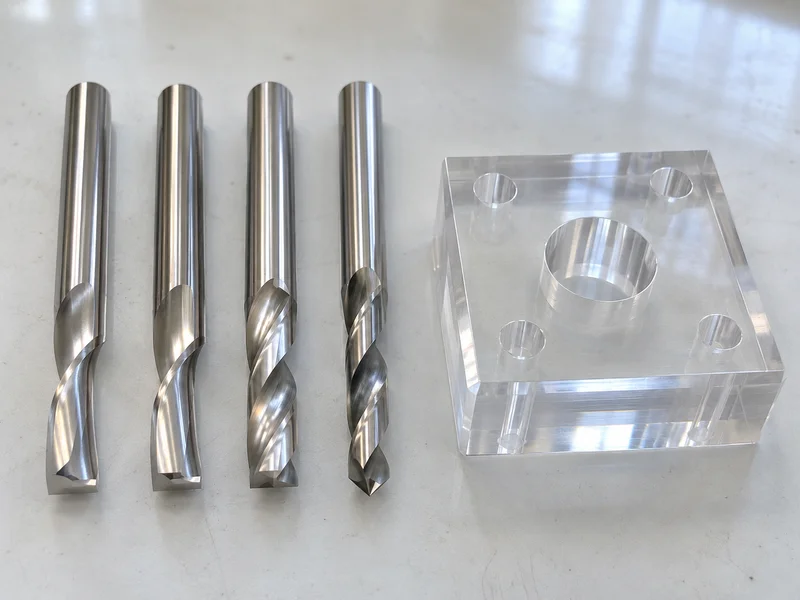
Practical settings:
- Tools: sharp, polished carbide with high rake and generous clearance
- Flutes: one or two flutes for milling, so chips have room to leave
- Drills: modified point angle and slow peck cycles for deep holes
- Coolant: compressed air or a water-based coolant confirmed compatible with PC
- Avoid: solvents, some cutting oils and alcohol-based cleaners
For example, a drill that rubs instead of cutting can leave a stressed, white ring around the hole. A sharp drill with pecking clears chips and keeps the hole clear. Chemical compatibility data is available from resin suppliers, and test methods for environmental stress cracking are published by ASTM International.
Key Takeaway: Confirm coolant and cleaner compatibility before the first part, not after cracks appear.
How Do You Control Stress and Crazing in Machined PC Parts?
You control stress and crazing in machined PC parts by starting with low-stress stock, removing material evenly and annealing when needed.
Methods:
- Use stress-relieved sheet or rod where available.
- Rough both sides and leave even finishing stock.
- Anneal before finishing for tight or optical parts, following the resin supplier’s temperature guidance.
- Finish with light passes and sharp tools.
- Add radii to internal corners and around holes.
For example, a clear PC cover with tapped holes may crack around the threads after assembly. Larger corner radii, annealing and threaded inserts instead of direct tapping reduce the risk. Our guide to threaded holes explains insert options.
Key Takeaway: Anneal and add radii on PC parts that carry screws or tight fits.
What Tolerances Are Realistic When Machining Polycarbonate?
Realistic tolerances when machining polycarbonate depend on part size, wall thickness, stress and temperature during measurement, not only on machine capability.
General guidance:
- Small, thick PC parts: tighter tolerances are practical with annealing and stable temperature.
- Thin or long parts: expect more movement after release from the fixture.
- Fits: PC expands roughly 6–7 times more than steel per degree, so measure at a defined temperature.
- Holes: may close slightly after drilling because of elastic recovery.
For example, a ±0.05 mm bore in a 20 mm thick PC block is realistic, while the same tolerance across a 300 mm thin cover is much harder. Machine capability is not finished-part tolerance, so we confirm tolerances per drawing during review. Our guide to tight tolerance machining explains how to place tight tolerances.
Key Takeaway: State the measurement temperature for tight PC fits.
How Does Machining Polycarbonate Compare With PTFE, UHMW and Nylon?
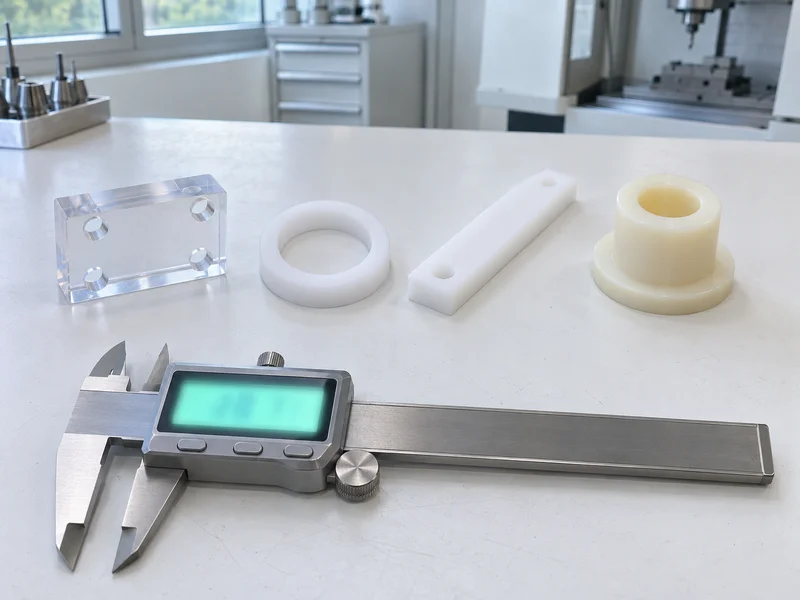
Machining polycarbonate is more dimensionally stable than machining PTFE, UHMW-PE or nylon, but less chemically resistant.
| Material (typical) | Stability when machined | Main machining issue | Typical uses |
|---|---|---|---|
| Polycarbonate (PC) | Good | Stress cracking, heat | Covers, windows, fixtures |
| PTFE | Low | Creep, high expansion, burrs | Seals, insulators, low-friction parts |
| UHMW-PE | Low | Springback, stringy chips | Wear strips, guides |
| Nylon (PA6, PA66) | Medium | Moisture absorption | Gears, bushings, rollers |
| Glass-filled plastics | Good | Tool wear, abrasive dust | Structural parts |
Key points for each:
- PTFE tolerances: keep tolerances loose; measure after the part rests at room temperature.
- UHMW design: use thick walls and generous tolerances; avoid fine threads.
- Nylon moisture conditioning: dimensions change as nylon absorbs water, so define the conditioning state.
- Glass-filled plastics: use carbide or diamond-coated tools and control dust.
Our guide to machining acetal covers POM, which is often a stable alternative.
Key Takeaway: If stability matters most and clarity does not, consider POM or glass-filled grades instead.
How Should Machined Polycarbonate Edges and Surfaces Be Inspected?
Machined polycarbonate edges and surfaces should be inspected for crazing, chips, haze and dimensional fit under defined lighting.
Inspection points:
- Crazing: fine cracks near holes, threads and corners
- Edge chips and burrs: especially on drilled exits
- Clarity: haze or tool marks on optical faces
- Dimensions: at a defined temperature after resting
- Cosmetic criteria: viewing distance, lighting and acceptable defect size
For example, a light window may be inspected at 300 mm under diffuse light, with no visible crazing allowed. Our quality control and inspection process records such criteria when they are on the drawing.
Key Takeaway: Put cosmetic and crazing criteria on the drawing for clear parts.
FAQ
- Q: Is polycarbonate easy to machine?
- Yes, with sharp tools, light passes and compatible coolant. Heat and chemicals are the main risks.
- Q: What coolant is used when machining polycarbonate?
- Usually compressed air or a water-based coolant confirmed compatible with PC.
- Q: Why does machined polycarbonate crack?
- Internal stress combined with incompatible chemicals or sharp corners causes crazing and cracks.
- Q: Should polycarbonate be annealed after machining?
- Annealing helps for tight or optical parts, following the resin supplier’s guidance.
- Q: Which is more stable to machine, polycarbonate or nylon?
- Polycarbonate, because nylon changes size as it absorbs moisture.
Conclusion
Machining polycarbonate succeeds when heat, stress and chemical exposure are controlled, and when fit and edge criteria are clear. Choose PC for clarity and toughness, and consider POM or filled grades when stability matters more. To review a plastic part, send your 3D model and 2D drawing to our engineers.