
CNC Milling Plastic: Workholding, Heat and Clean Edges
CNC milling plastic is different from milling metal. Plastics are softer, more flexible and more sensitive to heat, so they move under clamping force, melt or smear at the cutting edge and form burrs that metal parts do not. Good results depend on three things: workholding that supports the part without distorting it, heat control at the cutter, and tools and paths that leave clean edges.
Most failures look like machining errors but start with the setup. For example, a thin acetal plate clamped hard in a vise can measure flat on the machine, then bow after release. Likewise, an acrylic edge milled with a dull tool can melt and re-weld its chips, leaving a cloudy, rough surface. In this guide, we explain CNC milling plastic step by step: workholding, heat, tools, edge quality, flatness and inspection. For prototype parts, see our guide to the plastic CNC prototype.
CNC milling plastic needs light, distributed clamping (vacuum tables, soft jaws or fixture plates), sharp tools with polished flutes and high rake, and cutting parameters that remove heat with the chip. Typical practice uses 1–3 flute cutters, high spindle speeds with adequate chip load, air blast or suitable coolant, and climb milling for cleaner edges. Thin and long parts need stress-relieved stock and balanced roughing. Burrs, melting and chip welding are prevented by sharp tools, correct feed and good chip evacuation.
In short: hold plastic gently, keep the cutter sharp and the chip thick enough to carry heat away, and plan for movement after release.
Key points:
- Workholding: spread clamping force; avoid distortion.
- Heat: sharp tools and correct chip load prevent melting.
- Edges: climb milling and finishing passes reduce burrs.
What Makes CNC Milling Plastic Different From Metal?
CNC milling plastic is different from metal because plastics have low stiffness, low thermal conductivity and high thermal expansion.
Effects in milling:
- Low stiffness: parts flex under clamping and cutting forces.
- Low thermal conductivity: heat stays at the cutter and the surface.
- High thermal expansion: parts grow when warm and shrink when cool.
- Low melting or softening points: chips can melt and stick.
- Internal stress in stock: parts can warp when material is removed.
For example, a 300 mm long nylon part can change length by several tenths of a millimeter between a warm workshop and a cool inspection room. Therefore, dimensions should be checked at a stable temperature. Our CNC milling service machines plastics as well as metals.
Key Takeaway: Treat plastic as a flexible, heat-sensitive material, not as soft metal.
How Should Plastic Parts Be Held for CNC Milling?
Plastic parts should be held for CNC milling with light, well-distributed force, so they stay still without being distorted.
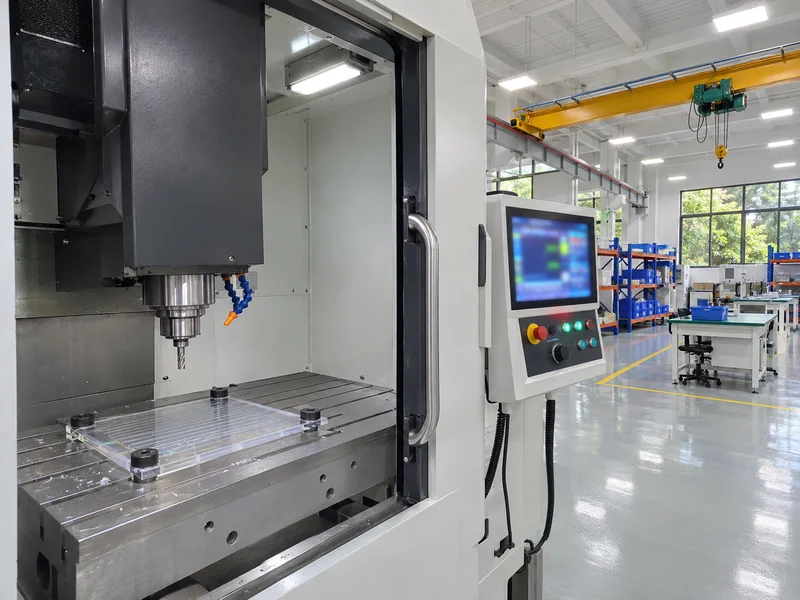
Workholding options:
- Vacuum tables: good for thin plates and sheets
- Soft jaws: machined to the part shape, spreading clamp force
- Fixture plates with dowels: for repeatable production
- Double-sided tape or adhesives: for very thin, small parts
- Tabs: leaving small bridges that are removed later
For example, a thin polycarbonate cover clamped at two points in a vise will bow. On a vacuum table, however, it stays flat across its whole area. In addition, torque-limited clamping helps keep force consistent from part to part.
Key Takeaway: If the part springs when released, the clamping was too hard or too concentrated.
How Do You Control Heat When CNC Milling Plastic?
You control heat when CNC milling plastic by making the chip carry the heat away and keeping the tool sharp.
Heat-control methods:
- Sharp tools with polished flutes, which cut instead of rubbing
- Adequate chip load: feed too low causes rubbing and heat
- High spindle speed balanced with feed
- Air blast to clear chips and cool the cut
- Coolant where the plastic tolerates it
- Avoid dwelling in corners and at the end of passes
For example, an acrylic part milled at a very low feed may melt along the edge, while a higher feed with the same speed gives clean chips and a clear edge. However, some plastics can crack or absorb certain coolants, so the coolant should be checked for each material.
Key Takeaway: In plastic, too slow a feed is as harmful as too fast. Keep the chip thick enough to carry heat.
Which Tools Work Best for CNC Milling Plastic?
The tools that work best for CNC milling plastic are sharp, high-rake cutters with few flutes and polished surfaces.
Tool guidelines:
- Flutes: 1–3 flutes for good chip clearance
- Rake angle: high positive rake for a clean shearing cut
- Coating: often uncoated, polished carbide; some coatings help with abrasive grades
- “O-flute” or plastic-specific cutters for acrylic and polycarbonate
- Diamond or wear-resistant tools for glass-filled plastics
For example, a single-flute O-flute cutter often gives a clear edge on acrylic, while a 4-flute metal cutter clogs and melts the chips. Glass-filled nylon, on the other hand, wears sharp carbide quickly, so tool life must be watched.
Key Takeaway: Keep separate tools for plastic. Tools used on metal lose the sharp edge plastic needs.
How Do You Get Clean Edges When CNC Milling Plastic?
You get clean edges when CNC milling plastic by using sharp tools, climb milling, light finishing passes and good chip evacuation.
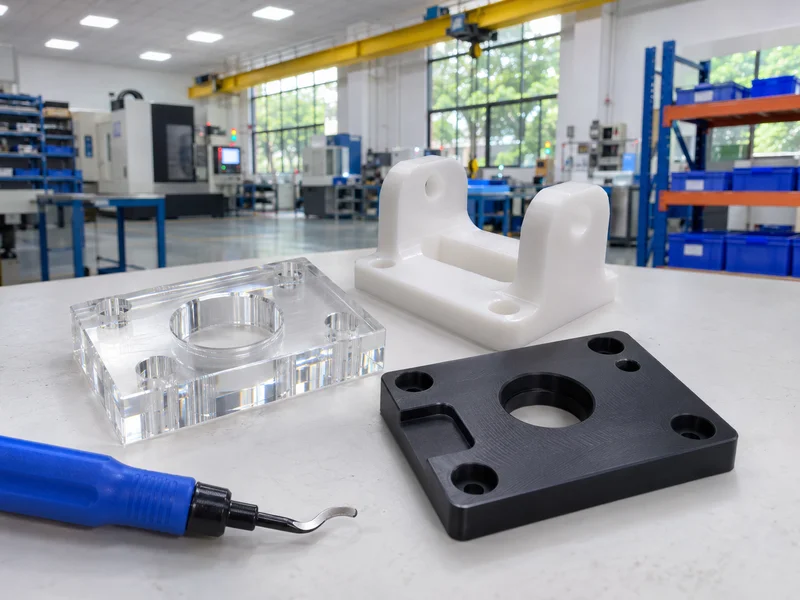
Edge-quality practices:
- Climb milling for most finishing passes
- Light finishing pass after roughing, to remove heat-affected material
- Constant engagement toolpaths, to avoid sudden load changes
- Exit planning, so the tool leaves the part without pushing a burr
- Deburring method: scraping or trimming suited to the plastic
For example, a POM part may show a fine burr on the exit side of a slot. A chamfer pass or a light finishing pass in the opposite direction removes it. For transparent parts, flame or vapor polishing may be used, but only where stress cracking is not a risk.
Key Takeaway: Decide which edges are cosmetic and which are functional. Then set the finishing and deburring effort to match.
How Do You Keep Milled Plastic Parts Flat and Stable?
You keep milled plastic parts flat and stable by using stress-relieved stock, balancing material removal and letting parts relax between operations.
Methods:
- Stress-relieved or annealed stock, especially for POM, PEEK and nylon
- Rough both sides first, leaving even stock
- Rest the part after roughing so stress can release
- Finish in light passes with light clamping
- Measure at room temperature after the part has stabilized
For example, a PEEK plate pocketed on one side may bow after release. Roughing both sides, resting it and then finishing keeps it much flatter. Our guide to metals for large CNC machined parts explains the same principle for metals.
Key Takeaway: Plan roughing, resting and finishing for any thin or flatness-critical plastic part.
How Should Milled Plastic Parts Be Inspected?
Milled plastic parts should be inspected at a stable temperature, with low contact force and with the part supported as it will be used.
Inspection points:
- Temperature: let parts stabilize at room temperature first
- Contact force: light probes or optical methods for soft parts
- Support: fixtures that hold the part like the assembly does
- Moisture: nylon and other absorbent plastics change size with humidity
- Edges and surfaces: checked against agreed cosmetic standards
For example, a nylon part measured straight from the machine and again the next day can show different results. Defining the measurement condition avoids disputes. Our guide to CMM measurement explains measurement planning, and general tolerances such as ISO 2768 can apply to non-critical features.
Key Takeaway: Agree how plastic parts will be measured before machining. The method changes the result.
FAQ
- Q: What plastics can be CNC milled?
- Common ones include POM, nylon, PEEK, PC, ABS, acrylic, PTFE, UHMW-PE and PP, among others.
- Q: Why does plastic melt during CNC milling?
- Usually because of a dull tool, too low a feed causing rubbing, or poor chip evacuation.
- Q: What tools are best for milling plastic?
- Sharp, high-rake carbide cutters with 1–3 polished flutes, or plastic-specific O-flute cutters.
- Q: How do you hold thin plastic parts for milling?
- With vacuum tables, soft jaws, fixture plates or tape, spreading the clamping force.
- Q: Why do milled plastic parts warp?
- Internal stress in the stock is released as material is removed, and heat or clamping can add distortion.
Conclusion
CNC milling plastic succeeds when workholding, heat control and edge finishing are planned for the material. Hold the part gently, keep tools sharp, balance material removal and inspect at a stable temperature. To review a milled plastic part, send your 3D model and 2D drawing to our engineers.