
CNC Plastic Machining: Materials, Tolerances and Cost
CNC plastic machining makes precise plastic parts by milling, turning and drilling them from solid plastic stock. It needs no tool, so it suits prototypes, low volumes, thick or large parts and engineering plastics that are hard to mold. However, it costs more per part than molding at volume, and some features that molding makes easily are expensive to machine.
The key questions are which plastic to use, what tolerance is realistic and when molding becomes the better route. For example, 200 PEEK bushings with tight bores are often best machined. In contrast, 20,000 ABS covers with clips and thin walls should almost always be molded. In this guide, we explain CNC plastic machining materials, realistic tolerances, design tips, costs and the point at which to mold instead. For milling technique, see our guide to CNC milling plastic.
CNC plastic machining cuts parts from plastic rod, plate or tube using milling, turning and drilling. Common materials include POM (acetal), nylon, PEEK, PC, ABS, acrylic, PTFE, UHMW-PE and PP. Realistic tolerances are wider than for metals, often about ±0.05–0.1 mm for general features and tighter on small, stable features in POM or PEEK. Plastic machining suits prototypes, low volumes, thick parts and high-performance plastics. Injection molding becomes cheaper at higher volumes, typically from a few hundred to a few thousand parts, and for thin walls, clips and complex shapes.
In short: machine plastics for low volume, thick parts and engineering plastics; mold them when volume rises and the design is stable.
Key points:
- Materials: POM, nylon and PEEK are the most stable to machine.
- Tolerances: wider than metal, set by material and size.
- Break-even: compare machining and molding at your volume.
What Is CNC Plastic Machining?
CNC plastic machining is the computer-controlled cutting of plastic stock into finished parts. It uses the same machines as metal machining, with tools and settings adapted to plastic.
Common processes:
- Milling: pockets, faces, profiles and 3D shapes
- Turning: shafts, bushings, rollers and round parts
- Drilling and tapping: holes and threads
- Multi-axis machining: complex parts in fewer setups
For example, a PEEK manifold block with cross-drilled channels can be machined in a few setups, while molding it would need a complex tool. Our CNC machining services machine PEEK, POM, nylon and other plastics from prototype to production.
Key Takeaway: Machining suits plastic parts that are thick, complex internally or needed in small numbers.
Which Materials Work Best for CNC Plastic Machining?
The materials that work best for CNC plastic machining are stable, stiff plastics that cut cleanly, such as POM, PEEK and nylon.
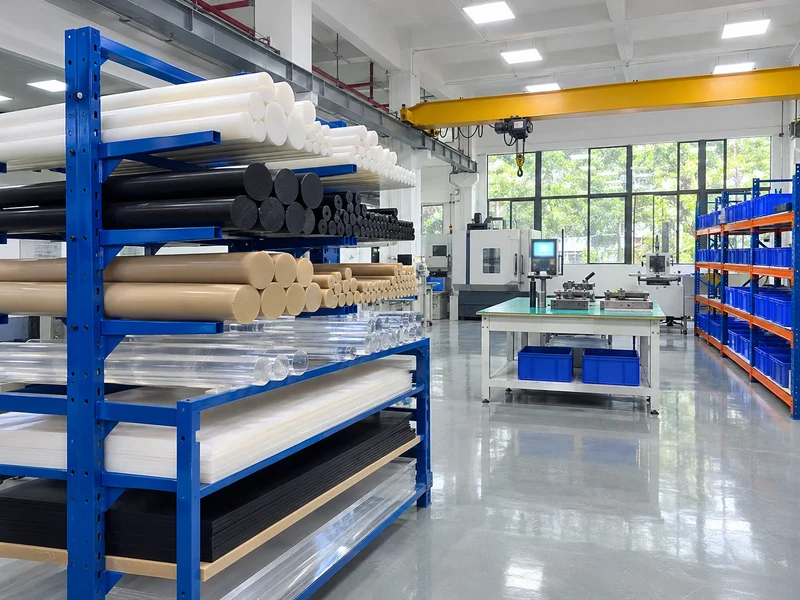
| Material (typical) | Machinability | Stability | Typical parts |
|---|---|---|---|
| POM (acetal) | Excellent | Very good | Gears, bushings, precision parts |
| PEEK | Good | Excellent | High-temperature and chemical parts |
| Nylon (PA6, PA66) | Good | Fair (absorbs moisture) | Wear parts, rollers |
| PC | Good | Good | Transparent covers, housings |
| Acrylic (PMMA) | Good, brittle | Good | Optical and display parts |
| PTFE | Fair (soft, creeps) | Poor | Seals, low-friction parts |
| UHMW-PE | Fair (soft) | Fair | Wear strips, guides |
For example, POM is often the first choice for tight-tolerance plastic parts, because it machines cleanly and absorbs little moisture. In contrast, PTFE is soft and creeps, so tight tolerances are hard to hold. Our comparison of acetal homopolymer vs copolymer explains POM grades.
Key Takeaway: For tight tolerances in plastic, start with POM or PEEK.
What Tolerances Can CNC Plastic Machining Hold?
CNC plastic machining can hold tolerances that depend on the material, the part size and the environment, not only on the machine.
Typical guidance:
- General features: about ±0.05–0.1 mm
- Small, stable features in POM or PEEK: tighter is often possible
- Large parts: wider, because of thermal expansion
- Soft plastics (PTFE, UHMW-PE): wider, because of creep and flexibility
- Moisture-sensitive plastics (nylon): define the measurement condition
Machine capability is not the same as finished-part tolerance. For example, a machine that positions to a few microns still cannot make a 200 mm nylon part hold ±0.02 mm in a humid workshop. Therefore, tolerances are controlled per drawing and per material. General tolerances such as ISO 2768 are useful for non-critical features.
Key Takeaway: Put tight tolerances only on functional features. Plastic punishes unnecessary precision.
How Should Parts Be Designed for CNC Plastic Machining?
Parts should be designed for CNC plastic machining with enough stiffness, accessible features and realistic tolerances.
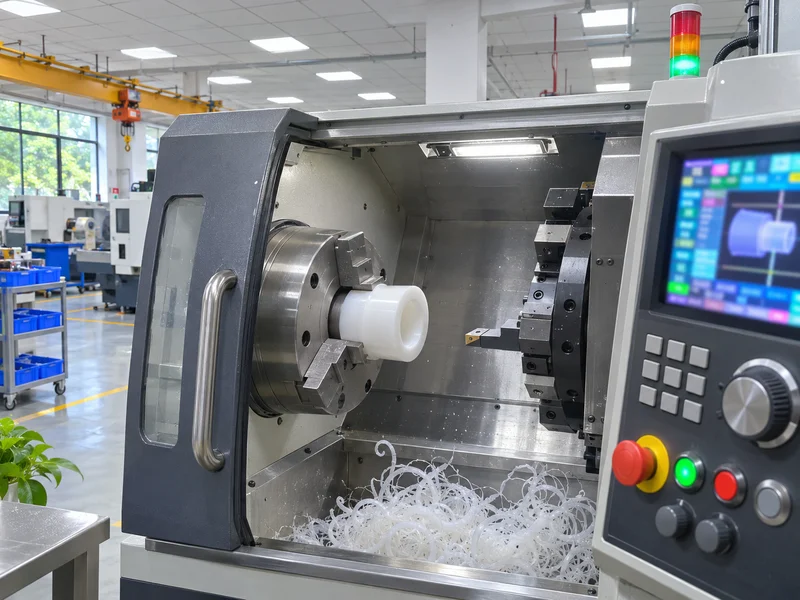
Design tips:
- Wall thickness: thicker than in molded parts, often 1.5 mm or more
- Inside corners: radii that match standard cutter sizes
- Deep pockets: limit depth to a few times the cutter diameter
- Threads: use inserts for frequently assembled threads
- Thin features: add support or tabs during machining
- Stock size: design around standard rod and plate sizes
For example, a POM part with a 0.5 mm thin wall may vibrate and break during machining. Increasing the wall to 1.5 mm makes it stable and cheaper. Our guide to CNC lathe vs CNC mill explains which process suits each shape.
Key Takeaway: Design machined plastic parts as machined parts, not as molded parts made by machining.
What Drives the Cost of Machined Plastic Parts?
CNC plastic machining cost comes from material, machine time, setups and finishing. There is no tool cost, but each part takes machine time.
Main cost drivers:
- Material price: PEEK costs far more than POM or nylon
- Material removal: large blocks with deep pockets take longer
- Setups: each new orientation adds time
- Tolerances and finish: tight features need slower passes and more inspection
- Quantity: setup cost spreads over more parts
For example, ten POM brackets may cost much more each than a batch of 200, because setup and programming are shared over fewer parts. We do not publish fixed prices; each quote follows the drawing and quantity. Our guide to rapid CNC machining explains how batch size and stock affect cost and lead time.
Key Takeaway: Ask for prices at two or three quantities. The curve shows when molding should be compared.
When Should You Mold Instead of Machining Plastic?
You should mold instead of machining plastic when volume rises, the design is stable and the part has features that molding makes easily.
Choose molding when:
- Volume reaches a few hundred to a few thousand parts or more
- Thin walls, clips and living hinges are needed
- Complex outer shapes would need many setups
- Part cost must fall significantly
- The material molds well, such as ABS, PC, PP or POM
Keep machining when:
- Volume is low or uncertain
- The design is still changing
- Parts are thick and would sink or void if molded
- The material is hard to mold, or stock shapes are more practical
For example, 500 POM gears may be machined first, then moved to a mold when demand reaches 10,000 a year. Our guide to low volume injection molding explains the step between machining and mass production, and our plastic injection molding service covers volume production.
Key Takeaway: Plan the switch to molding early. Design changes for moldability take time.
FAQ
- Q: What is CNC plastic machining?
- It is the milling, turning and drilling of plastic stock into finished parts using CNC machines.
- Q: Which plastics are easiest to machine?
- POM (acetal) is the easiest and most stable, followed by PEEK, nylon and PC.
- Q: What tolerances can machined plastic parts hold?
- Typically about ±0.05–0.1 mm for general features, tighter on small, stable features in POM or PEEK.
- Q: Is CNC machining or injection molding cheaper for plastic parts?
- Machining is cheaper for low volumes; injection molding is cheaper once volume passes a break-even point.
- Q: Can CNC machining replace injection molding?
- For prototypes, low volumes and thick or complex parts, yes. For high volumes and thin-walled parts, molding is better.
Conclusion
CNC plastic machining gives precise plastic parts without tooling, as long as material, tolerances and design suit the process. Choose stable plastics for tight features, design for machining and compare costs with molding as volume grows. To review your part, send your 3D model and 2D drawing to our engineers.