
PET Injection Molding: Grades, Drying and Mold Temperature
PET injection molding makes parts from polyethylene terephthalate, a polyester known for stiffness, dimensional stability, chemical resistance and a good surface. Most people know PET from bottles, which are made by injection molding a preform and then blow molding it. Engineering parts, however, are usually molded from glass-filled PET grades, such as housings, connectors and appliance components.
PET is less forgiving than many common plastics. For example, PET molded with too much moisture can look fine yet be brittle, because water breaks its polymer chains in the barrel. Likewise, an engineering PET part molded in a cold mold may stay partly amorphous and warp later in heat. In this guide, we explain PET injection molding for buyers: grades, moisture, mold temperature, part design and the inputs a supplier needs for a reliable quote. For a material comparison, see our guide to polyethylene terephthalate vs polypropylene.
PET injection molding requires thorough drying, typically to below about 0.02% moisture (often about 0.005% for clear preforms), because PET hydrolyzes in the melt. Melt temperatures are about 260–290 °C. Clear PET parts and preforms are molded in cold molds to stay amorphous and transparent, while engineering parts in glass-filled PET need hot molds, often about 120–140 °C, to crystallize fully and keep their shape in heat. A reliable quote needs the part geometry, exact grade, clear or crystalline requirement, moisture control plan and volume.
In short: decide whether the part must be clear or crystalline, specify the grade, and make moisture control part of the quote.
Key points:
- Moisture: PET must be dried very well.
- Mold temperature: cold for clear parts, hot for crystalline parts.
- Inputs: grade, appearance and service conditions.
What Is PET Injection Molding?
PET injection molding is the injection molding of polyethylene terephthalate. There are two main uses:
- Preforms and clear parts: amorphous, transparent PET, often later blow molded into bottles or containers
- Engineering parts: crystalline, usually glass-filled PET, used for stiff, heat-resistant components
Each use needs a different process. Clear parts need fast cooling to prevent crystallization, which would make them hazy. Engineering parts, in contrast, need slow cooling in a hot mold so they crystallize and stay stable. Our guide to comprehensive list of transparent polymers compares PET with other clear plastics.
Key Takeaway: Tell the supplier whether the part must be clear or crystalline. It changes the whole process.
Which PET Grades Are Used in Injection Molding?
PET grades used in injection molding include bottle grades, clear copolyesters and glass-filled engineering grades.
| Grade type (typical) | Main property | Typical parts |
|---|---|---|
| Bottle-grade PET | Clarity, toughness | Preforms, clear containers |
| Copolyester (e.g. PETG) | Clarity, easier processing | Clear housings, displays |
| PET-GF30 | Stiffness, heat resistance | Housings, connectors, appliance parts |
| Flame-retardant PET-GF | Electrical safety | Electrical components |
For example, a clear display cover may use PETG because it stays amorphous more easily. A motor housing may use PET-GF30 for stiffness at temperature. Grade properties are measured with standard test methods, such as those from ISO, so compare datasheets on the same basis.
Key Takeaway: Name the grade, filler content and flame rating. “PET” alone is not enough for a quote.
Why Is Moisture Control So Important in PET Injection Molding?
Moisture control is important in PET injection molding because PET reacts with water at melt temperature. This reaction, hydrolysis, breaks the polymer chains and lowers the molecular weight.
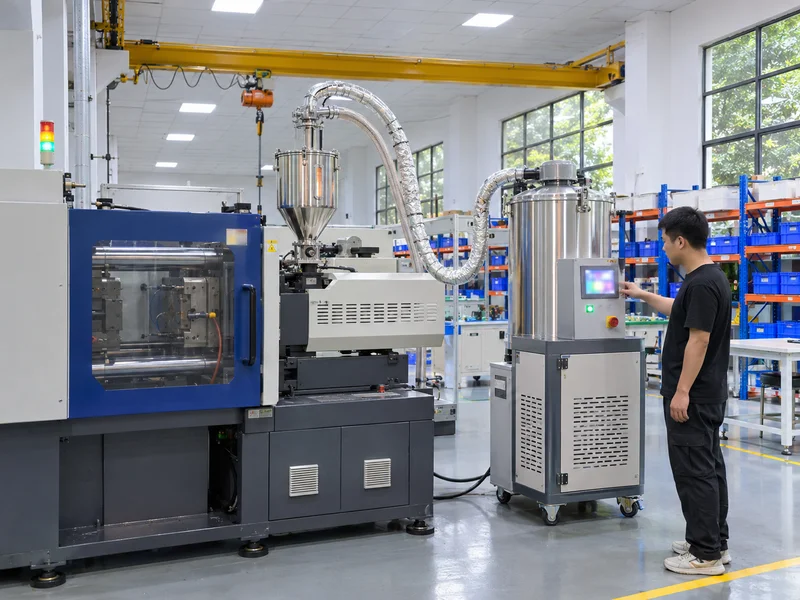
Effects of poor drying:
- Brittle parts with low impact strength
- Lower intrinsic viscosity (IV), a measure of chain length
- Bubbles or splay on the surface
- Haze in clear parts
- Inconsistent filling from shot to shot
PET is usually dried in a desiccant dryer, often at about 150–170 °C for several hours, to below about 0.02% moisture. For example, PET dried for only half the required time can pass a visual check but fail a drop test. Our guide to plastic resin drying explains dryer settings and moisture checks.
Key Takeaway: Ask the supplier how PET moisture is measured and recorded for each lot.
How Does Mold Temperature Affect PET Parts?
Mold temperature affects PET parts because it decides how much the material crystallizes.
- Cold mold (about 10–40 °C): fast cooling keeps PET amorphous and clear.
- Hot mold (about 120–140 °C): slow cooling crystallizes PET, giving stiffness and heat resistance.
- In between: partly crystalline parts, which may shrink, warp or turn hazy later.
For example, a PET-GF30 bracket molded at 60 °C may look acceptable but warp when it reaches 120 °C in service, because it continues to crystallize. Molded at 130 °C, it stays stable. Our injection mold manufacturing projects include molds heated for high mold temperatures when the grade requires it.
Key Takeaway: For engineering PET, ask for the planned mold temperature. Too cool a mold causes later warpage.
How Should Parts Be Designed for PET Injection Molding?
Parts should be designed for PET injection molding with uniform walls, good radii and gating that suits the grade.
Design guidelines:
- Wall thickness: uniform, typically about 1–4 mm for engineering parts
- Radii: generous inside corners, especially in glass-filled grades
- Ribs: about 50–60% of the wall thickness
- Gate location: to control fiber orientation and warpage
- Weld lines: away from loaded or visible areas
- Draft: about 1° or more, depending on texture
For example, a long glass-filled PET housing may warp because fibers align along the flow. Moving the gate to the center often balances shrinkage. Our guide to plastic shrinkage explains how fibers affect shrinkage.
Key Takeaway: Gate location controls warpage in glass-filled PET. Review it before the mold is built.
What Are Common PET Molding Defects?
Common PET molding defects come from moisture, temperature and crystallization problems.
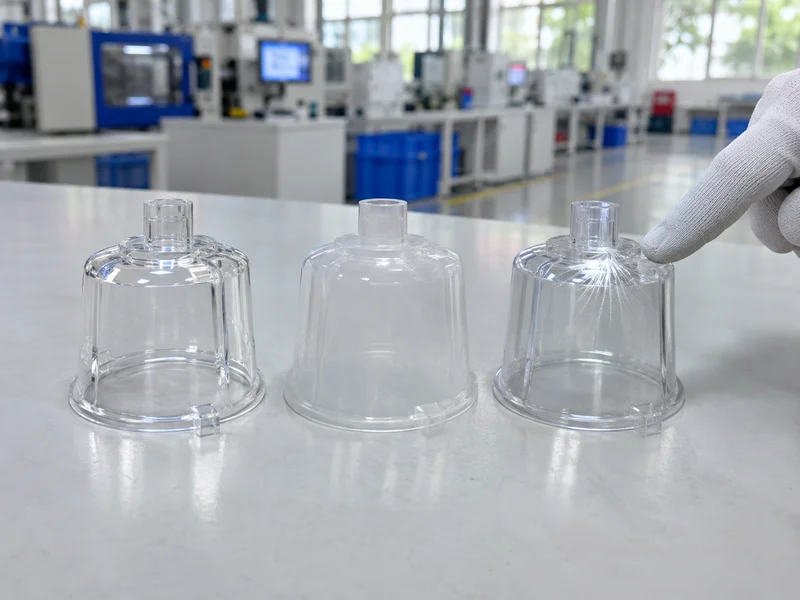
| Defect | Common cause |
|---|---|
| Brittleness | Poor drying, overheating |
| Haze in clear parts | Slow cooling, moisture, contamination |
| Warpage | Low mold temperature, fiber orientation |
| Splay and bubbles | Moisture |
| Yellowing | Too high melt temperature or long residence time |
| Short shots | Low melt temperature, poor venting |
For example, yellow streaks in a clear PET part often point to material staying too long in the barrel. Using a smaller barrel or reducing residence time fixes it. Our guide to injection molding defects and troubleshooting covers general defects.
Key Takeaway: Most PET defects trace back to drying and temperature. Check those records first.
What Inputs Does a Supplier Need for a Reliable PET Injection Molding Quote?
A supplier needs the 3D model and 2D drawing first, then the information that decides grade, process and quality.
Inputs for a reliable quote:
- 3D model and 2D drawing, with critical dimensions
- Exact grade, filler content and flame rating
- Clear or crystalline requirement
- Service conditions: temperature, chemicals and loads
- Cosmetic requirements: gloss, color and allowed marks
- Annual volume and lot sizes
- Documents needed, such as material certificates or inspection reports
For example, a quote request that says “PET-GF30, flame-retardant, 130 °C service, 20,000 parts per year” lets the supplier plan drying, mold heating and steel. PET is not one of our standard listed resins, so we confirm grade availability and process capability for each PET project before quoting. Our guide to the injection molding quote and RFQ checklist lists more inputs.
Key Takeaway: State the grade and service temperature in the RFQ. They decide whether the quote is realistic.
FAQ
- Q: Can PET be injection molded?
- Yes. PET is injection molded into preforms, clear parts and glass-filled engineering parts.
- Q: Why does PET need so much drying?
- Because moisture breaks PET’s polymer chains in the melt, making parts brittle.
- Q: What mold temperature is used for PET?
- About 10–40 °C for clear amorphous parts, and about 120–140 °C for crystalline engineering parts.
- Q: What is the difference between PET and PETG?
- PETG is a modified copolyester that stays clear more easily and is easier to process, but it has lower heat resistance.
- Q: Why do PET parts warp?
- Often because of low mold temperature, which leaves the part partly amorphous, or because of glass fiber orientation.
Conclusion
PET injection molding gives stiff, stable or clear parts when moisture, mold temperature and grade are controlled. Decide clear or crystalline, specify the grade and service conditions, and make drying part of the quote. To review a PET part, send your 3D model and 2D drawing to our engineers.