
Advantages of Cast Iron vs Steel Aluminium Industrial Components: How to Pick the Best One and Save Money
The advantages of cast iron vs steel aluminium industrial components come down to damping, stiffness, weight, machinability and cost. Cast iron absorbs vibration and is cheap in complex shapes. Steel is the strongest and stiffest of the three, and it can be welded. Finally, aluminium is the lightest, machines fastest and resists corrosion without much help.
However, for a machined base, frame or housing, the wrong material shows up quickly. For example, a machine base made from welded steel plate may ring and pass vibration to a spindle, while a cast iron base of the same shape stays quiet. On the other hand, a portable fixture in cast iron may be too heavy to lift. In this guide, we compare the advantages of cast iron vs steel aluminium industrial components for machined bases and structural parts, including damping, stiffness, weight, machining, corrosion and cost. For heavy parts in general, see our guide to metals for large CNC machined parts.
Cast iron (for example grey iron EN-GJL-250) offers excellent vibration damping, good compressive strength, good wear resistance and low cost in complex cast shapes, but it is brittle and cannot be welded easily. Steel offers the highest strength and stiffness (about 200 GPa) and can be welded into large frames, but it damps vibration poorly and is heavy. Aluminium is about one-third the weight of steel, machines fastest and resists corrosion, but it is about one-third as stiff and costs more per kilogram than iron or mild steel. Choose cast iron for quiet, stable bases; steel for strong welded frames; aluminium for light, fast-machined parts.
In short: cast iron for damping and stability, steel for strength and welded frames, aluminium for low weight and fast machining.
Key points:
- Damping: cast iron is far better than steel or aluminium.
- Stiffness: steel is about three times stiffer than aluminium.
- Weight: aluminium is about one-third the density of iron or steel.
What Are the Advantages of Cast Iron vs Steel Aluminium Industrial Components?
The advantages of cast iron vs steel aluminium industrial components differ by property. In other words, each material wins in a different area.
| Property (typical) | Grey cast iron | Carbon steel | Aluminium alloy |
|---|---|---|---|
| Density | ≈7.2 g/cm³ | ≈7.85 g/cm³ | ≈2.7 g/cm³ |
| Elastic modulus | ≈100–140 GPa | ≈200 GPa | ≈69–72 GPa |
| Vibration damping | Excellent | Poor | Poor to fair |
| Tensile strength | ≈150–350 MPa | ≈400–700 MPa | ≈200–570 MPa |
| Ductility | Low (brittle) | High | Medium |
| Weldability | Poor | Good | Fair to good |
| Machinability | Good | Fair to good | Excellent |
| Corrosion resistance | Fair (rusts) | Poor without coating | Good |
Cast iron grades are defined in standards such as those from ISO and EN, so specify the grade, not only “cast iron”.
Key Takeaway: Decide which property limits your part first. The material choice usually follows.
Why Is Cast Iron Used for Machine Bases?
In practice, cast iron is used for machine bases because it damps vibration, stays dimensionally stable and is economical in complex shapes.
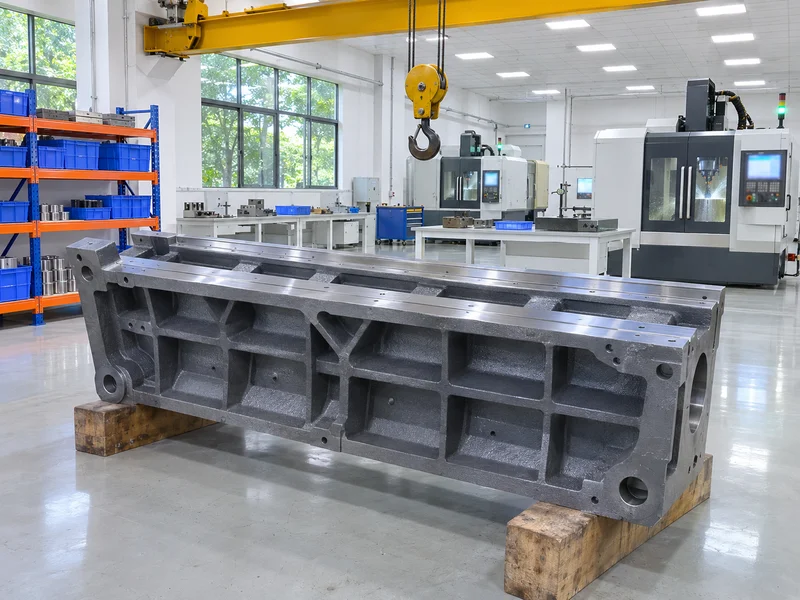
Its main advantages are:
- Damping: graphite flakes in grey iron absorb vibration energy.
- Stability: properly stress-relieved castings move very little over time.
- Wear: cast iron slideways and surfaces resist wear and scuffing.
- Complex shapes: ribs and pockets are cast in, reducing machining.
- Cost: low material cost per kilogram for large parts.
Even so, there are limits to consider:
- Brittle: cast iron can crack under impact.
- Pattern cost: casting needs a pattern or mold, so very low volumes cost more.
- Lead time: casting adds weeks before machining starts.
For instance, a precision grinding machine base is almost always cast iron, because damping protects the surface finish. Our guide to casting vs machining explains when a cast blank pays back.
Key Takeaway: Among the advantages of cast iron vs steel aluminium industrial components, damping stands out. Choose cast iron where vibration and long-term stability matter more than weight or impact strength.
When Is Steel the Better Choice?
By contrast, steel is the better choice when the component needs the highest strength and stiffness, impact resistance or welding into large frames.
Typical steel components:
- Welded machine frames for large or one-off equipment
- Heavily loaded brackets and arms
- Parts exposed to impact or shock
- Shafts, pins and wear parts, often heat treated
For example, a large press frame is often welded steel, because it must carry high loads and is too large to cast economically. However, welded steel frames usually need stress relief before machining to stay stable. Our guide to strength of titanium vs steel compares steel grades by strength.
Key Takeaway: When comparing the advantages of cast iron vs steel aluminium industrial components, steel wins on strength. Choose steel for strength, stiffness and welded structures, and plan stress relief before finish machining.
When Does Aluminium Make Sense for Industrial Components?
Meanwhile, aluminium makes sense for industrial components when weight, machining speed or corrosion resistance matter more than stiffness and damping.
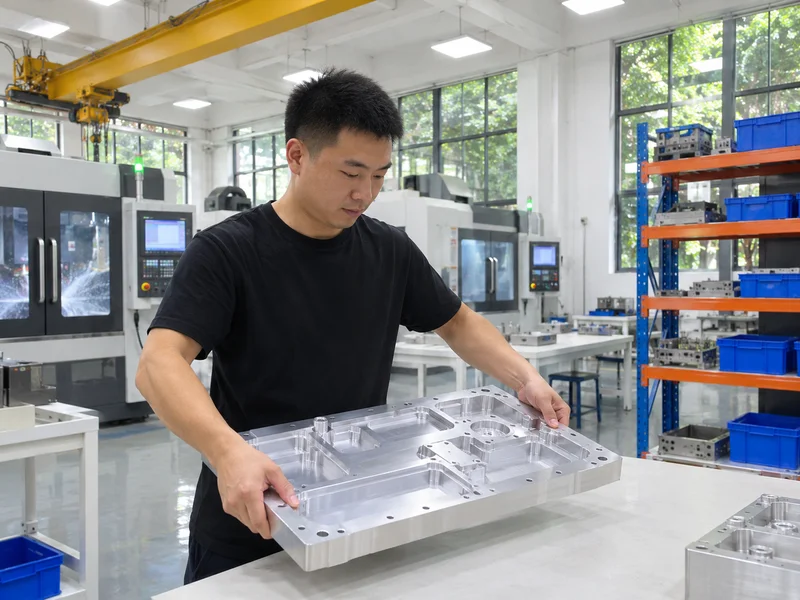
Typical aluminium components:
- Fixtures and jigs that operators lift by hand
- Moving parts in automation, where low inertia matters
- Housings and covers with many machined features
- Heat sinks and thermally conductive parts
For instance, a pick-and-place gripper frame in aluminium reduces moving mass, so the robot can run faster. In contrast, an aluminium machine base would deflect about three times more than steel of the same shape. Our comparison of 6061 T6 aluminum vs 7075 T6 explains the main machining grades.
Key Takeaway: Choose aluminium for light, moving or fast-machined parts, not for stiff, heavy bases.
How Do Machining and Cost Affect the Advantages of Cast Iron vs Steel Aluminium Industrial Components?
Similarly, machining and cost compare differently for cast iron vs steel aluminium industrial components, because raw material, machining time and finishing all change.
| Cost factor (typical) | Cast iron | Steel | Aluminium |
|---|---|---|---|
| Raw material per kg | Low | Low | Higher |
| Blank cost for complex shapes | Low (cast) | Higher (welded or cut) | Medium (plate or cast) |
| Machining speed | Good | Moderate | Fastest |
| Tool wear | Moderate (abrasive) | Moderate | Low |
| Finishing | Paint | Paint, plating or oxide | Anodizing or bare |
For example, a pocketed fixture plate may be cheaper in aluminium even at a higher material price, because it machines several times faster. Our CNC machining services cover aluminium, carbon steel, tool steel and stainless steel; cast blanks are machined to drawing when supplied or sourced per project.
Key Takeaway: Compare the cost of the finished part, not the price per kilogram.
How Should You Specify the Material on the Drawing?
Above all, you should specify the material on the drawing with the exact grade, condition and any required treatment.
Include:
- Grade and standard, such as EN-GJL-250, S355 or 6061-T6
- Condition, such as stress-relieved, normalized or T651
- Coating or finish, such as paint, anodizing or plating
- Certificate needs, if traceability is required
- Acceptable alternatives, to protect lead time
For example, “aluminium” alone can lead to a soft alloy that dents in use, while “6061-T651” makes the requirement clear. Our quality control and inspection process can supply material certificates on request.
Key Takeaway: Write the grade and condition on the drawing. It removes guesswork for every supplier.
FAQ
- Q: What are the main advantages of cast iron?
- Excellent vibration damping, good stability and wear resistance, and low cost in complex cast shapes.
- Q: Is steel stronger than cast iron?
- Yes. Steel has higher tensile strength and ductility, while grey cast iron is brittle.
- Q: Why use aluminium instead of steel?
- For lower weight, faster machining and better corrosion resistance, when stiffness is not the limiting factor.
- Q: Which material is best for a machine base?
- Usually cast iron for damping and stability, or stress-relieved welded steel for very large or one-off bases.
- Q: Can cast iron be welded?
- Only with difficulty and special procedures. Steel is far easier to weld.
Conclusion
The advantages of cast iron vs steel aluminium industrial components depend on the part’s main need: damping and stability, strength and weldability, or low weight and fast machining. Specify the exact grade and condition. To compare materials for your part, send your 3D model and 2D drawing to our engineers.