
Acetal Homopolymer vs Copolymer: How to Pick the Best
Acetal homopolymer vs copolymer is a choice between slightly higher mechanical performance and better chemical and thermal stability. Acetal homopolymer (POM-H) is stiffer, stronger and more creep resistant. Acetal copolymer (POM-C) resists hot water, strong alkalis and long-term heat aging better, and it is easier to process without degradation.
For many molded parts, either grade works. However, the difference shows up at the edges. For example, a small gear under constant load may keep its tooth shape longer in homopolymer. A pump component in hot, alkaline cleaning water, however, usually lasts longer in copolymer. In this guide, we compare acetal homopolymer vs copolymer for molded parts by strength, wear, chemicals, temperature, molding and dimensional control. For a broader comparison, see our guide to Delrin vs nylon.
Acetal homopolymer (POM-H) has higher crystallinity, giving it typically about 10–15% higher strength and stiffness, better creep and fatigue resistance and a melting point of about 175 °C. Acetal copolymer (POM-C) melts at about 165 °C and offers better resistance to hot water, steam and strong alkalis, better long-term thermal stability, a wider processing window and less centerline porosity in thick sections. Choose homopolymer for maximum stiffness and creep resistance; choose copolymer for chemical exposure, hot water and thick parts.
In short: homopolymer for strength and creep; copolymer for chemicals, hot water and easier processing.
Key points:
- Mechanical: homopolymer is stiffer, stronger and resists creep better.
- Chemical: copolymer resists hot water and strong alkalis better.
- Processing: copolymer is more stable and forgiving in molding.
What Is the Difference Between Acetal Homopolymer vs Copolymer?
The difference between acetal homopolymer vs copolymer lies in the polymer chain. Homopolymer is made of one repeating unit, which packs into a highly crystalline structure. Copolymer adds a small amount of a second unit, which interrupts the chain and stabilizes it against breakdown.
| Property (typical) | POM-H (homopolymer) | POM-C (copolymer) |
|---|---|---|
| Density | about 1.42 g/cm³ | about 1.41 g/cm³ |
| Melting point | about 175 °C | about 165 °C |
| Tensile strength | Higher | Slightly lower |
| Stiffness | Higher | Slightly lower |
| Creep and fatigue resistance | Better | Good |
| Hot water and alkali resistance | Fair | Better |
| Thermal stability in processing | Lower | Higher |
| Centerline porosity in thick stock | More likely | Less likely |
Delrin is a well-known homopolymer trade name, while many other acetal grades are copolymers. Properties are measured with standard methods, such as those published by ISO, so compare datasheets on the same basis.
Key Takeaway: Ask which type a quoted “POM” or “acetal” is. The label alone does not say.
Which Is Stronger: Acetal Homopolymer or Copolymer?
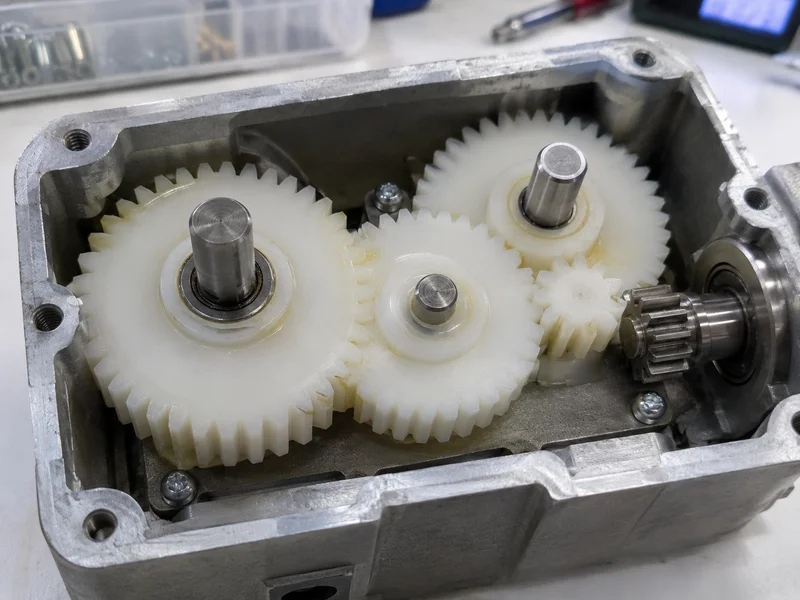
Acetal homopolymer is stronger and stiffer than copolymer, typically by around 10–15% in tensile strength and flexural modulus. It also resists creep and fatigue better.
In practice, that matters for:
- Gears that carry constant torque
- Springs and snap-fits that must keep their force
- Thin-walled parts that must stay stiff
- Fasteners and clips under long-term load
For example, a molded clip that holds a cable under tension may relax less over years in homopolymer. However, the difference is moderate, so copolymer often meets the requirement with margin.
Impact strength also differs slightly. Homopolymer is usually a little tougher at room temperature, while toughened grades of both types are available for parts that must survive drops or snap-fit assembly. In addition, glass-filled acetal grades raise stiffness further, but they reduce wear performance and make shrinkage more directional.
Key Takeaway: Choose homopolymer when stiffness or creep is the limiting factor. Otherwise, the difference rarely decides the design.
How Do Wear and Friction Compare?
Overall, wear and friction are similar for acetal homopolymer vs copolymer, and both are excellent. Acetal has a low friction coefficient and good wear resistance against steel, which is why it is common in gears, bearings and sliding parts.
Here are the practical points:
- Homopolymer tends to have slightly better wear resistance under high load.
- In comparison, copolymer performs very well in most sliding applications.
- Lubricated grades with PTFE or silicone reduce friction further.
- Counterface material and surface finish matter more than the acetal type.
For example, a gear pair of acetal on acetal can be noisy and wear faster than acetal running against nylon or steel. Therefore, the mating material should be chosen together with the acetal grade.
Key Takeaway: For wear parts, select the mating material and lubrication first, then the acetal type.
Which Handles Chemicals and Hot Water Better?
Acetal copolymer handles chemicals and hot water better than homopolymer. This is because its chain is more stable against hydrolysis and alkaline attack.
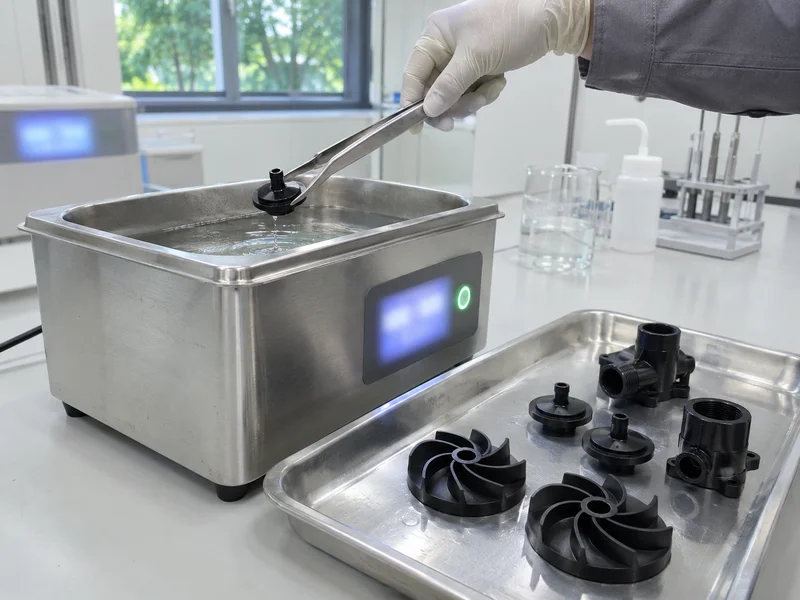
- Hot water and steam: copolymer keeps properties longer.
- Strong alkalis: copolymer resists a wider pH range.
- Acids: strong acids attack both types.
- Fuels, oils and solvents: most of them cause no problem.
- Chlorinated water: either type can degrade, so check the grade data.
As a result, copolymer is common in plumbing components, pump parts, food processing equipment and parts cleaned with hot alkaline detergents. Food-contact use needs grade-specific compliance documents, for example against U.S. FDA requirements.
UV light is a weakness of both types. Unstabilized acetal chalks and loses strength outdoors, so UV-stabilized or black grades are used for outdoor parts. For example, an outdoor clip in natural acetal can turn brittle within a few seasons, while a UV-stabilized black grade lasts much longer.
Key Takeaway: For hot water, steam or alkaline cleaning, choose copolymer.
How Does Temperature Affect Acetal Homopolymer vs Copolymer?
First of all, temperature affects acetal homopolymer vs copolymer in two ways: short-term stiffness and long-term aging. On one hand, homopolymer has a slightly higher melting point and keeps stiffness a little better at moderate temperatures. On the other hand, copolymer ages better during long exposure to heat.
- Short-term heat: homopolymer has a slight advantage.
- Long-term heat aging: copolymer is usually more stable.
- Continuous use: typical limits are around 80–100 °C, depending on grade and load.
- Low temperatures: each type keeps good toughness in the cold.
Our guide to plastics for hot temperatures compares acetal with higher-temperature options.
Key Takeaway: For long service in warm environments, copolymer is often the safer choice.
How Do Acetal Homopolymer vs Copolymer Mold Differently?
Acetal homopolymer vs copolymer mold similarly, but copolymer is more forgiving. In particular, homopolymer is more sensitive to overheating and long residence time in the barrel, which can release formaldehyde and cause degradation.
| Molding factor (typical) | POM-H | POM-C |
|---|---|---|
| Processing window | Narrower | Wider |
| Thermal stability in barrel | Lower | Higher |
| Mold shrinkage | about 2.0–2.2% | about 1.8–2.0% |
| Venting needs | High | High |
| Thick sections | More voids risk | Fewer voids |
Also, both shrink a lot, because acetal is highly crystalline. Therefore, mold dimensions must account for it, and thick sections should be avoided. Both also need good venting, because trapped gas causes burn marks. Our guides to plastic shrinkage and injection mold venting cover both issues.
Key Takeaway: Do not swap homopolymer and copolymer in the same mold without checking shrinkage and dimensions.
How Do Fit and Dimensional Stability Compare?
Fit and dimensional stability are good for both acetal types, because acetal absorbs very little moisture. That makes acetal more stable than nylon in humid conditions.
Still, there are differences to consider:
- Shrinkage: homopolymer shrinks slightly more, so a mold cut for copolymer can give smaller parts in homopolymer.
- Post-mold shrinkage: both continue to shrink slightly after molding; annealing can stabilize critical parts.
- Thick sections: copolymer has less centerline porosity, which helps machined stock and thick molded parts.
Therefore, for precise gears and bearings, specify the acetal type on the drawing. Our guide to injection molding tolerances explains how to set realistic tolerances for semi-crystalline plastics.
Key Takeaway: Write the acetal type on the drawing for tight-tolerance parts. A material swap can move dimensions.
Acetal Homopolymer vs Copolymer: Which Should You Choose?
You choose between acetal homopolymer vs copolymer by naming the main risk for the part.
- Constant load, creep or stiffness? Use homopolymer.
- Hot water, steam or alkaline cleaners? Pick copolymer.
- Long-term heat aging? In most cases, copolymer.
- Thick sections or machined stock? Again, copolymer.
- Gears and springs in dry, room-temperature service? Either; homopolymer has a slight edge.
We mold POM and other engineering resins, from T1 trial to volume production, and machine POM for prototypes. For other material choices, see our injection molding material selection guide.
Key Takeaway: Choose homopolymer for mechanical limits and copolymer for chemical, thermal and processing limits.
FAQ
- Q: What is the difference between acetal homopolymer and copolymer?
- Homopolymer has one repeating unit and higher crystallinity, giving more strength and stiffness. Copolymer adds a second unit, improving chemical and thermal stability.
- Q: Is Delrin a homopolymer or copolymer?
- Delrin is a well-known acetal homopolymer trade name.
- Q: Which acetal is better for hot water?
- Copolymer. It resists hot water, steam and strong alkalis better than homopolymer.
- Q: Which acetal is stronger?
- Homopolymer, typically by about 10–15% in strength and stiffness, with better creep resistance.
- Q: Do homopolymer and copolymer shrink the same?
- Not exactly. Homopolymer usually shrinks slightly more, so swapping types can change part dimensions.
Conclusion
Acetal homopolymer vs copolymer comes down to strength and creep against chemical resistance, heat aging and easier processing. Choose homopolymer for mechanical limits and copolymer for hot water, chemicals and thick parts. To confirm the right grade for your part, send your 3D model and 2D drawing to our engineers.
Need support on your own project? Learn more about our plastic injection molding service or request a quote.