
Machining Acetal: Grades, Warping and Tolerances
Machining acetal (POM) is one of the easiest ways to make precise plastic parts. Acetal is stiff, dimensionally stable, low in friction and absorbs very little moisture, so machined gears, bushings, valve parts and fixtures hold their size well. It cuts cleanly, with good chip formation and a smooth finish.
Even so, a good result depends on what the drawing specifies. For example, a thick acetal plate machined deeply on one side may warp if the stock was not stress relieved, or show centerline porosity in a sealing face if homopolymer rod was used. In this guide, we explain machining acetal and what to specify for a precision part: grade, stock form, tolerances, heat and stress control, surface finish, threads and inspection. For grade selection, see our guide to acetal homopolymer vs copolymer.
Machining acetal (POM) gives precise, stable plastic parts. It machines with sharp, high-rake carbide or HSS tools, high speeds and moderate feeds, often with air blast or water-based coolant. Copolymer (POM-C) is usually preferred for machined stock because it has less centerline porosity; homopolymer (POM-H, such as Delrin) is stiffer. Stress-relieved stock and balanced roughing reduce warpage. Realistic tolerances are often about ±0.025–0.05 mm on small, stable features. Specify grade, stock condition, critical tolerances, surface finish, edge breaks and inspection temperature.
In short: specify the POM grade and stress-relieved stock, keep tolerances realistic and control heat and stress during machining.
Key points:
- Grade: POM-C for porosity-free stock; POM-H for stiffness.
- Stability: stress-relieved stock and balanced cuts.
- Tolerances: tighter than most plastics, but not metal-level everywhere.
Why Is Machining Acetal a Good Choice?
Acetal is good for machining because it is stiff, stable and cuts cleanly.
Key advantages:
- Clean chips and smooth surfaces
- Low moisture absorption, so dimensions stay stable
- High stiffness for a plastic
- Low friction and good wear, ideal for moving parts
- Good chemical resistance to fuels and solvents
For example, a POM gear machined from rod can run quietly against steel with little lubrication. In contrast, a nylon gear of the same size would change size more with humidity. Our guide to CNC plastic machining compares acetal with other plastics.
Key Takeaway: Choose acetal for precise, stable plastic parts that move or wear.
Which Grade Should You Specify for Machining Acetal?
You should specify the acetal grade for machining based on porosity, stiffness and service conditions.
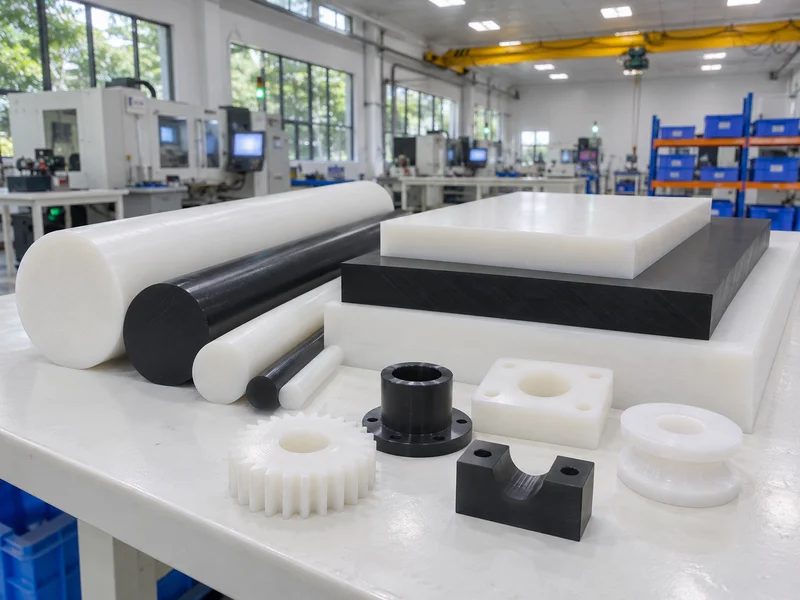
| Grade (typical) | Machining behavior | Best for |
|---|---|---|
| POM-C (copolymer) | Low centerline porosity, stable | General precision parts, sealing faces |
| POM-H (homopolymer, e.g. Delrin) | Stiffer, possible centerline porosity in thick rod | Stiff gears, springs |
| Glass-filled POM | Stiffer, more abrasive, less wear-friendly | Structural parts |
| PTFE-filled POM | Lower friction | Bearings and sliders |
For example, a valve seat machined from the center of thick POM-H rod may expose porosity on its sealing face, while POM-C rod is usually solid. Properties are measured with standard methods from ISO.
Key Takeaway: For sealing faces or thick parts, specify POM-C stock.
How Do You Avoid Warping When Machining Acetal?
You machine acetal without warping by using stress-relieved stock, removing material evenly and letting the part relax before finishing.
Methods:
- Stress-relieved (annealed) stock from a reliable supplier
- Rough both sides, leaving even stock
- Rest the part after roughing
- Light finishing passes with sharp tools
- Light clamping, spread over large areas
For example, a 10 mm acetal plate pocketed on one side may bow by several tenths of a millimeter if finished in one pass. Roughing both sides first, then finishing, keeps it flat. Our guide to CNC milling plastic explains workholding and heat control.
Key Takeaway: Plan roughing and finishing as separate steps for any thin or flat acetal part.
What Tolerances Can Machined Acetal Parts Hold?
Machined acetal parts can hold tighter tolerances than most plastics, but they still depend on size, temperature and part design.
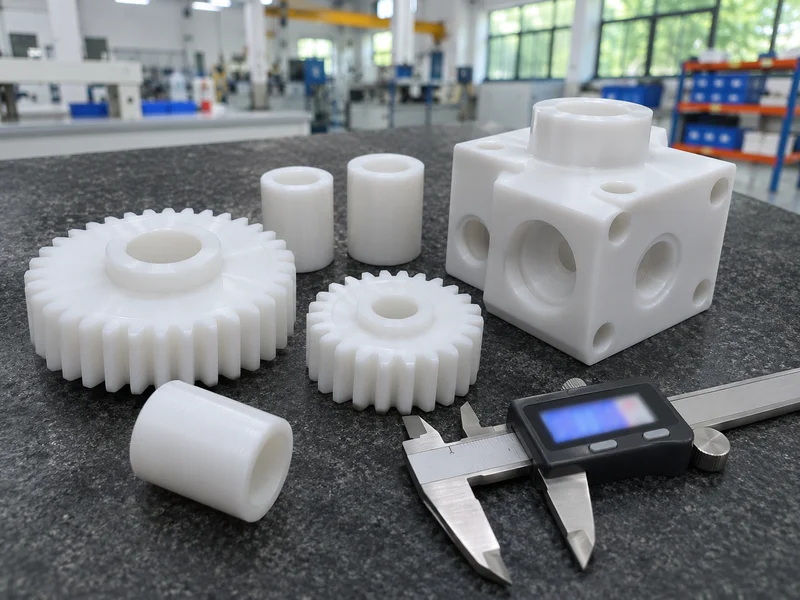
Typical guidance:
- Small, stable features: about ±0.025–0.05 mm
- Larger dimensions: wider, because of thermal expansion
- Thin walls: wider, because of flexibility
- Fits with metal parts: check clearance over the temperature range
Acetal expands about 10 times more than steel with temperature. For example, a 100 mm acetal part grows about 0.1 mm with a 10 °C temperature rise. Therefore, measurement temperature should be defined. General tolerances such as ISO 2768 work for non-critical features.
Key Takeaway: Define the measurement temperature for tight acetal dimensions.
How Should Threads and Holes Be Specified in Acetal?
Threads and holes in acetal should be specified with the plastic’s behavior in mind.
Guidelines:
- Tapped threads: fine for occasional assembly; use coarser threads where possible.
- Thread inserts: for frequent assembly or high torque.
- Reamed holes: for precise bores; account for slight elastic recovery.
- Self-tapping screws: design bosses for them if used.
- Chamfers: on hole entries to avoid burrs and stress.
For example, an M4 thread tapped directly in acetal may strip after repeated assembly, while a threaded insert lasts much longer. Our guide to threaded holes covers thread options in detail.
Key Takeaway: Use inserts where threads will be assembled often or torqued hard.
What Surface Finish and Edge Quality Should You Specify?
You should specify surface finish and edge quality where they affect function, such as sliding faces, seals and visible edges.
Specification items:
- Surface roughness on sliding or sealing faces, such as Ra 0.8 µm
- Edge break size, such as 0.2–0.5 mm chamfer
- Burr-free requirement on functional edges
- Cosmetic standard for visible faces
For example, a sliding acetal guide may need Ra 0.8 µm on its running face, while non-functional faces can stay as machined. Our guide to surface roughness Ra vs Rz explains roughness parameters.
Key Takeaway: Specify roughness only where it matters. Extra finishing adds cost.
How Should Machined Acetal Parts Be Inspected?
Machined acetal parts should be inspected at a stable temperature, with light measuring force and fixtures that support thin features.
Inspection points:
- Temperature: parts stabilized at room temperature
- Measuring force: light for thin or flexible features
- Gauges: go/no-go for bores and threads
- CMM: for complex geometry
- Visual: burrs, porosity and surface defects
Our CNC machining services machine POM from prototype to production, and inspection reports are supplied on request.
Key Takeaway: Agree inspection conditions in advance. Plastic dimensions change with temperature and force.
FAQ
- Q: Is acetal easy to machine?
- Yes. It is one of the easiest plastics to machine, with clean chips and good stability.
- Q: Which is better for machining, Delrin or acetal copolymer?
- Copolymer is often preferred for thick stock because of less centerline porosity; Delrin homopolymer is stiffer.
- Q: What tolerances can machined acetal hold?
- Often about ±0.025–0.05 mm on small, stable features.
- Q: Why does machined acetal warp?
- Internal stress in the stock is released during machining, especially with uneven material removal.
- Q: Can you tap threads in acetal?
- Yes, but inserts are better for frequent assembly or high torque.
Conclusion
Machining acetal gives precise, stable parts when the grade, stock condition, tolerances and machining sequence are specified properly. Choose POM-C for thick or sealing parts, control stress and heat, and inspect at a stable temperature. To review an acetal part, send your 3D model and 2D drawing to our engineers.