
5-Axis Milling: Tool Access, Collisions and Fixtures
5-axis milling moves the cutting tool and the part along three linear axes and two rotary axes, so the tool can reach a part from almost any angle. It allows complex surfaces, undercuts and angled features to be machined in one or two setups, often with shorter tools and better finishes. However, those extra angles also bring new risks: collisions between the spindle, holder, fixture and part, and features that look reachable in CAD but are not on the real machine.
Checking tool access and collision risk before machining avoids scrapped parts and damaged machines. For example, a deep pocket on an angled face may need a long tool that chatters, unless the part is tilted so a short tool can reach. Likewise, a large clamp can collide with the spindle when the table rotates. In this guide, we explain 5-axis milling: 3+2 vs simultaneous machining, tool access, collision risk, fixtures, accuracy and design tips. For simpler parts, see our guide to 3-axis CNC machining.
5-axis milling uses three linear axes (X, Y, Z) plus two rotary axes (A/B or B/C) to orient the tool relative to the part. In 3+2 (positional) machining, the rotary axes lock at an angle while 3 axes cut; in simultaneous 5-axis, all axes move together for freeform surfaces. Benefits include fewer setups, shorter tools, better finishes on complex surfaces and access to angled features. Risks include collisions between spindle, holder, fixture and part, limited rotary travel and reduced rigidity at extreme angles. Tool access and collisions are checked in CAM simulation with an accurate machine model, fixture and stock.
In short: 5-axis milling reduces setups and improves access, but every part needs a collision and access check with the real machine and fixture.
Key points:
- Modes: 3+2 positional or simultaneous 5-axis.
- Benefits: fewer setups, shorter tools, better surfaces.
- Risks: collisions and limited travel, checked by simulation.
What Is 5-Axis Milling?
5-axis milling is milling on a machine with two rotary axes in addition to X, Y and Z. The rotary axes tilt and rotate the part or the spindle.
Common machine types:
- Trunnion table: the table tilts (A or B) and rotates (C).
- Swivel head: the spindle head tilts, and the table rotates.
- Head-head: both rotary axes are in the head, common on large machines.
Two machining modes:
- 3+2 (positional): rotate to an angle, lock, then cut with 3 axes.
- Simultaneous 5-axis: all axes move together during cutting.
For example, a manifold block with holes on five faces can be machined in 3+2 mode in one setup. An impeller with twisted blades needs simultaneous 5-axis. Our Dongguan factory includes a Makino 5-axis machining center, and our CNC milling service covers 3- and 5-axis work.
Key Takeaway: Most 5-axis parts need only 3+2 machining. Simultaneous 5-axis is for freeform surfaces.
When Does 5-Axis Milling Help?
5-axis milling helps when a part has features on several faces, angled features or complex surfaces.
It helps when:
- Features on many faces would need several 3-axis setups
- Angled holes and faces must relate accurately
- Deep features can be reached with shorter tools by tilting
- Freeform surfaces need consistent tool contact
- Undercuts can be reached by tilting
It helps less when:
- The part is a simple plate with features on one or two faces
- Volume is high and dedicated 3-axis fixtures are cheaper per part
For example, a housing with holes on four sides and an angled port may need four setups on 3 axes but one on 5 axes, improving feature alignment. Our guide to 4 axis CNC explains the step between.
Key Takeaway: Count setups. If 5 axes remove two or more, they usually pay off.
How Do You Check Tool Access in 5-Axis Milling?
You check tool access in 5-axis milling by confirming that each feature can be reached with a rigid tool at an achievable angle.
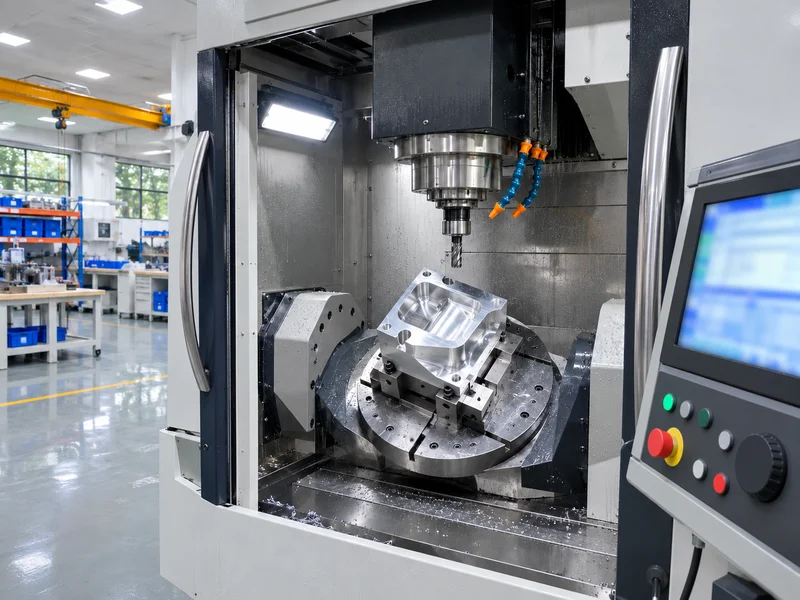
Tool access checks:
- Tool length: the shortest tool that reaches the feature
- Holder clearance: the holder must clear walls near the feature
- Tilt angle limits: within the machine’s rotary travel
- Approach direction: for drilled and threaded holes
- Surface normal: for finishing freeform surfaces
For example, a deep slot on an inclined face may need a 100 mm long tool on 3 axes but only 40 mm when the part is tilted 30°. The shorter tool cuts faster and leaves a better finish. Our guide to large part CNC machining explains access planning for big parts.
Key Takeaway: Ask whether features can be reached with standard tools. Long special tools add cost and risk.
How Is Collision Risk Checked in 5-Axis Milling?
Collision risk in 5-axis milling is checked by simulating the full program with accurate models of the machine, spindle, holder, tools, fixture and stock.
Collision checks:
- Machine kinematics: correct rotary limits and pivot points
- Holder and spindle models, not only the cutter
- Fixture and clamps in their real positions
- Stock and in-process material
- Rapid moves between operations
- Rotary axis wind-up and retract strategy
For example, a program that is safe in CAM without the fixture may drive the spindle nose into a clamp when the table rotates 90°. Simulation with the fixture model catches it. Machine safety principles are described by organizations such as OSHA.
Key Takeaway: Simulate with the real fixture and holder. Most collisions happen outside the cutting moves.
How Should Fixtures Be Designed for 5-Axis Milling?
Fixtures for 5-axis milling should hold the part rigidly while leaving as many faces open as possible.
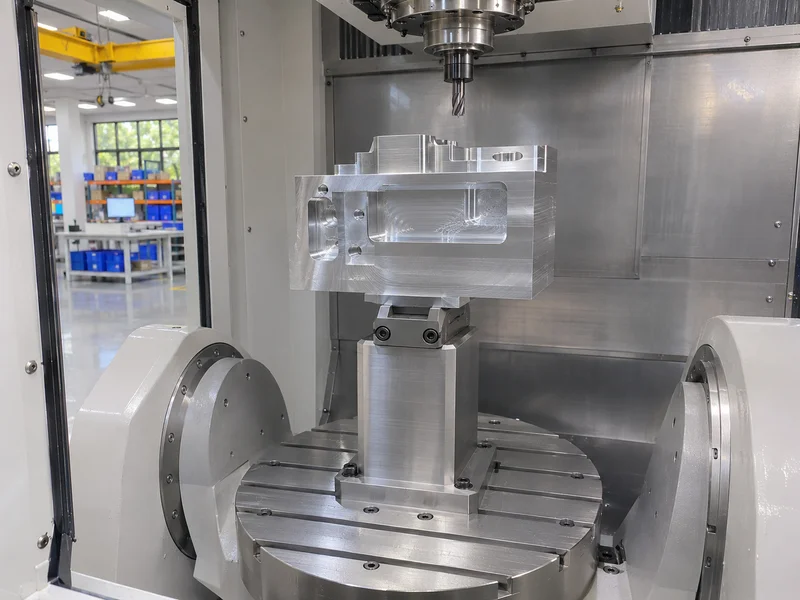
Fixture design points:
- Raise the part above the table to clear the spindle at steep angles
- Small footprint clamps, such as dovetail or zero-point systems
- Clamp on features that are machined later or on extra stock
- Rigidity to avoid vibration at extreme angles
- Repeatability for multiple parts
For example, a part held in a dovetail vise on a riser lets the tool reach five faces in one setup. The dovetail is then removed in a second, short operation. Our guide to CNC machining materials explains how stock size relates to fixturing.
Key Takeaway: Leave extra stock for clamping when needed. It opens access to five faces.
How Accurate Is Multi-Axis Machining?
5-axis milling accuracy depends on machine calibration, rotary axis accuracy, thermal stability and setup, not just the number of axes.
Accuracy factors:
- Rotary axis calibration and pivot point accuracy
- Thermal growth of spindle and machine
- Rigidity at the tilt angles used
- Tool deflection
- Single-setup machining, which removes re-clamping errors
For example, features machined in one 5-axis setup often relate better than features on two 3-axis setups, because no re-clamping is needed. However, machine capability is not finished-part tolerance; tolerances are controlled per drawing. Our quality control and inspection process verifies parts by CMM when required.
Key Takeaway: Put related features in one 5-axis setup for the best accuracy between them.
How Can Designers Make These Parts Easier to Machine?
Designers can make 5-axis milling easier by keeping features reachable with standard tools and avoiding unnecessary complexity.
Design tips:
- Avoid very deep, narrow pockets on angled faces
- Use standard hole sizes and thread sizes
- Add radii that match standard cutters
- Keep angled features within reasonable tilt angles
- Allow clamping stock where possible
- Apply tight tolerances only where needed
For example, changing a sharp internal corner to a 3 mm radius allows a standard end mill instead of a slow EDM operation. Our guide to GD&T profile tolerance explains realistic surface tolerances.
Key Takeaway: Review deep features and sharp corners with the machinist before freezing the design.
FAQ
- Q: What is 5-axis milling?
- Milling with three linear and two rotary axes, so the tool can reach the part from many angles.
- Q: What is 3+2 machining?
- Positioning the rotary axes at a fixed angle, then cutting with three axes.
- Q: When is 5-axis milling better than 3-axis?
- When it removes setups, reaches angled or deep features with shorter tools, or machines freeform surfaces.
- Q: How are collisions avoided in 5-axis milling?
- By simulating programs with accurate machine, holder, fixture and stock models.
- Q: Is 5-axis milling more expensive?
- The hourly rate is higher, but fewer setups often lower the total cost of complex parts.
Conclusion
5-axis milling reduces setups and improves access on complex parts, but every program should be checked for tool access and collisions with the real machine and fixture. Design for standard tools and clampable stock. To review a 5-axis part, send your 3D model and 2D drawing to our engineers.