
PP Copolymer vs Homopolymer: Stiffness, Impact and Heat
PP copolymer vs homopolymer is the first choice to make when specifying polypropylene for an injection-molded part. Homopolymer PP is stiffer, stronger and slightly more heat resistant. Copolymer PP contains ethylene, which makes it much tougher, especially at low temperatures. Both are light, chemically resistant and low cost, but the wrong type can crack in the cold or bend too easily in use.
The difference matters most at the edges of use. For example, a homopolymer storage box may crack when dropped in a cold warehouse, while a copolymer box survives. On the other hand, a copolymer bracket may sag under load where a homopolymer bracket stays stiff. In this guide, we compare PP copolymer vs homopolymer for injection-molded parts: structure, stiffness, impact, heat, clarity, living hinges, molding and how to choose. For general PP molding, see our guide to injection molding for polypropylene parts.
PP copolymer vs homopolymer: homopolymer PP (PP-H) is made of propylene only, giving higher stiffness (flexural modulus often about 1.3–1.8 GPa), higher strength and slightly higher heat resistance, but poor impact strength below about 0 °C. Copolymers contain ethylene: random copolymers (PP-R) improve clarity and flexibility; impact (block) copolymers (PP-B or ICP) greatly improve low-temperature impact strength at some loss of stiffness. Choose homopolymer for stiffness and heat; impact copolymer for toughness and cold use; random copolymer for clarity and flexible thin parts.
In short: homopolymer for stiffness; impact copolymer for toughness and cold; random copolymer for clarity.
Key points:
- Homopolymer: stiffest and strongest.
- Impact copolymer: tough at low temperatures.
- Random copolymer: clearer and more flexible.
What Is the Difference Between PP Copolymer vs Homopolymer?
The difference between PP copolymer vs homopolymer is the polymer chain. Homopolymer contains only propylene units, while copolymers include a small amount of ethylene.
| Property (typical) | Homopolymer (PP-H) | Impact copolymer (PP-B) | Random copolymer (PP-R) |
|---|---|---|---|
| Stiffness | Highest | Medium | Lower |
| Impact strength at 23 °C | Low to medium | High | Medium |
| Impact at −20 °C | Poor | Good | Poor to fair |
| Clarity | Translucent | Opaque | Best (clarified grades) |
| Heat deflection | Highest | Lower | Lower |
| Living hinge | Good | Good | Good |
Properties depend on the grade and are measured with standard methods from ISO. For example, a random copolymer with a clarifier is common for clear food containers.
Key Takeaway: Decide the copolymer type, not just “copolymer”. Random and impact copolymers behave very differently.
How Do Stiffness and Strength Compare?
Stiffness and strength favor homopolymer in PP copolymer vs homopolymer comparisons.
Practical effects:
- Homopolymer: stiffer walls, higher load capacity, less creep.
- Impact copolymer: more flexible, more creep under constant load.
- Glass- or talc-filled grades: available in both, raising stiffness further.
For example, a shelf bracket or appliance frame often uses homopolymer or talc-filled PP for stiffness. In contrast, a bumper-like protective part uses impact copolymer. Our guide to ABS vs polypropylene compares PP with a stiffer alternative.
Key Takeaway: Choose homopolymer or filled PP when stiffness or creep limits the part.
How Does Impact Strength Compare in the Cold?
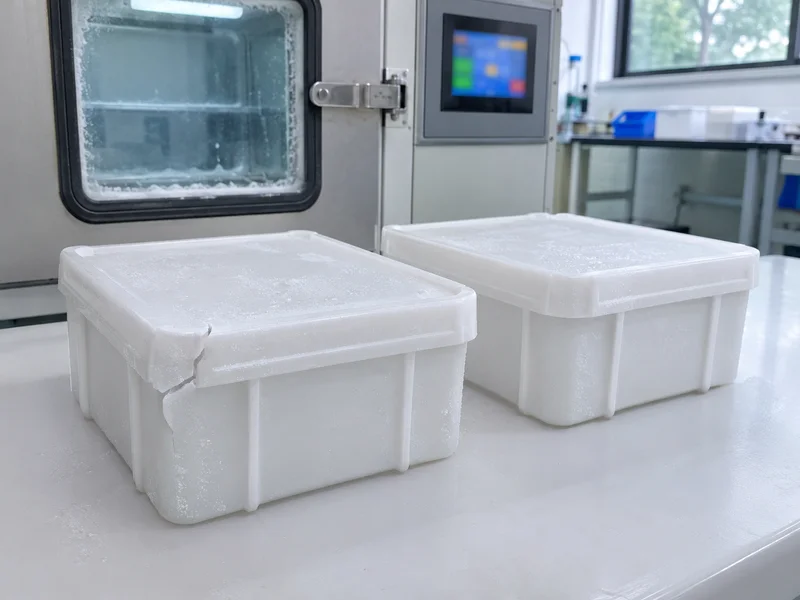
Impact strength in the cold strongly favors impact copolymer. Homopolymer becomes brittle near and below 0 °C.
Practical effects:
- Homopolymer: may crack when dropped or hit in cold conditions.
- Impact copolymer: stays tough down to about −20 °C or lower, depending on grade.
- Random copolymer: better than homopolymer at room temperature, but limited in the cold.
For example, crates, bins and automotive interior parts that may be handled in winter usually use impact copolymer. Impact is tested by methods such as Charpy or Izod from standards bodies like ASTM International.
Key Takeaway: If the part may be dropped or hit below 0 °C, use impact copolymer.
How Do Heat Resistance and Clarity Compare?
Heat resistance favors homopolymer, while clarity favors random copolymer.
- Heat: homopolymer has a slightly higher melting point and heat deflection temperature, useful for dishwasher or hot-fill parts.
- Clarity: random copolymer with a clarifying agent gives the clearest PP parts.
- Impact copolymer: usually opaque.
For example, a clear storage container uses clarified random copolymer, while a microwave-safe food tray may use homopolymer for heat. Our guide to clear plastic injection molding explains clear materials.
Key Takeaway: For clear PP parts, specify clarified random copolymer.
How Do Living Hinges Work in PP Copolymer vs Homopolymer?
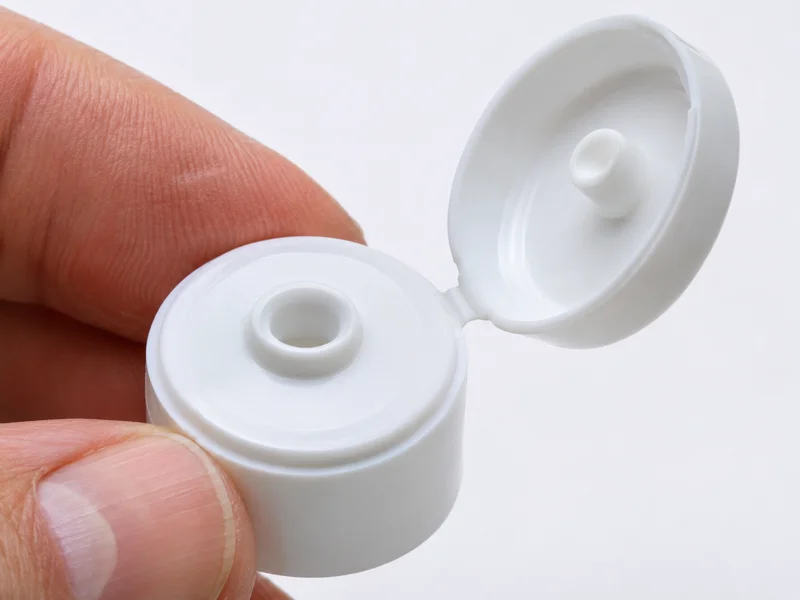
Living hinges work well in both PP copolymer vs homopolymer, because PP’s molecular structure orients in the thin hinge section and resists fatigue.
Hinge design points:
- Hinge thickness: typically about 0.2–0.5 mm
- Flow across the hinge, so molecules orient correctly
- Flex the hinge soon after molding to orient it
- Copolymer may give more forgiving hinges in some designs
For example, a flip-top cap with a living hinge can open thousands of times without breaking if the gate is placed so flow crosses the hinge. Our guide to polypropylene vs polyethylene explains why PP suits hinges better than PE.
Key Takeaway: Gate so flow crosses the hinge. Hinge life depends on orientation.
How Do PP Copolymer vs Homopolymer Mold Differently?
PP copolymer vs homopolymer mold similarly, with small differences in shrinkage, flow and cycle time.
| Molding factor (typical) | Homopolymer | Copolymer |
|---|---|---|
| Shrinkage | about 1.5–2.0% | about 1.2–2.0% |
| Warpage tendency | Slightly higher | Slightly lower |
| Cycle time | Slightly faster (crystallizes faster) | Slightly slower |
| Drying | Not required | Not required |
| Flash tendency | High (low viscosity) | High |
For example, swapping homopolymer for copolymer in the same mold may change dimensions by a few tenths of a percent, so critical parts should be re-measured. Our plastic injection molding service molds PP in both types.
Key Takeaway: Do not swap PP types in a running mold without checking dimensions.
PP Copolymer vs Homopolymer: Which Should You Choose?
You choose between PP copolymer vs homopolymer by the part’s main requirement.
- Stiffness, strength, heat? Homopolymer.
- Impact, especially cold? Impact copolymer.
- Clarity or flexibility? Random copolymer.
- Living hinges? Either, with correct gating.
- Structural parts? Talc- or glass-filled homopolymer.
For example, a car battery tray uses impact copolymer for crash and cold impact, while a kettle base uses homopolymer for heat. Our injection molding material selection guide covers other choices.
Key Takeaway: Match the PP type to the failure you most need to avoid.
FAQ
- Q: What is the difference between PP copolymer and homopolymer?
- Homopolymer is pure propylene and stiffer; copolymers include ethylene for toughness or clarity.
- Q: Which PP is better in cold temperatures?
- Impact copolymer, which stays tough well below 0 °C.
- Q: Which PP is stiffer?
- Homopolymer.
- Q: Which PP is clearest?
- Clarified random copolymer.
- Q: Can both types make living hinges?
- Yes, if the hinge is thin and flow crosses it.
Conclusion
PP copolymer vs homopolymer comes down to stiffness and heat against toughness and clarity. Choose homopolymer for stiff, hot parts, impact copolymer for tough and cold use, and random copolymer for clear parts. To review PP selection for your part, send your 3D model and 2D drawing to our engineers.