
ABS vs Polypropylene: How to Pick the Best One Without Waste
ABS vs polypropylene is a choice between a rigid, good-looking, easy-to-finish plastic and a light, flexible, chemical-resistant one. ABS gives stiff housings with good impact strength, tight tolerances and a surface that paints, plates and glues well. Polypropylene (PP) gives living hinges, excellent chemical and fatigue resistance and lower part cost, but it is softer and harder to decorate.
Both are low-cost, widely used molding resins, so they often compete for the same part. For example, a handheld device housing usually moves toward ABS for appearance and screw bosses, while a hinged storage lid usually moves toward PP. In this guide, we compare ABS vs polypropylene for injection molded parts by impact, flexibility, chemicals, tolerances, finishing and cost. For each resin on its own, see our guides to ABS injection molding and polypropylene injection molding.
ABS is an amorphous plastic with a density of about 1.04–1.06 g/cm³, low mold shrinkage of about 0.4–0.7%, good stiffness and impact strength, and an excellent surface for painting, plating and bonding. Polypropylene is a semi-crystalline plastic with a density of about 0.90 g/cm³, higher shrinkage of about 1.0–2.5%, excellent chemical and fatigue resistance, and the ability to form living hinges. Choose ABS for rigid, precise, cosmetic housings; choose PP for flexible, hinged or chemically exposed parts.
In short: ABS for rigid, precise and cosmetic parts; PP for flexible, hinged and chemical-contact parts.
Key points:
- Stiffness and accuracy: ABS is stiffer and holds tighter tolerances.
- Flexibility and chemicals: PP flexes, hinges and resists chemicals better.
- Cost: PP is lighter and usually cheaper per part.
What Is the Difference Between ABS vs Polypropylene?
The difference between ABS vs polypropylene comes from their structure. ABS is amorphous, so it shrinks little and evenly. PP is semi-crystalline, so it shrinks more and resists chemicals better.
| Property (typical) | ABS | PP (homopolymer / copolymer) |
|---|---|---|
| Structure | Amorphous | Semi-crystalline |
| Density | about 1.04–1.06 g/cm³ | about 0.90–0.91 g/cm³ |
| Mold shrinkage | about 0.4–0.7% | about 1.0–2.5% |
| Stiffness | Higher | Lower |
| Living hinge | No | Excellent |
| Chemical resistance | Fair; attacked by many solvents | Excellent |
| Painting, plating, gluing | Easy | Difficult without surface treatment |
| Drying before molding | Recommended | Not normally needed |
Values vary by grade, so compare datasheets measured with the same ISO test methods.
Key Takeaway: ABS and PP solve different problems. Start from the requirement, not from the resin price.
How Do Impact Strength and Stiffness Compare in ABS vs Polypropylene?
Impact strength and stiffness in ABS vs polypropylene depend on grade and temperature. ABS is stiffer and has good impact strength at room temperature. PP copolymer is tough and flexible, while PP homopolymer becomes brittle near freezing.
- ABS: rigid, with good impact strength from its rubber phase
- PP homopolymer: stiffer than copolymer, but brittle in the cold
- PP impact copolymer: tough, including at low temperatures
- Glass-filled versions: both gain stiffness and lose some impact strength
For example, a drop-tested power tool housing often uses ABS or PC/ABS for stiffness and screw-boss strength. A cold-chain crate uses impact-copolymer PP, because it survives drops at low temperature.
Snap-fits show the difference clearly. An ABS snap-fit must stay within a lower allowable strain, so its arm is usually longer or thinner. A PP snap-fit can bend further, but it may relax over time if it stays under load. Therefore, the snap-fit design should be checked for the chosen resin, not copied from a part in the other material.
Key Takeaway: Specify stiffness and the lowest service temperature together. That pair usually decides ABS vs PP.
Which Is Better for Flexing Parts and Living Hinges?
In ABS vs polypropylene, PP is far better for flexing parts and living hinges. PP can bend many thousands of times at a thin hinge without breaking. ABS cracks when bent repeatedly.
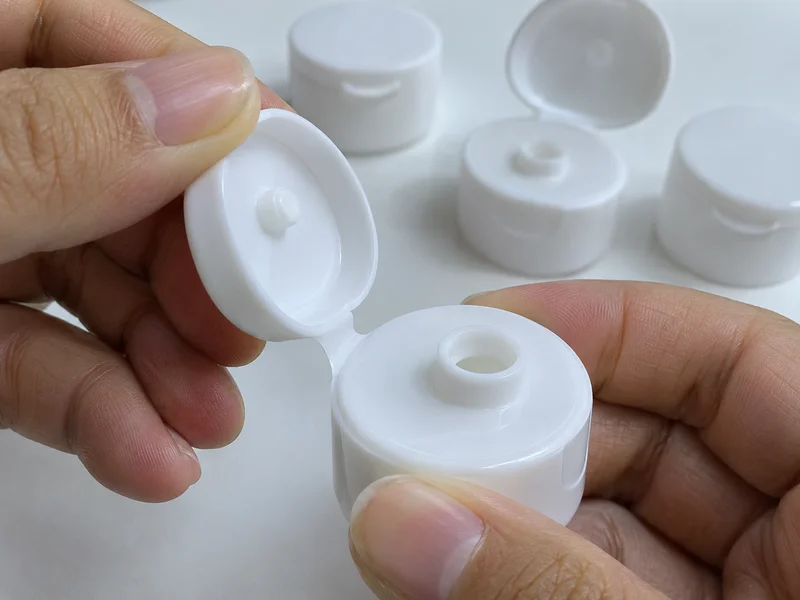
That matters for:
- Flip-top caps and hinged boxes
- Clips and latches that flex in every use
- Thin flexible straps and cable ties
- Parts that must bend during assembly
On the other hand, ABS snap-fits work well for parts that snap once or a few times. They need careful strain limits, because ABS has lower allowable strain than PP.
Key Takeaway: If the part bends in daily use, choose PP. If it snaps once and must stay rigid, ABS works well.
How Do Chemical and Heat Resistance Compare in ABS vs Polypropylene?
In ABS vs polypropylene, chemical resistance strongly favors PP. PP resists most acids, bases, alcohols, detergents and many solvents. ABS is attacked by many solvents, such as acetone, and some oils and cleaners can cause stress cracking.
Heat resistance is closer:
- ABS: typical continuous use up to about 80 °C, depending on grade
- PP: melts at about 160–165 °C; continuous use often around 100 °C for unloaded parts
- Under load: both lose stiffness as temperature rises, so check heat deflection
UV resistance is weak for both without stabilizers. For outdoor use, specify UV-stabilized grades or consider ASA instead of ABS. Our list of UV-resistant plastics covers outdoor options.
Key Takeaway: For cleaners, chemicals or fluids, PP is the safer default. Test ABS with every chemical it will touch.
Which Holds Tighter Tolerances: ABS or PP?
In ABS vs polypropylene, ABS holds tighter tolerances. Its low, even shrinkage makes dimensions predictable, and it warps less on flat parts. PP shrinks more and less evenly, so large flat PP parts warp more easily.
- ABS shrinkage: about 0.4–0.7%, fairly uniform
- PP shrinkage: about 1.0–2.5%, varies with flow direction and wall thickness
- Warpage: higher risk with PP on large flat panels
- Assembly fits: easier to control with ABS
For example, two housing halves that must close with an even gap are easier to match in ABS. In PP, the same design may need ribs, uniform walls and careful cooling. Our guides to plastic shrinkage and injection molding tolerances explain how to plan for this.
Key Takeaway: For precise fits and flat cosmetic panels, choose ABS. For PP, design for shrinkage from the start.
How Do Finishing, Painting and Bonding Compare?
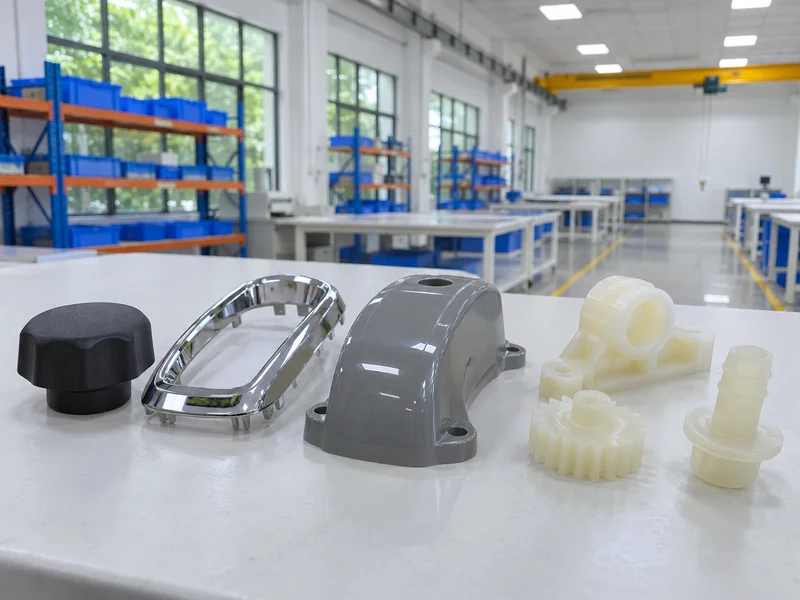
For ABS vs polypropylene finishing, painting and bonding are much easier with ABS. ABS accepts paint, chrome plating, ultrasonic welding, solvent bonding and most adhesives. PP has a low surface energy, so paint and glue do not stick well without treatment.
| Finishing option | ABS | PP |
|---|---|---|
| Painting | Easy | Needs flame, plasma or primer treatment |
| Electroplating | Common with plating grades | Rare |
| Adhesive bonding | Easy | Difficult |
| Ultrasonic welding | Good | Possible, harder |
| Texture and gloss | Excellent surface | Good, often waxy feel |
| Pad printing | Easy | Needs treatment |
Therefore, consumer products with paint, chrome or printed logos usually use ABS. Our guide to injection molding surface finishes shows texture and gloss options for both.
Key Takeaway: If the part needs paint, plating or glue, choose ABS, or budget for PP surface treatment.
Which Costs Less: ABS or Polypropylene?
In ABS vs polypropylene cost comparisons, polypropylene usually costs less per part. PP resin is typically cheaper per kilogram, and its density is about 15% lower, so the same part uses less material by weight. In addition, PP normally needs no drying.
However, cost per good part also depends on:
- Wall thickness: PP may need thicker walls or ribs to match ABS stiffness.
- Cycle time: semi-crystalline PP may need more cooling for flat, stable parts.
- Secondary operations: painting or bonding PP adds treatment cost.
- Scrap: warpage on large PP parts can raise reject rates.
For example, a 50 g ABS housing becomes roughly a 43 g part in PP, because PP is about 15% less dense. At the same price per kilogram, that alone saves about 15% of material cost. However, if the PP version needs 20% thicker walls to match stiffness, most of that saving disappears.
Key Takeaway: Compare complete part cost, including finishing and scrap. PP’s resin saving can disappear on cosmetic, painted parts.
ABS vs Polypropylene: Which Should You Choose?
You choose between ABS vs polypropylene by naming the one property the part cannot compromise.
- Rigid housing with screw bosses? ABS.
- Cosmetic, painted or plated surface? ABS.
- Living hinge or flexing clip? PP.
- Contact with cleaners, chemicals or fluids? PP.
- Lowest cost and weight? PP.
- Tight assembly fits on large parts? ABS.
We mold ABS, PP, PC/ABS and other commodity and engineering resins, from T1 trial to volume production. For other comparisons, see polycarbonate vs ABS and polyethylene terephthalate vs polypropylene.
Key Takeaway: Pick the material for its hardest requirement. Price is the tiebreaker, not the starting point.
FAQ
- Q: Is ABS stronger than polypropylene?
- ABS is stiffer and usually stronger in short-term loading. PP is tougher in flexing and resists fatigue better.
- Q: Which is more chemical resistant, ABS or PP?
- PP. It resists most acids, bases and solvents, while ABS is attacked by many solvents such as acetone.
- Q: Can ABS make a living hinge?
- No. ABS cracks when flexed repeatedly. PP is the standard material for living hinges.
- Q: Which holds tighter tolerances?
- ABS. Its shrinkage is about 0.4–0.7%, compared with about 1.0–2.5% for PP.
- Q: Can you paint polypropylene?
- Yes, but only after surface treatment such as flame, plasma or a primer, because paint does not stick to untreated PP.
Conclusion
ABS vs polypropylene comes down to rigidity, precision and finish against flexibility, chemical resistance and cost. Choose ABS for rigid, cosmetic housings and PP for hinges and chemical contact. To confirm the right resin for your part, send your 3D model and 2D drawing to our engineers.
For production support, explore our plastic injection molding service. You can also share your drawing for an engineering review.