
POM Injection Molding for Gears, Snap-Fits and Latches
POM injection molding produces precise, stiff, low-friction parts such as gears, bushings, clips, latches, pump components and fasteners. POM (polyoxymethylene, acetal) combines high stiffness, fatigue resistance, low moisture absorption and excellent wear behavior. However, it is highly crystalline, so it shrinks a lot, needs good venting and can release formaldehyde if overheated.
Design and tooling decide whether POM parts work. For example, a POM gear with uneven walls can shrink unevenly and run noisily, while a snap-fit with a sharp root can crack after a few cycles. In this guide, we explain POM injection molding for wear, fit and part function: grades, design for gears and snap-fits, shrinkage and tolerances, tooling, processing and testing. For grade choice, see our guide to acetal homopolymer vs copolymer.
POM injection molding uses homopolymer (POM-H) or copolymer (POM-C) acetal at melt temperatures of about 190–230 °C and mold temperatures of about 60–100 °C. POM shrinks about 1.8–2.2%, needs well-vented molds and should not be overheated or held too long in the barrel to avoid formaldehyde release. Parts need uniform walls, generous radii, adequate draft and gates placed for even shrinkage. POM suits gears, bearings, snap-fits and sliding parts because of its stiffness, fatigue resistance and low friction. Specify grade, critical dimensions with measuring conditions, mating materials and wear requirements.
In short: POM gives precise, wear-resistant parts when shrinkage, venting and radii are designed in.
Key points:
- Function: stiffness, fatigue resistance, low friction.
- Molding: high shrinkage, good venting, no overheating.
- Design: uniform walls and radii at snap-fit roots and gear teeth.
Why Use POM Injection Molding for Functional Parts?
POM injection molding is used for functional parts because POM keeps its shape, resists wear and springs back reliably.
Key properties:
- High stiffness for an unfilled plastic
- Excellent fatigue resistance for repeated loads and snap-fits
- Low friction and wear against steel and other plastics
- Low moisture absorption, so dimensions stay stable
- Good chemical resistance to fuels and solvents
For example, a POM latch in a car interior can be opened and closed thousands of times without losing its spring force. Our plastic injection molding service includes POM from T1 trial to volume production.
Key Takeaway: Choose POM where parts move, slide or flex repeatedly.
How Should Gears Be Designed for POM Injection Molding?
Gears should be designed for POM injection molding with uniform sections and features that keep the tooth shape accurate after shrinkage.
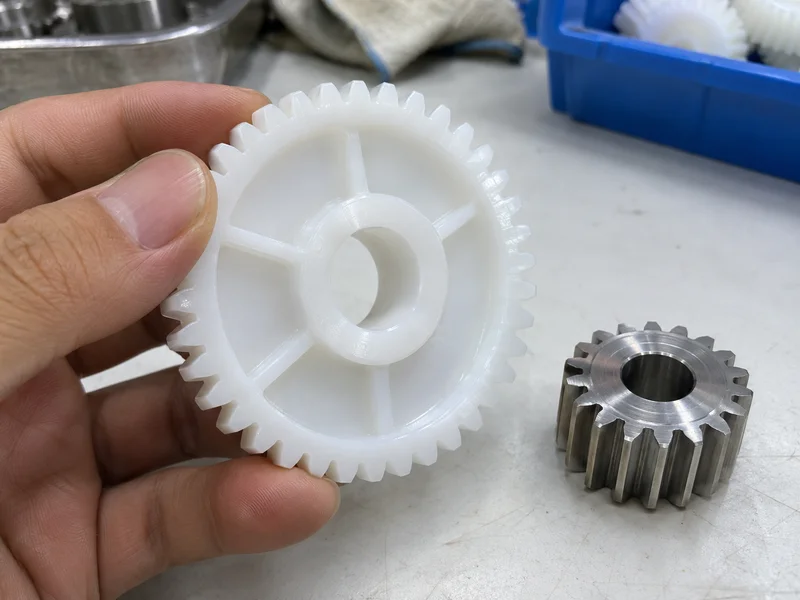
Design guidelines:
- Uniform rim and web thickness
- Cored hubs instead of solid hubs
- Symmetrical design and central gating for even shrinkage
- Tooth root radii to reduce stress
- Mold compensation for shrinkage in the tooth profile
For example, a solid POM gear with a thick hub may shrink unevenly and become slightly oval, causing noise. A ribbed web with a cored hub and a center or diaphragm gate keeps it round. Our guide to plastic shrinkage explains shrinkage behavior.
Key Takeaway: Gate gears at the center where possible. Even flow gives round, quiet gears.
How Should Snap-Fits and Latches Be Designed in POM?
Snap-fits and latches in POM should be designed with controlled strain and radii, so they flex without cracking.
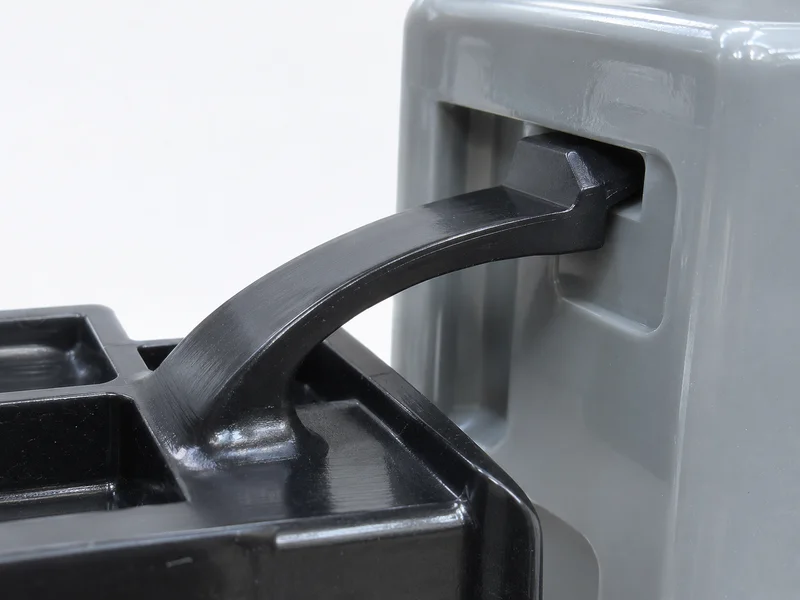
Guidelines:
- Allowable strain: keep design strain within the grade’s limit for repeated use
- Root radius: generous radius at the base of the cantilever
- Tapered beams to spread strain
- Lead-in angles for smooth assembly
- Retention angles for the required holding force
For example, a cantilever snap with a sharp root may crack after a few assemblies, while adding a 0.5 mm root radius greatly reduces stress. Our guide to basics of injection molding design covers general design rules.
Key Takeaway: Always radius the root of a POM snap-fit. It is the most common failure point.
What Tolerances Can POM Injection Molding Hold?
POM injection molding can hold good tolerances, but its high shrinkage means mold compensation and process control are important.
Practical points:
- Shrinkage: about 1.8–2.2%, differing with flow direction and wall thickness
- Post-mold shrinkage: small dimensional change in the first days
- Critical dimensions: measured after a defined conditioning time
- Mold adjustment: steel-safe dimensions allow fine tuning
For example, a POM bushing bore may be cut slightly undersize in the mold and adjusted after T1 measurements, so the final bore lands in tolerance. Our guide to injection molding tolerances explains realistic ranges.
Key Takeaway: Plan steel-safe dimensions for critical POM features. Tuning after T1 is normal.
What Tooling Does POM Injection Molding Need?
POM injection molding needs tooling with good venting, controlled temperatures and gates designed for crystalline materials.
Tooling points:
- Venting: essential, because trapped gas causes burns and deposits.
- Mold temperature: often about 60–100 °C for good crystallinity and surface.
- Gates: sized to allow packing before freezing.
- Steel: hardened or corrosion-resistant steel for long runs.
- Deposit control: easy access for cleaning vents.
For example, a POM mold with poor venting can build up white deposits (mold deposit) on the cavity over time, which affect surface and dimensions. Our guide to injection mold venting gives vent guidance.
Key Takeaway: Plan vent cleaning in POM mold maintenance. Deposits build up gradually.
How Is POM Processed Safely?
POM is processed safely by avoiding overheating and long residence time, because degraded POM releases formaldehyde gas.
Processing guidelines:
- Melt temperature: about 190–230 °C; follow the grade’s data.
- Residence time: keep short; avoid large barrels for small shots.
- Purging: purge before stops and when changing materials.
- Never mix with PVC, which can cause violent degradation.
- Ventilation at the machine.
For example, POM left in a hot barrel during a long stop can degrade and produce gas. Purging before the stop prevents it. Safety information is published by resin suppliers and occupational safety bodies such as OSHA.
Key Takeaway: Purge POM before stops and never run it after PVC without full cleaning.
How Should POM Parts Be Tested for Wear and Function?
POM parts should be tested for wear and function under conditions close to real use.
Test examples:
- Gear running tests at load and speed
- Snap-fit cycle tests for retention force over cycles
- Wear tests against the real mating material
- Dimensional checks after conditioning
- Noise checks for gears and sliders
For example, a POM gear running against steel may last much longer than the same gear running against POM. Testing the real pair avoids surprises. Our guide to machining acetal explains machined POM prototypes for early testing.
Key Takeaway: Test POM parts with their real mating materials. Wear depends on the pair.
FAQ
- Q: What is POM injection molding?
- The injection molding of polyoxymethylene (acetal) to make stiff, low-friction, wear-resistant parts.
- Q: What is the shrinkage of POM?
- Typically about 1.8–2.2%.
- Q: What mold temperature is used for POM?
- Often about 60–100 °C.
- Q: Why does POM need good venting?
- Trapped gas causes burns and mold deposits, and POM is sensitive to overheating.
- Q: Is POM good for gears?
- Yes. It is one of the most common plastics for molded gears because of its stiffness and wear behavior.
Conclusion
POM injection molding makes precise, wear-resistant gears, latches and sliding parts when design, tooling and processing respect its high shrinkage and heat sensitivity. Use uniform sections and radii, vent the mold well and test with real mating parts. To review a POM part, send your 3D model and 2D drawing to our engineers.