
CNC Machining Materials: Aluminum, Steel, Titanium, Brass
CNC machining materials range from aluminum and steel to titanium, brass and engineering plastics. The right choice sets part cost, lead time, strength, corrosion resistance and finishing options. Many buyers choose by habit, for example “6061” or “304”, but small grade changes can cut machining time or improve performance noticeably.
A quick screen helps. For example, switching a part from 2024 to 6061 aluminum may make anodizing easier and corrosion better, while switching from 1018 to 1045 steel adds strength for little cost. In this guide, we give a buyer’s screen for CNC machining materials and compare common pairs: 6061 vs 6082 and 2024 vs 6061 aluminum, 303 vs 304 stainless, 1018 vs 1045 steel, 4140 prehard, titanium grade 2 vs grade 5, and C360 vs C260 brass. For plastics, see our guide to CNC plastic machining.
A buyer’s screen for CNC machining materials asks five questions: what load and stiffness are needed, what environment (corrosion, temperature), what finish (anodize, plate, paint), what quantity and lead time, and what certificates are required. Common choices: 6061-T6 aluminum for general parts; 7075 for high strength; 303 stainless for free machining, 304/316 for corrosion; 1045 or 4140 prehard steel for strength; Ti-6Al-4V for strength-to-weight; C360 brass for fast-machined fittings; POM, nylon and PEEK for plastic parts. Standard stock sizes and free-machining grades reduce cost and lead time.
In short: screen materials by load, environment, finish, quantity and certificates, then choose common, machinable grades where possible.
Key points:
- Screen: load, environment, finish, quantity, certificates.
- Machinability: free-machining grades cut cost.
- Availability: standard stock shortens lead time.
How Should Buyers Screen CNC Machining Materials?
Buyers should screen CNC machining materials with a short list of questions before choosing a grade.
The five-question screen:
- Load and stiffness: what strength, hardness and deflection limits apply?
- Environment: moisture, chemicals, salt, temperature?
- Finish: anodizing, plating, painting, passivation or bare?
- Quantity and lead time: prototype or production, how fast?
- Documentation: material certificates, compliance (RoHS, REACH)?
For example, an indoor bracket with light loads and black anodizing points directly to 6061-T6. A marine fitting points to 316 stainless or titanium. Compliance requirements such as RoHS are published on EUR-Lex.
Key Takeaway: Answer the five questions before naming a grade. The answers usually narrow it to two options.
How Do Aluminum CNC Machining Materials Compare?
Aluminum CNC machining materials compare mainly on strength, corrosion resistance, anodizing quality and availability.
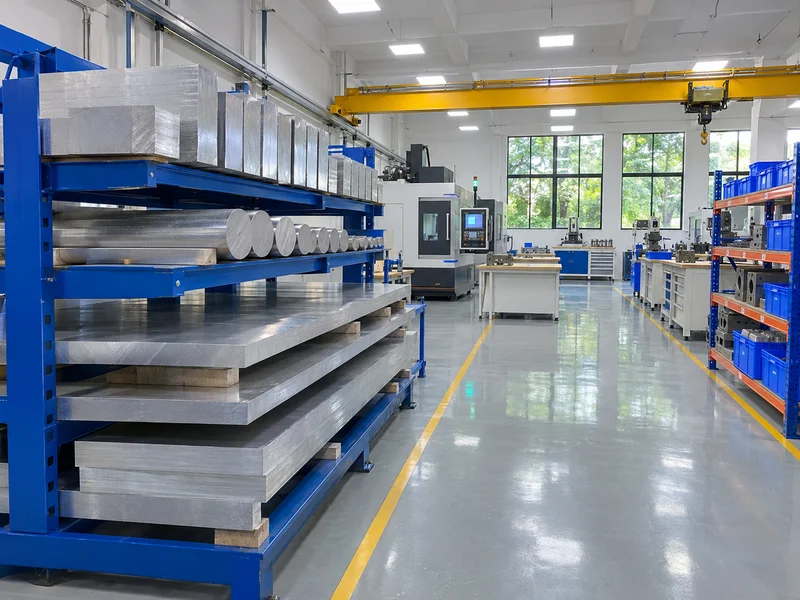
| Pair | Key difference | Typical choice |
|---|---|---|
| 6061 vs 6082 | Very similar; 6082 slightly stronger, common in Europe | Use whichever is stocked in your region |
| 2024 vs 6061 | 2024 stronger and better fatigue, but poor corrosion and anodizing | 6061 for general parts; 2024 for aerospace-style fatigue parts |
| 6061 vs 7075 | 7075 much stronger, more expensive | 7075 when strength sets the size |
For example, a European drawing may call 6082-T6 while an Asian supplier stocks 6061-T6; for most parts, either works. Our comparison of 6061 T6 aluminum vs 7075 T6 covers the strength choice.
Key Takeaway: Allow equivalent aluminum grades on the drawing. It shortens lead time.
How Do Stainless Steel Machining Grades Compare?
Stainless steel machining grades compare on machinability and corrosion resistance.
- 303: free-machining (contains sulfur); fastest to machine, lower corrosion resistance, not for welding.
- 304: general corrosion resistance; work hardens; slower to machine.
- 316: better chloride resistance; similar machining to 304.
- 17-4PH: high strength after aging; machines well in condition A.
For example, a batch of small threaded fittings for indoor use machines much faster in 303 than 304, lowering cost. However, the same fitting in a marine environment needs 316. Our guide to 304 stainless steel versus 316 stainless steel explains corrosion differences.
Key Takeaway: Use 303 for indoor, threaded parts; 304 or 316 when corrosion matters.
How Do Carbon and Alloy Steel Grades Compare?
Carbon and alloy steel grades compare on strength, hardenability and machinability.
| Grade (typical) | Characteristics | Typical parts |
|---|---|---|
| 1018 | Low carbon, easy to machine and weld, low strength | Brackets, plates, case-hardened parts |
| 1045 | Medium carbon, stronger, can be induction hardened | Shafts, pins |
| 4140 annealed | Alloy steel, heat treatable | Parts to be hardened after machining |
| 4140 prehard (about 28–32 HRC) | Ready strength without post-machining heat treatment | Tooling, fixtures, shafts |
For example, a fixture plate in 4140 prehard avoids heat-treatment distortion, because it is machined already hardened. Our guide to is alloy steel the same as stainless steel explains alloy steels further.
Key Takeaway: Choose 4140 prehard to avoid heat treatment after machining.
How Do Titanium and Brass Grades Compare?
Titanium and brass grades compare on strength, corrosion and machinability.
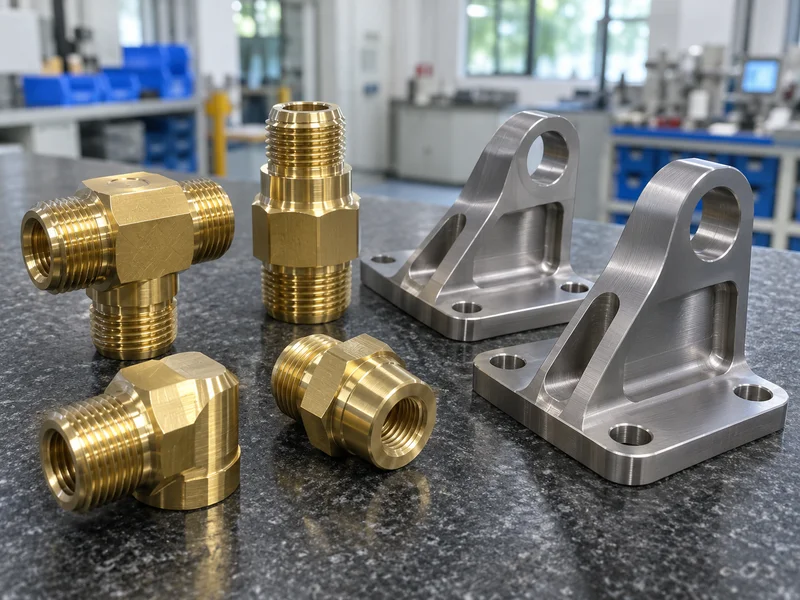
Titanium:
- Grade 2 (CP titanium): excellent corrosion resistance, moderate strength, easier to machine.
- Grade 5 (Ti-6Al-4V): much stronger, harder to machine, higher cost.
Brass:
- C360 (free-cutting brass): contains lead for very fast machining; excellent for fittings.
- C260 (cartridge brass): better formability and lower lead, slower to machine.
For example, a chemical-plant fitting may use titanium grade 2 for corrosion, while a structural bracket uses grade 5. A plumbing fitting machines fastest in C360, but lead-free requirements may require another alloy. Our guide to titanium strength vs aluminum compares titanium with aluminum.
Key Takeaway: Check lead-free requirements before choosing C360 brass.
How Do CNC Machining Materials Affect Cost and Lead Time?
CNC machining materials affect cost and lead time through raw material price, machining speed, tool wear and stock availability.
Cost and lead-time drivers:
- Material price: titanium and PEEK are far more expensive than aluminum.
- Machinability: free-machining grades (303, C360, 12L14) cut faster.
- Tool wear: titanium and hardened steels wear tools faster.
- Stock sizes: standard bar and plate sizes reduce waste and waiting.
- Finishing: anodizing suits aluminum; plating suits steel.
For example, the same small part may cost several times more in titanium than in aluminum, mostly from material and machining time. Our CNC machining services machine aluminum, stainless steel, tool steel, carbon steel, copper, brass, titanium, PEEK, POM and nylon, from prototype to production.
Key Takeaway: Ask the supplier which equivalent grades they stock. It often saves days.
How Should Materials Be Specified on the Drawing?
Materials should be specified on the drawing with the grade, standard, condition and acceptable alternatives.
Include:
- Grade and standard, such as 6061-T6 (ASTM B221) or EN AW-6082-T6
- Condition, such as T651, annealed or prehardened
- Finish, such as anodize type and color
- Certificates, such as mill certificate 3.1
- Alternatives, such as “6061-T6 or 6082-T6”
For example, adding “or equivalent approved by engineering” protects lead time without losing control. Our quality control and inspection process can supply material certificates on request.
Key Takeaway: List acceptable alternatives. It keeps projects moving when stock is short.
FAQ
- Q: What is the most common CNC machining material?
- Aluminum 6061-T6 is the most common for general machined parts.
- Q: What is the difference between 6061 and 6082 aluminum?
- They are very similar; 6082 is slightly stronger and more common in Europe.
- Q: Is 303 or 304 stainless better for machining?
- 303 machines faster; 304 has better corrosion resistance and weldability.
- Q: What is 4140 prehard?
- 4140 alloy steel supplied hardened to about 28–32 HRC, so it can be machined without later heat treatment.
- Q: Which brass machines best?
- C360 free-cutting brass machines fastest, but it contains lead.
Conclusion
CNC machining materials should be screened by load, environment, finish, quantity and certificates, then narrowed to common, machinable grades. Allow equivalents and choose free-machining grades where they suit the part. To review material choice for your part, send your 3D model and 2D drawing to our engineers.