
TPE Injection Molding Process: Part Design and Tooling
The TPE injection molding process makes soft, flexible parts from thermoplastic elastomers, such as grips, seals, gaskets, feet, buttons and soft-touch overmolds. TPEs feel and behave like rubber but process like thermoplastics: they melt, flow and solidify without vulcanization, and scrap can be reground. However, they are soft, sticky and prone to flash, so the part, tool and process must be designed for them.
Many TPE problems come from vague specifications. For example, a drawing that says only “TPE, black, soft” can lead to a grade that feels right but swells in oil or fails to bond to the substrate. In this guide, we explain what to define for a TPE injection molding process: TPE type and hardness, part design, tooling, processing, overmolding and testing. For TPE families, see our guide to TPR vs TPE.
The TPE injection molding process uses thermoplastic elastomers such as TPE-S (SEBS-based), TPV, TPU and TPC, typically from about Shore 20A to 60D. Melt temperatures are often about 180–230 °C for SEBS-based TPE, mold temperatures about 20–50 °C, and some grades need drying. TPEs have low viscosity and flash easily, so tight shutoffs and shallow vents are needed. Parts need generous draft, uniform walls and ejection designed for soft materials. For overmolding, the TPE grade must be compatible with the substrate. Define hardness, chemical resistance, compression set, color, bond strength and cosmetic standards.
In short: define the TPE type, hardness and service needs, design for soft ejection and flash control, and check bonding when overmolding.
Key points:
- Type and hardness: SEBS, TPV, TPU or TPC; Shore A or D.
- Tooling: tight shutoffs, shallow vents, soft ejection.
- Overmolding: substrate-compatible grades.
What Is the TPE Injection Molding Process?
The TPE injection molding process melts thermoplastic elastomer pellets, injects them into a mold, and cools them into flexible parts. Unlike rubber, no curing step is needed.
Main TPE families:
- TPE-S (SEBS/SBS-based): soft-touch, grips, general seals
- TPV (vulcanized EPDM/PP): better heat and compression set
- TPU: tough, abrasion resistant
- TPC (copolyester): higher temperature and chemical resistance
For example, a toothbrush grip uses SEBS-based TPE overmolded on PP, while an automotive seal may use TPV for heat and compression set. We mold TPE and TPU in our plastic injection molding service, and our guide to TPU injection molding covers TPU separately.
Key Takeaway: Name the TPE family, not just “TPE”. Each family behaves differently.
What Should You Define for a TPE Part?
You should define the properties that the TPE part needs in service, because many grades look similar at first touch.
Specification items:
- Hardness, such as Shore 50A ± 5
- Chemical resistance, such as oils, skin oils or cleaners
- Temperature range in use
- Compression set, for seals
- UV resistance, for outdoor parts
- Color and gloss
- Regulatory needs, such as food contact or skin contact
For example, a gasket that must seal for years needs a low compression set, which points to TPV rather than a basic SEBS grade. Hardness is measured with methods such as those from ASTM International (ASTM D2240).
Key Takeaway: Specify function, not just feel. Hardness alone does not predict sealing or chemical performance.
How Should Parts Be Designed for the TPE Injection Molding Process?
Parts should be designed for the TPE injection molding process with uniform walls, generous draft and features that release easily.
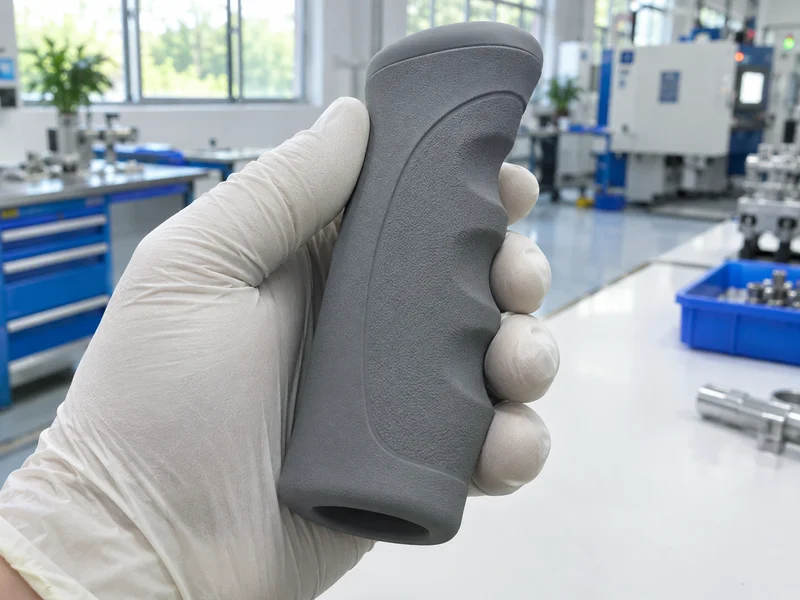
Design guidelines:
- Wall thickness: uniform, typically about 1–3 mm for overmolds
- Draft: about 1–3°, more for textured or very soft grades
- Radii: generous, to avoid tearing
- Undercuts: soft TPE can often be stripped from small undercuts
- Thin edges: avoid feather edges that tear or flash
- Texture: matte textures hide flow marks and reduce stickiness
For example, a soft Shore 30A grip with a high-gloss mold surface may stick to the cavity and tear on ejection. A light texture improves release. Our guide to draft angle guidelines explains basics.
Key Takeaway: Use texture and generous draft on soft TPE parts. Both improve release.
What Tooling Does the TPE Injection Molding Process Need?
The TPE injection molding process needs tooling with tight shutoffs, shallow vents and ejection designed for soft parts.
Tooling points:
- Shutoffs: tight, because TPEs flash through very small gaps.
- Vents: shallow, often about 0.01–0.02 mm.
- Ejection: large ejector areas, stripper plates or air poppets.
- Gates: sized to avoid jetting and shear.
- Surface: light texture or matte finish for release.
For example, a soft TPE seal can be blown off the core with air instead of being pushed by pins, which might punch through it. Our injection mold manufacturing team designs ejection for each grade.
Key Takeaway: Tell the toolmaker the exact TPE grade and hardness. Ejection and venting depend on it.
How Is TPE Processed in the Molding Machine?
TPE is processed at moderate melt temperatures with controlled speed, and some grades need drying.
Process points:
- Melt temperature: often about 180–230 °C for SEBS-based TPE; follow the grade data.
- Mold temperature: often about 20–50 °C.
- Drying: required for TPU, TPC and some TPE grades; often not for SEBS.
- Injection speed: moderate to avoid jetting and flash.
- Pack pressure: low to moderate to avoid flash.
For example, overpacking a soft TPE part may cause flash at the parting line and sink when released. Our guide to injection molding flash explains flash control.
Key Takeaway: Keep pack pressure low on soft TPE parts. Flash appears quickly.
How Does Overmolding Change the TPE Injection Molding Process?
Overmolding changes the TPE injection molding process because the TPE must bond to a substrate and seal against it without flash.
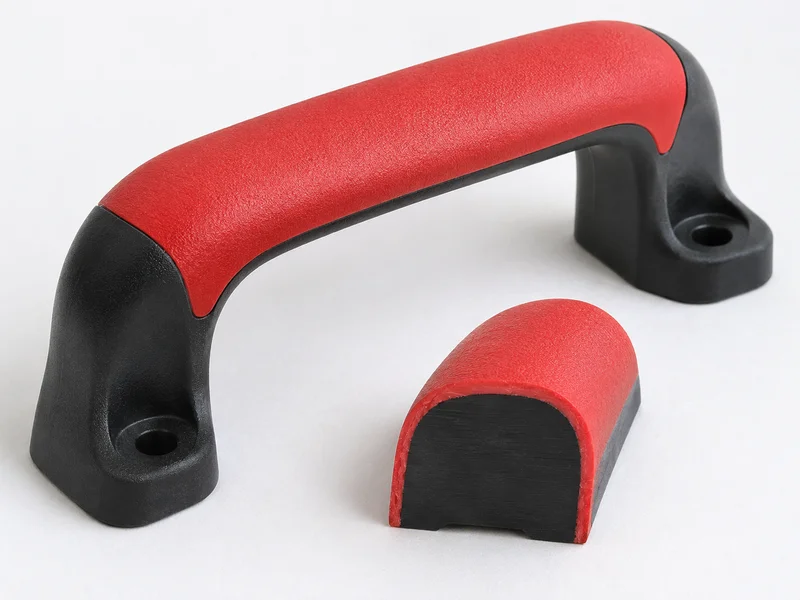
Overmolding points:
- Compatible grades: for example TPE grades made for PP, ABS, PC or PA
- Substrate condition: clean, dry and preferably warm
- Shutoffs on the substrate: controlled interference
- Mechanical locks: holes or grooves for critical bonds
- Bond testing: peel tests on samples
For example, a TPE grade made for PP will not bond well to PC. Choosing the substrate-specific grade is essential. Our guide to overmold tooling explains the tool side, and our overmolding service covers production.
Key Takeaway: Choose the TPE grade by substrate. Bonding is chemistry, not process alone.
How Should TPE Parts Be Tested?
TPE parts should be tested for the properties that matter in use.
Common tests:
- Hardness on molded parts
- Bond strength for overmolds
- Compression set for seals
- Chemical exposure tests for swelling
- Visual standards for flow marks, gloss and flash
For example, a seal sample can be compressed for a set time at temperature and measured for recovery, showing whether it will keep sealing. Our quality control and inspection process supplies inspection reports on request.
Key Takeaway: Agree test methods with the TPE grade. They prove the part, not only the material.
FAQ
- Q: What is the TPE injection molding process?
- Melting thermoplastic elastomer pellets, injecting them into a mold and cooling them into flexible parts, without vulcanization.
- Q: What temperature is TPE molded at?
- SEBS-based TPEs are often molded at about 180–230 °C melt temperature; check the grade data.
- Q: Does TPE need drying?
- Some grades do, especially TPU and TPC; many SEBS grades do not.
- Q: Why does TPE flash easily?
- It has low viscosity, so it flows into very small gaps.
- Q: Can TPE bond to any plastic?
- No. TPE grades are formulated for specific substrates such as PP, ABS, PC or PA.
Conclusion
The TPE injection molding process works well when the TPE family, hardness and service properties are defined, the tool controls flash and ejection, and overmolding uses compatible grades. To review a TPE part, send your 3D model and 2D drawing to our engineers.