
Micro Injection Molding: Principle, Benefits, and Applications
Micro injection molding is a high-precision manufacturing process used to produce miniature plastic components with sub-millimeter features, offering exceptional accuracy and scalability for complex industrial designs. You likely face the challenge of producing incredibly small components that standard manufacturing methods simply cannot handle effectively. Dimensional variation can affect fit and function in miniature medical or electronic components, so critical features need drawing-based tolerances and a project-specific validation plan. micro injection molding can support miniature features and controlled small shot sizes when the part, tool, material and process are developed together.
1. What defines the principle of micro injection molding?
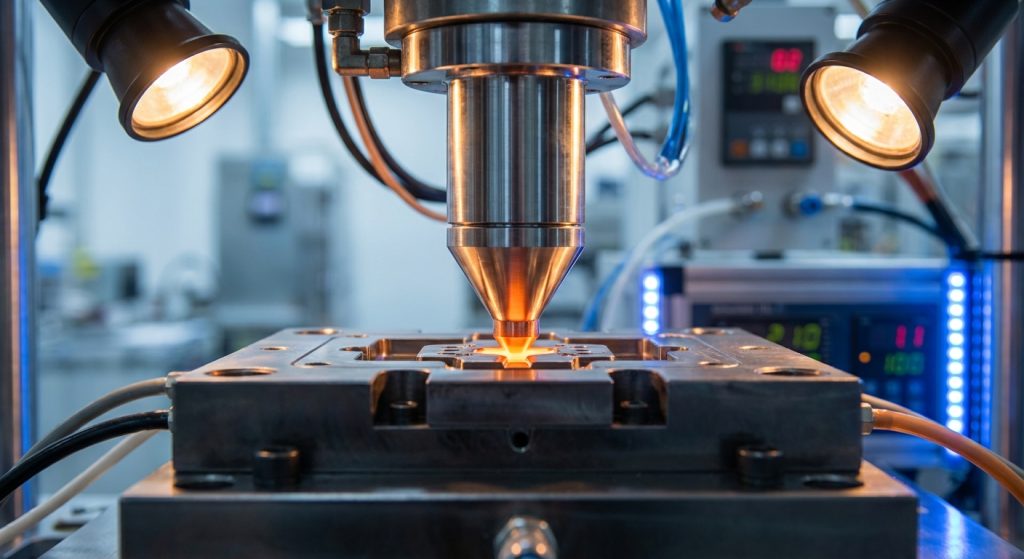
The core principle involves utilizing a micro-structured mold and a high-resolution injection unit to create parts weighing less than one gram. You prepare a precision-machined cavity that matches your desired miniature geometry. During the process, the material is injected with extreme pressure control into these tiny spaces.
How does the injection cycle work?
The cycle begins with material heating followed by controlled injection into a micro-featured mold. Thermal stability, venting, gate design and shot control must be developed together to fill the required features.
What are the defining characteristics?
Think about it: “micro” refers to the part size, the minute features within a larger component, or the requirement for micro tolerances. In your design, you must focus on:
- Shot size precision.
- Tooling tolerances defined by the feature, measurement method and functional requirement.
- High-resolution material dosing.
Key Takeaway: Understanding the principle of precision material delivery allows you to produce intricate components that standard machines simply cannot replicate.
| Feature | Micro Specification | |
|---|---|---|
| Typical Part Weight | Often small; project-specific | |
| Minimum Wall Thickness | Depends on resin, flow length and geometry | |
| Tolerance Range | Defined and validated by project |
Standard molding principles fail where micron-level precision becomes the primary requirement.
2. Why are the benefits of micro injection molding so significant?
Potential benefits include control of very small shot volumes, reduced runner or part mass, and scalable production after validation. Micro injection molding can support features that are difficult to produce with standard molding equipment.
How does it improve cost-efficiency?
Here is the deal: smaller tooling and reduced clamping forces allow you to use more efficient machines. Cost depends on tool architecture, shot size, material, handling, inspection, volume and validation requirements. These savings come from:
- Lower energy consumption.
- Minimal resin waste.
- Shorter cooling cycles.
Does it enhance design freedom?
You can incorporate micro-holes, delicate thin walls, and complex internal channels without compromising structural integrity. This freedom enables engineers to push the boundaries of product functionality.
Key Takeaway: Leveraging specialized micro-tooling reduces your overhead while providing the precision needed for next-generation miniature devices.
| Benefit | Impact on Project | |
|---|---|---|
| Precision | May reduce secondary work | |
| Scalability | Scalable after process validation | |
| Versatility | Supports advanced polymers |
Cost-efficiency in micro-manufacturing is directly tied to the optimization of specialized injection units.
3. What applications rely most on micro injection molding?
Critical applications are found in the medical, electronics, and automotive industries where component failure is not an option. You rely on this technology for everything from drug delivery systems to high-density fiber optic connectors.
Where is it used in healthcare?
Look: surgical instruments and diagnostic devices require components that are both tiny and biocompatible. For medical applications, the molder, material, environment and validation plan must match the applicable device and regulatory requirements. Common medical parts include:
- Catheter components.
- Hearing aid housings.
- Microfluidic chips.
What about consumer tech?
As smartphones and wearables continue to shrink, the demand for micro-optical lenses and sensors grows. Throughput and repeatability depend on part geometry, cavitation, material, handling, inspection and the validated process window.
Key Takeaway: Identifying the right high-precision application ensures your product remains competitive in a market driven by miniaturization and reliability.
| Industry | Core Application | |
|---|---|---|
| Medical | Drug delivery valves | |
| Electronics | Micro-switches | |
| Automotive | Engine sensors |
Market trends indicate that the reliance on miniature components will only increase as devices become smarter.
4. How does micro injection molding achieve micron-scale accuracy?
Accuracy is achieved through the integration of specialized injection units and ultra-high-precision tooling machined via EDM or micro-CNC. You must use machines with higher-resolution feed options to control tiny material volumes. Specialized micro injection molding equipment can improve control of small shot volumes, subject to the selected material, tool and process window.
How do micro injection molding units differ?
But consider this: micro units use much smaller barrel diameters to prevent material degradation and maintain pressure. This specialized hardware is essential for consistent quality. Accuracy is maintained through:
- Servomotor-controlled plungers.
- Real-time pressure monitoring.
- Precision dosing valves.
Is mold alignment critical?
Mold alignment is critical because small mismatch can become significant relative to a miniature feature. Guidance, clamping, wear control and measurement should be specified to the part requirements.
Key Takeaway: High-resolution material dosing is one important control for miniature features; tooling, alignment, process stability and metrology also govern the result.
| Control Factor | Micro Molding Method | |
|---|---|---|
| Dosing | Plunger-based micro-injection | |
| Clamping | Precision electric drives | |
| Alignment | Sub-micron guide systems |
Mechanical precision at the machine level is the foundation for every successful micro-part.
5. Why is micro injection molding different from standard molding?
The main differences lie in the shot size, the specialized machinery required, and the extreme precision of the tooling. You cannot simply “downscale” a standard machine and expect the same results. In every micro injection molding project, the resolution of the injection plunger must be significantly higher than standard screws.
What are the tooling differences?
The truth is: micro molds are often made from high-grade steel using Electrical Discharge Machining (EDM). This allows for features that are too small for traditional milling cutters. Differences include:
- Surface finish requirements.
- Venting channel size.
- Ejection pin placement.
How does shot size impact quality?
Shot sizes in micro-molding are often less than 0.1 grams. You need a machine that can handle these tiny volumes without allowing the material to sit too long and degrade.
Key Takeaway: Recognizing that micro-molding is a distinct engineering discipline prevents you from making costly mistakes with standard equipment.
| Aspect | Standard Molding | Micro Molding | |
|---|---|---|---|
| Shot Size | Grams to Kilograms | Milligrams | |
| Machinery | Large hydraulic/electric | Compact specialized | |
| Features | Millimeter scale | Micron scale |
Distinguishing between macro and micro requirements is the first step toward manufacturing success.
6. Which materials perform best for micro injection molding?
PEEK, LCP and Liquid Silicone Rubber (LSR) are among the materials considered for some micro-molding applications, but grade selection depends on function, geometry, processing and compliance requirements. You must select materials that can fill thin-walled sections without excessive pressure. Utilizing micro injection molding with these resins ensures your parts maintain their properties at small scales.
Why use Liquid Crystal Polymers?
LCP grades can offer useful flow and thermal properties for some intricate electronic connectors. Candidate materials include:
- PEEK for strength.
- LSR for biocompatibility.
- Ultem for heat resistance.
Can standard resins be used?
You can use standard plastics like ABS or PC, but they must be “precision grades.” These variants offer more consistent shrinkage rates for tight tolerances.
Key Takeaway: Select the exact resin grade against fill behavior, feature geometry, functional properties, temperature exposure and compliance requirements.
| Material Type | Key Property | Common Use | |
|---|---|---|---|
| LCP | High Flow | Connectors | |
| PEEK | Bio-stable | Implants | |
| LSR | Flexible | Seals |
Material rheology plays a decisive role in the final dimensional stability of miniature components.
7. What tooling challenges occur in micro injection molding?
Tooling challenges include managing air entrapment, ensuring clean part ejection, and maintaining tool longevity under high pressure. You must design vents that are small enough to block plastic but large enough to let air escape. The complexity of micro injection molding tooling requires advanced engineering foresight.
How is venting handled?
Believe it or not: air trapped in a micro-cavity can cause “burn marks” or incomplete parts. You need to use vacuum venting or specialized porous inserts to solve this. Key tooling hurdles involve:
- Cavity pressure balancing.
- Micro-ejector pin fragility.
- Heat transfer management.
Is demolding difficult in micro injection molding?
Yes, because micro-parts are so light, they often stick to the mold surface due to static or surface tension. You must use specialized coatings or robotic grippers for successful removal.
Key Takeaway: Investing in high-quality EDM-machined tooling is the only way to avoid chronic production defects in micro-scale parts.
| Challenge | Engineering Solution | |
|---|---|---|
| Static | Ionized air blowers | |
| Filling | Direct gating systems | |
| Wear | Titanium nitride coatings |
Advanced tooling design is the most critical variable in the micro-manufacturing equation.
8. How does micro injection molding impact the medical sector?
Micro injection molding is used for some medical-device components, but molding does not by itself make a part sterile, implantable or compliant. Material traceability, environment, validation, inspection, packaging and any sterilization route must be defined for the specific device.
What are micro-implants?
Some medical applications use micro-molded components with strict edge, particulate and material requirements. The device owner must define the approved resin, defect limits and validation evidence. Medical applications include:
- Pacemaker components.
- Bio-resorbable staples.
- Drug delivery nozzles.
Why is cleanliness vital?
Whether a controlled environment or cleanroom is required depends on the device classification, contamination risk and customer specification. Molding alone does not make a component ready for clinical use.
Key Takeaway: Precision in medical molding is a matter of patient safety; micro-molding provides the necessary reliability for critical healthcare innovations.
| Medical Part | Material Used | Function | |
|---|---|---|---|
| Valvular Seal | LSR | Fluid control | |
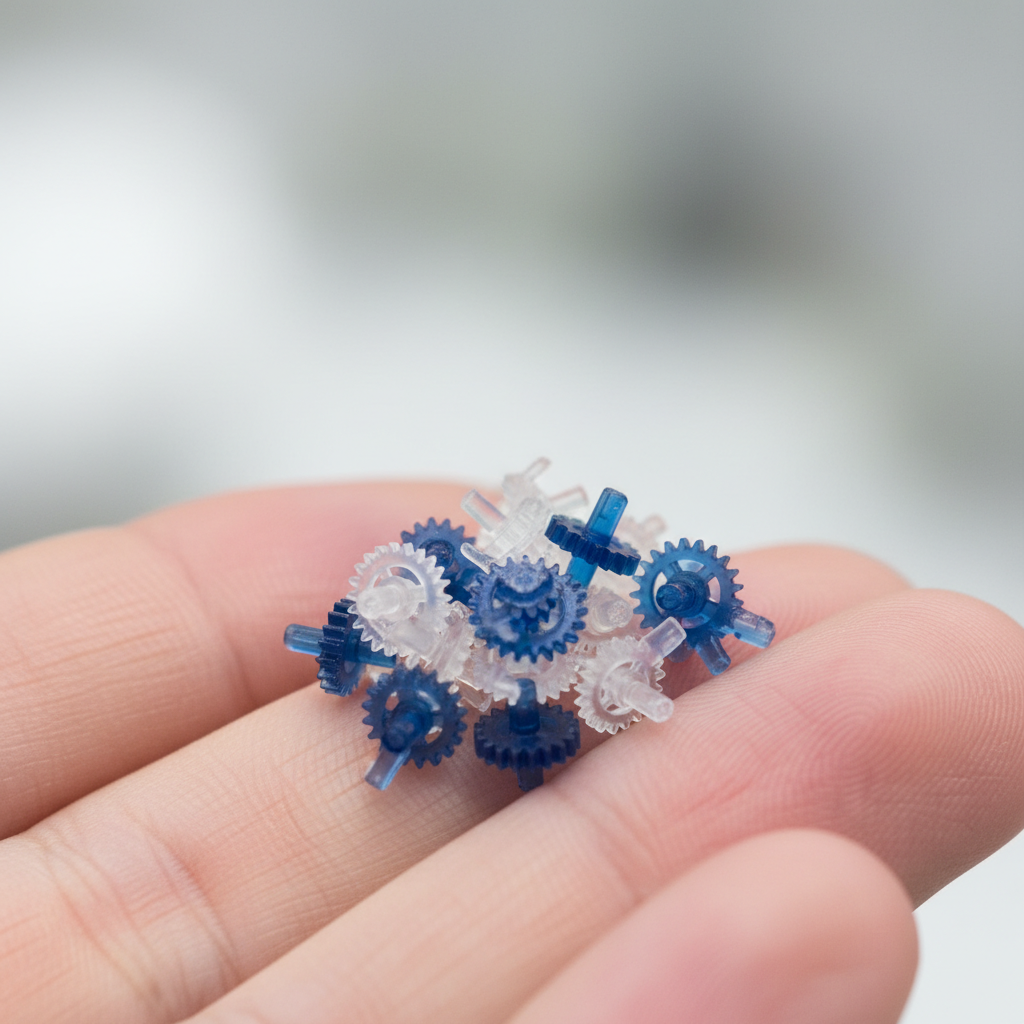
| Micro-Gears | PEEK | Robotic surgery | |
| Optical Lenses | PMMA | Endoscopy |
Healthcare innovation relies on the repeatable precision offered by micro-scale plastic injection.
9. Can micro injection molding support electronics miniaturization?
Electronics miniaturization is driven by the need for smaller, faster, and more efficient components in mobile devices. You require connectors with incredibly high pin densities that standard molding cannot achieve. The micro injection molding process enables the mass production of these essential electronic interfaces.
How does it help micro-optics?
Even better: you can mold lenses and prisms with sub-micron surface finishes. This is vital for laser-based sensors and fiber optic communications. Key electronic features include:
- High pin-count headers.
- Shielded micro-housings.
- Precision switch actuators.
Is thermal management an issue?
You must use heat-resistant polymers to ensure the parts survive the soldering process. Micro-molding supports materials that can withstand high temperatures without warping.
Key Takeaway: Staying ahead in the electronics market requires the ability to produce increasingly smaller parts that maintain high mechanical performance.
| Part | Technical Requirement | |
|---|---|---|
| Connectors | Thin-wall stability | |
| Prisms | Optical clarity | |
| Switches | Wear resistance |
Miniaturization trends in tech are supported by the structural integrity of micro-molded plastics.
10. How do you optimize a micro injection molding project?
Optimization involves a deep Design for Manufacturability (DFM) review and the use of automated inspection systems. You should validate your design early to identify potential flow or ejection issues. When you reach out to our team for a project review, you gain access to metrology tools that measure parts smaller than a grain of rice.
What metrology does micro injection molding use?
The truth is: standard calipers are useless for micro-parts. You need high-resolution vision systems and laser scanners to verify dimensions. Optimization steps include:
- Detailed DFM analysis.
- Automated gate removal.
- Real-time process monitoring.
Is automation necessary?
Yes, you need robotic handling to ensure that micro-parts are not damaged or lost during the ejection phase. Automation increases your yield and consistency.
Key Takeaway: Success in micro-molding depends on moving beyond human sight and utilizing advanced metrology and automation to maintain quality.
| Optimization Step | Expected Result | |
|---|---|---|
| DFM Review | Identify manufacturability risks | |
| Vision Inspection | Check defined visible or dimensional features | |
| Flow study when justified | Compare defined gate and filling questions |
Metrology and formal DFM after project launch are important parts of micro-project development. For adjacent design decisions, review the guides to injection molding tolerances and injection molding gate types.
11. How should replaceable cavity inserts be planned for micro molds?
Replaceable cavity inserts let you repair or change the smallest, most worn features of a micro mold without rebuilding the whole tool. Because micro features such as thin cores, pins and sharp edges wear or break first, it pays to plan them as separate inserts from the start.
Which features should be made as inserts?
- Thin cores and pins that can bend or break
- Gate areas that erode with filled resins
- Fine textures or micro-structures that wear over time
- Features likely to change after first sample review
How do you keep inserts interchangeable?
For example, a micro connector cavity may hold its fragile core pins in a separate insert, ground to fit a pocket with controlled clearance and located by dowels, so a spare insert can be fitted during a short stop. Each insert should be numbered, measured and recorded so that a spare matches the original. Our guide to mold inserts explains insert types and fits. Insert steels are usually ordered to tool steel standards such as ASTM A681, published by ASTM International.
| Repair strategy | When it is used |
|---|---|
| Spare insert on the shelf | High-wear or breakable features |
| Weld and re-machine | Small local damage on hardened steel |
| Re-cut by EDM | Worn edges or eroded gate areas |
| New insert with design change | Feature changed after sampling |
Key Takeaway: Above all, design the weakest micro features as numbered, interchangeable inserts and keep spares for them.
12. How do you plan gate and vent inspection access in a micro mold?
Gate and vent inspection access means the mold is built so that gates and vents can be seen, measured and cleaned without full disassembly. In micro parts, a vent blocked by a few microns of residue or a slightly worn gate can cause short shots, burns or flash, so regular checks matter.
What should the inspection plan cover?
- Vent depth checked against the resin flash limit
- Vent cleanliness after a set number of shots
- Gate size and edge condition under magnification
- Access from the parting line or a removable insert
How does this work in practice?
For instance, placing vents on a removable insert or on the parting line lets the toolroom inspect them with a microscope at each maintenance stop. Recording vent depth and gate size in the mold maintenance log shows wear trends before they turn into rejected parts. Our guides to injection mold venting and maintenance of molds explain these checks in more detail.
Key Takeaway: In other words, if you cannot easily see a micro gate or vent, you cannot keep it in control.
Our injection mold manufacturing team plans inserts, gate and vent access for small precision molds during design review.

Conclusion
Micro injection molding is one route for miniature components when shot control, tooling, material handling, metrology and validation are developed as a system. The required tolerance, feature geometry and application risk should determine the equipment and acceptance plan for medical, electronic or other precision parts.
For a project-specific review, contact our team with the 3D model, drawing, resin, critical features, expected volume, quality requirements and target timing. Formal DFM normally follows project launch, and the validation plan is agreed against the application requirements.
Frequently Asked Questions
Can I use micro injection molding for prototype runs? Yes, though it is most cost-effective at high volumes. The high initial cost of micro-tooling means you should ideally use this process for parts that will eventually reach mass production.
How can sticking be addressed? Review draft, texture, shrinkage, venting, ejection, surface finish, process settings and the resin. DLC, PVD or other treatments may be available from qualified coating specialists when the application justifies them; no coating is a universal fix.
How do I know if my design requires micro-molding instead of standard molding? Look at your part weight and tolerance requirements. If your component weighs less than one gram or has features measured in microns, you almost certainly need a micro-molding specialist.
How should a polymer be selected for high-temperature electronic connectors? LCP is one candidate, but selection should use the exact grade data for flow, temperature exposure, electrical performance, dimensional stability, compliance and the connector geometry.
Can I achieve multi-material designs in micro-molding? Yes, overmolding is possible at a micro scale. You can combine a rigid polymer with a soft elastomer to create functional seals or multi-colored indicators for miniature devices.