
Heat Staking Plastic: Methods, Stud Design and Materials
Heat staking plastic is a joining method that melts and reforms a molded plastic stud to hold another part, such as a circuit board, metal bracket, lens or label, in place. It needs no screws or adhesives, works with dissimilar materials and is easy to automate. For many small molded assemblies, heat staking is the simplest way to retain a component permanently.
Heat staking is only one of several assembly and decoration options for molded parts, and choosing the wrong one adds cost or failures. For example, a PCB held by four heat-staked studs may be cheaper and faster than four screws, while a sealed housing needs a welding method instead. In this guide, we explain heat staking plastic: how it works, stud and head design, materials, process control and testing, and how it compares with ultrasonic, spin and hot plate welding, pad printing and laser marking. For welding, see our guide to ultrasonic welding plastic.
Heat staking plastic uses a heated tool, hot air or ultrasonic energy to soften a molded stud and form it into a head that clamps another component. It suits retaining PCBs, metal parts, lenses and labels in thermoplastic housings, including dissimilar materials. Good results depend on stud diameter and height, head shape, clearance hole size, material, temperature, pressure and time, and cooling under pressure. Pull-off testing validates retention. For sealed joints, ultrasonic, spin or hot plate welding are better; for marking, pad printing or laser marking are used.
In short: heat staking retains components; welding seals joints; printing and laser marking add information.
Key points:
- Retention, not sealing: heat staking clamps parts mechanically.
- Design: stud and head geometry decide strength.
- Control: temperature, pressure, time and cooling.
What Is Heat Staking Plastic?
Heat staking plastic is the process of reforming a thermoplastic stud with heat and pressure to lock a mating part.
Process steps:
- Place the component over molded studs.
- Heat and press the studs with a forming tool.
- Form a head that overlaps the component.
- Cool under pressure to set the head.
- Release the tool.
For example, a PC/ABS sensor housing may retain a PCB with four staked studs, replacing screws. Our plastic injection molding service molds housings with staking studs designed in.
Key Takeaway: Heat staking turns a molded stud into a rivet.
Which Heat Staking Methods Are Common?
Common heat staking methods differ in how heat reaches the stud.
| Method | Heat source | Typical uses |
|---|---|---|
| Hot (thermal) staking | Heated tip contacts stud | General PCBs, brackets |
| Hot air / cold staking | Hot air softens, cold tool forms | Filled resins, cosmetic heads |
| Ultrasonic staking | Ultrasonic vibration | Fast cycles, small studs |
| Infrared staking | IR light | Clean, non-contact heating |
For example, hot air followed by a cold forming punch reduces sticking and fiber exposure on glass-filled studs.
Key Takeaway: Choose the method by material, cycle time and head appearance.
How Should Studs Be Designed for Heat Staking Plastic?
Studs for heat staking plastic should be designed for the head shape, retention force and the component’s hole.
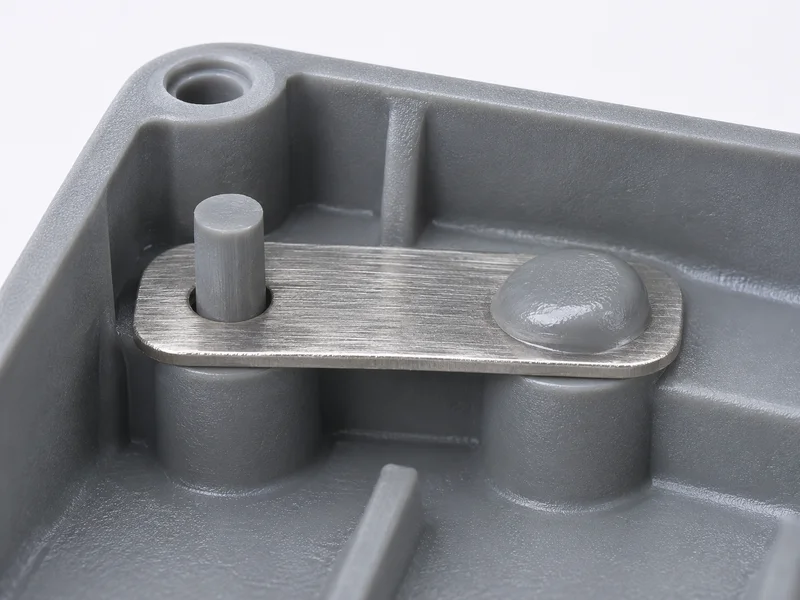
Design guidance:
- Stud diameter: sized for the required pull-off force
- Stud height above the component: enough material to form the head (often about 1.5 × diameter for dome heads)
- Clearance hole: small clearance to keep the part located
- Root radius: to avoid stress concentration
- Head shape: dome, flat, flush or knurled, by space and strength
- Hollow studs for larger diameters to avoid sink
For example, a 2 mm stud with a dome head may hold a small PCB securely, while a heavy bracket may need larger hollow studs. Our guide to basics of injection molding design explains sink and boss rules.
Key Takeaway: Size stud height for the head volume. Too little material gives weak heads.
Which Materials Work for Heat Staking Plastic?
Most thermoplastics work for heat staking plastic, but behavior varies.
- Amorphous resins (ABS, PC, PC/ABS): stake easily over a wide temperature range.
- Semi-crystalline resins (PP, PA, PBT, POM): need tighter temperature control.
- Glass-filled grades: stake well with hot air or cold-forming methods.
- Thermosets: cannot be heat staked.
For example, a PBT-GF30 housing may need a higher temperature and a cold-form punch to give a smooth head. Our guide to PBT injection molding covers PBT behavior.
Key Takeaway: Run staking trials on the production grade, not a substitute.
How Is Heat Staking Plastic Controlled and Tested?
Heat staking plastic is controlled through temperature, pressure, time and cooling, and tested by pull-off and visual checks.
Process controls:
- Tool temperature within a validated window
- Force or travel limits
- Heating and cooling time
- Fixture location of the part
Tests:
- Pull-off or push-out force
- Head dimensions and fill
- Cracks or voids at the stud base
- Component looseness
For example, a minimum pull-off force per stud can be verified on samples from each setup. Pull test methods are often adapted from ASTM International standards. Our quality control and inspection process records such tests when required.
Key Takeaway: Validate with pull-off tests and monitor the process window.
How Does Heat Staking Compare With Plastic Welding Methods?
Heat staking compares with plastic welding methods by its purpose: staking retains parts, while welding joins two plastic parts, often with a seal.
| Method | Joins | Seal | Typical uses |
|---|---|---|---|
| Heat staking | Plastic to any material | No | PCBs, brackets, labels |
| Ultrasonic welding | Plastic to plastic | Yes, with good design | Small housings |
| Spin welding | Round plastic parts | Yes | Caps, filters, floats |
| Hot plate welding | Plastic to plastic, large joints | Yes | Tanks, reservoirs |
Key points:
- Spin welding plastic: friction from rotation melts circular joints; strong and hermetic.
- Hot plate welding plastic: a heated plate melts both joint faces; suits large or complex joints.
For example, a fluid reservoir needs hot plate or ultrasonic welding to seal, while its internal PCB may be heat staked.
Key Takeaway: Use staking for retention and welding for sealed plastic joints.
When Are Pad Printing and Laser Marking Used on Molded Parts?
Pad printing and laser marking are used when molded parts need logos, symbols, scales or traceability codes.
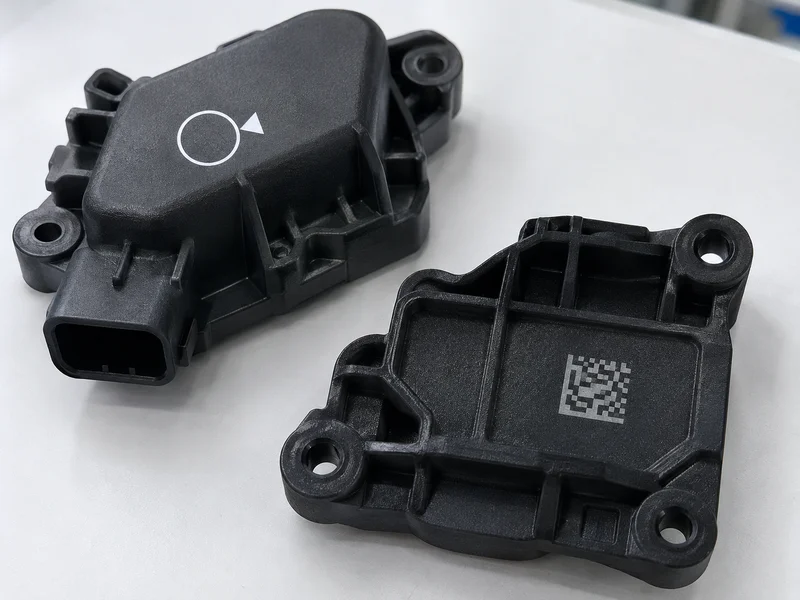
- Pad printing molded plastic: transfers ink from an etched plate with a silicone pad; suits curved surfaces and colors.
- Laser marking injection molded parts: changes the surface color or texture with a laser; permanent and good for codes.
- Material additives: some resins need laser-sensitive additives for contrast.
- Adhesion: pad printing on PP or PE may need surface treatment.
For example, a white logo on a black PC/ABS cover may be pad printed, while a lot code on a PA66 connector is laser marked. Our Dongguan factory has laser marking machines, and decoration options are confirmed per project.
Key Takeaway: Choose pad printing for color graphics and laser marking for permanent codes.
FAQ
- Q: What is heat staking plastic?
- Reforming a molded plastic stud with heat and pressure to retain another component.
- Q: Is heat staking stronger than screws?
- It can be strong enough for many retention needs, but it is permanent and not adjustable.
- Q: Can glass-filled plastics be heat staked?
- Yes, often with hot air and cold forming tools.
- Q: Does heat staking create a seal?
- No. Use ultrasonic, spin or hot plate welding for sealed joints.
- Q: What is the difference between pad printing and laser marking?
- Pad printing applies ink; laser marking alters the plastic surface permanently.
Conclusion
Heat staking plastic is a simple, permanent way to retain components in molded housings when stud design and process control are right. Use welding for sealed joints and pad printing or laser marking for graphics and codes. To review an assembly, send your 3D model and 2D drawing to our engineers.