
Izod vs Charpy Impact Test: How to Pick the Best One and Save Money
Izod vs Charpy impact test is a common question when comparing plastics for molded parts. Both tests measure how much energy a notched specimen absorbs when a swinging pendulum breaks it, so both indicate toughness. They differ in how the specimen is held and struck, which standards define them and how results are reported, so values from one test cannot be compared directly with the other.
Impact data is easy to misread. For example, a datasheet may show a high Izod value for an impact-modified PP, but a molded part with a sharp corner and a weld line can still crack in a drop test. In this guide, we compare Izod vs Charpy impact test methods, explain how to read impact data, cover impact modifiers and their trade-offs, and show how to test the impact performance of real molded parts. For material families, see our injection molding material selection guide.
Izod vs Charpy impact test: in the Izod test (ASTM D256, ISO 180) the notched specimen is clamped vertically as a cantilever and struck on its free end; in the Charpy test (ISO 179, ASTM D6110) the specimen lies horizontally on two supports and is struck in the middle, behind the notch. Both report absorbed energy, Izod often in J/m (ASTM) or kJ/m² (ISO) and Charpy in kJ/m². Results depend on notch, temperature, thickness and molding conditions, so they rank materials but do not predict part performance. Real parts need drop, falling-weight or application tests.
In short: Izod and Charpy both rank toughness, but they are not interchangeable, and neither replaces testing the actual part.
Key points:
- Setup: Izod is a cantilever; Charpy is a simply supported beam.
- Units: check J/m vs kJ/m² before comparing.
- Parts: design and molding change impact behavior.
What Is the Difference Between the Izod vs Charpy Impact Test?
The difference between the Izod vs Charpy impact test is how the specimen is supported and where it is struck.
| Feature | Izod | Charpy |
|---|---|---|
| Specimen position | Vertical, clamped at one end | Horizontal, supported at both ends |
| Strike point | Free end, notch facing hammer | Center, opposite the notch |
| Main standards | ASTM D256, ISO 180 | ISO 179, ASTM D6110 |
| Common units | J/m (ASTM), kJ/m² (ISO) | kJ/m² |
| Common in | North American datasheets | European datasheets |
For example, a European datasheet may list “Charpy notched 23 °C: 8 kJ/m²”, while a US datasheet lists “Notched Izod: 80 J/m”. These numbers are not directly comparable. Test standards are published by ASTM International and ISO.
Key Takeaway: Above all, compare materials using the same test, standard, notch and temperature.
How Should Izod vs Charpy Impact Test Data Be Read?
Izod vs Charpy impact test data should be read with attention to test method, notch, temperature and units.
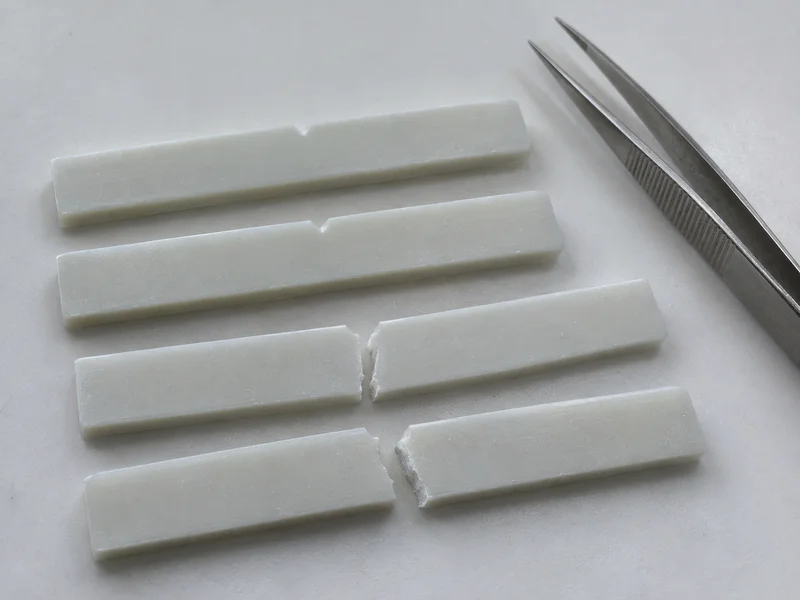
Check:
- Method: Izod or Charpy, and which standard
- Notched or unnotched: notched values are much lower
- Temperature: room temperature vs −20 °C or −40 °C
- Units: J/m vs kJ/m²
- Break type: complete, partial or no break
- Conditioning: dry or conditioned (important for nylon)
For example, dry PA66 may have low notched impact at room temperature, while conditioned PA66 is much tougher. Our guide to nylon 6 vs nylon 66 explains moisture effects.
Key Takeaway: In other words, low-temperature notched values are the most useful for brittle-risk parts.
Which Plastics Have High Impact Resistance?
Plastics with high impact resistance include PC, impact-modified grades, TPE blends and some engineering resins.
- PC and PC/ABS: high impact at room temperature
- ABS: good impact, moderate cost
- Impact-modified PP copolymer: good low-temperature impact
- Impact-modified PA: toughened nylon for automotive parts
- POM copolymers: good toughness with stiffness
- Glass-filled grades: stiffer but often lower impact
For example, a PP copolymer housing can pass a cold drop test that a PP homopolymer fails. Our guide to PP copolymer vs homopolymer explains the difference.
Key Takeaway: For this reason, choose by low-temperature impact if parts will be dropped in the cold.
What Are the Trade-Offs of Impact Modifiers in Molded Parts?
Impact modifiers in molded parts add toughness but change other properties.
Trade-offs:
- Lower stiffness and strength
- Lower heat deflection temperature
- Changed surface appearance, sometimes duller
- Different shrinkage and warpage
- Higher cost for specialty modifiers
For example, adding an impact modifier to a PBT connector improves latch toughness but may reduce stiffness at temperature. Testing the exact grade avoids surprises. Our guide to PBT injection molding covers PBT grades.
Key Takeaway: Overall, toughness gained usually costs some stiffness or heat resistance.
How Do Design and Molding Affect Impact Performance?
Design and molding affect impact performance because real parts contain stress concentrators that test bars do not.
Main factors:
- Sharp corners and notches
- Weld lines at impact areas
- Thin walls near loads
- Residual stress from overpacking
- Moisture and degradation from poor drying
- Fiber orientation in filled grades
For example, a PC housing with a sharp inside corner at a screw boss may crack on drop, while a 0.5 mm radius prevents it. Our guide to 9 ways to fix injection molding weld lines explains weld-line strength.
Key Takeaway: Equally, a tough material can still fail in a part with sharp corners or weld lines.
How Should Impact Testing of Injection Molded Plastic Parts Be Done?
Impact testing of injection molded plastic parts should reproduce real loads on real parts.
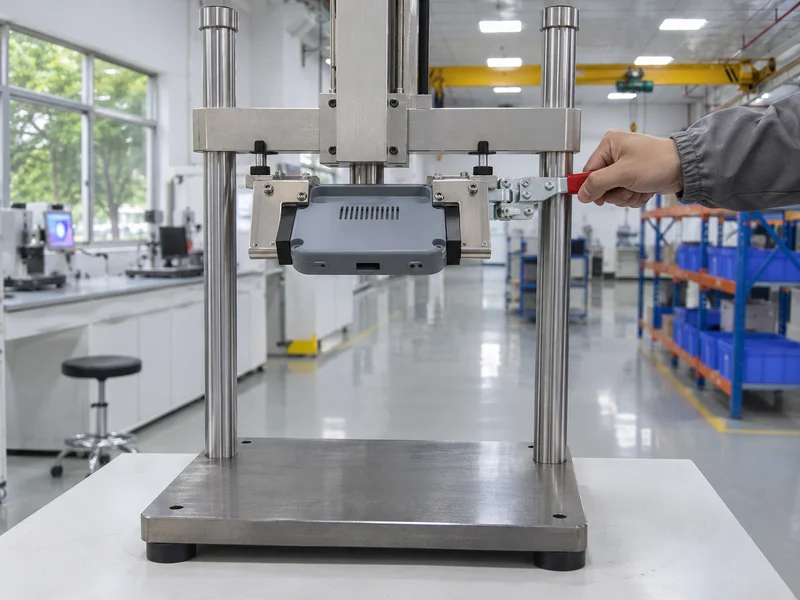
Common tests:
- Drop tests from defined heights and orientations
- Falling-weight (dart) tests on flat areas
- Instrumented impact tests for force-time data
- Low-temperature tests after conditioning
- Aging tests before impact
For example, a handheld device housing may be dropped from 1.2 m onto concrete at −10 °C in six orientations. Our plastic injection molding service can supply sample parts for such tests.
Key Takeaway: As a rule, test the part, not only the datasheet.
How Should Izod vs Charpy Impact Test Results Be Specified?
Izod vs Charpy impact test results should be specified with the method, conditions and acceptance criteria.
Specification items:
- Material property: test method, notch, temperature and minimum value
- Part test: drop height, surface, orientation and temperature
- Acceptance: no cracks, no function loss
- Conditioning: dry or conditioned state
- Sample size
For example, “Charpy notched ISO 179/1eA ≥ 10 kJ/m² at −30 °C; part drop 1 m, 6 orientations, no cracks” is complete.
Key Takeaway: Finally, specify both a material value and a part-level test.
FAQ
- Q: What is the difference between Izod and Charpy tests?
- Izod clamps the specimen as a cantilever; Charpy supports it at both ends and strikes the center.
- Q: Can Izod and Charpy values be compared?
- Not directly; methods, specimens and units differ.
- Q: Which plastics are most impact resistant?
- PC, PC/ABS, impact-modified PP and PA, and tough POM copolymers.
- Q: Do impact modifiers reduce stiffness?
- Usually yes, and often heat resistance too.
- Q: How are molded parts impact tested?
- With drop tests, falling-weight tests and instrumented impact tests on real parts.
Conclusion
The Izod vs Charpy impact test choice matters for comparing materials, but real parts need part-level testing. Read impact data carefully, understand modifier trade-offs, design out stress concentrators and specify both material and part tests. To review a part, send your 3D model and 2D drawing to our engineers.