
Bead Blast Texture: Process, Anodizing and Consistency
Bead blast texture is the uniform matte surface created when fine media, usually glass beads, are blasted onto a machined part. It hides tool marks, reduces glare and fingerprints and gives a soft, consistent look, especially under anodizing. For visible aluminum and stainless parts, such as instrument housings, covers, handles and front panels, bead blast texture is often the difference between a part that looks machined and one that looks finished.
Getting a consistent bead blast texture across batches, alloys and suppliers is harder than it sounds. For example, two batches of the same housing blasted weeks apart may look slightly different after black anodizing, because media wear and pressure changed. In this guide, we explain bead blast texture: what it looks like, how it is produced, how it interacts with anodizing and materials, how to keep it consistent, where it should not be used and how to specify it. For media and roughness values, see our bead blast surface finish chart.
Bead blast texture is a fine, uniform matte finish produced by blasting glass or ceramic beads at a surface. On aluminum it typically gives a satin to matte appearance around Ra 0.8–3.2 µm, depending on media size and pressure, and it is commonly followed by anodizing for color and protection. Consistency depends on media type, size and condition, pressure, distance, angle, coverage and the alloy. It should be masked off sealing faces, fits and threads. A reference sample, media specification and target roughness range are the most reliable way to specify it.
In short: bead blast texture gives a uniform matte look; control media and parameters and approve a reference sample.
Key points:
- Appearance: hides tool marks, reduces glare and fingerprints.
- Consistency: media condition and pressure matter most.
- Masking: protect functional surfaces.
What Is Bead Blast Texture?
Bead blast texture is a micro-dimpled matte surface created by the impact of round media on a metal or plastic surface.
Characteristics:
- Uniform matte or satin look
- Diffuse light reflection instead of shiny tool marks
- Slightly softened edges
- Fingerprint and scratch hiding
For example, a 6061 instrument cover milled with visible tool paths looks uniform after fine bead blasting and clear anodizing. Our guide to anodized vs non anodized aluminum explains anodizing choices.
Key Takeaway: Above all, bead blast texture is mainly an appearance finish with practical benefits.
How Is Bead Blast Texture Produced?
Bead blast texture is produced in a blasting cabinet where compressed air propels media at the part.
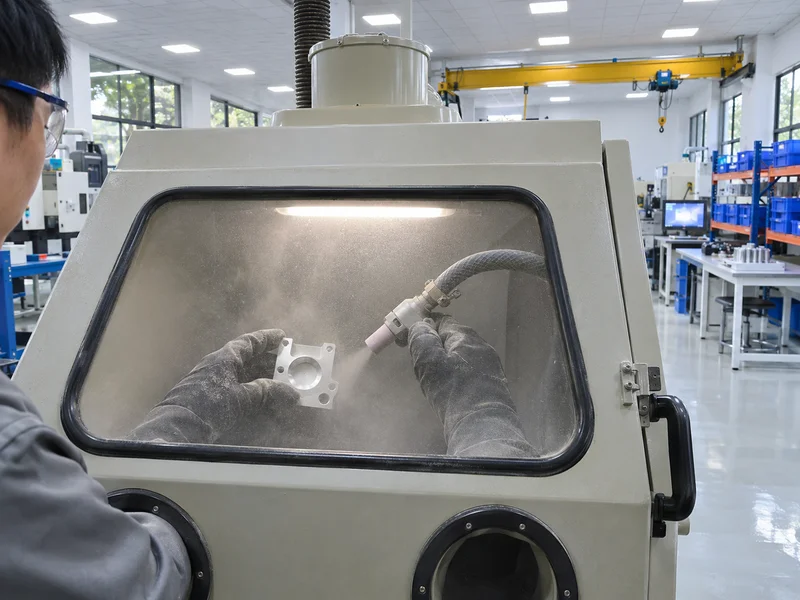
Process steps:
- Clean and deburr the machined part.
- Mask threads, bores and sealing faces.
- Blast with controlled media, pressure, distance and angle.
- Check coverage and uniformity.
- Clean off media residue.
- Apply the following finish, such as anodizing.
For example, blasting at a consistent 150–200 mm nozzle distance and angle gives a more even texture than handheld variation. Our CNC machining services include sand and bead blasting with following finishes.
Key Takeaway: In other words, consistent parameters produce a consistent texture.
How Does the Texture Look Under Anodizing?
Under anodizing, the texture looks soft, even and slightly lighter than polished anodized surfaces.
Effects:
- Black anodizing: deep, even matte black; shows texture differences clearly
- Clear anodizing: soft silver satin
- Colored anodizing: muted, uniform colors
- Alloy effects: 6061 gives consistent color; 7075 can look slightly different
For example, two housings in 6061 and 7075 may both be blasted and black anodized but show slightly different tones. Using one alloy keeps them matching. Our guide to aluminium alloy 6061 properties explains why 6061 anodizes well.
Key Takeaway: For this reason, use the same alloy and process for parts that sit side by side.
How Do You Keep Bead Blast Texture Consistent?
You keep the texture consistent by controlling media, parameters and comparison.
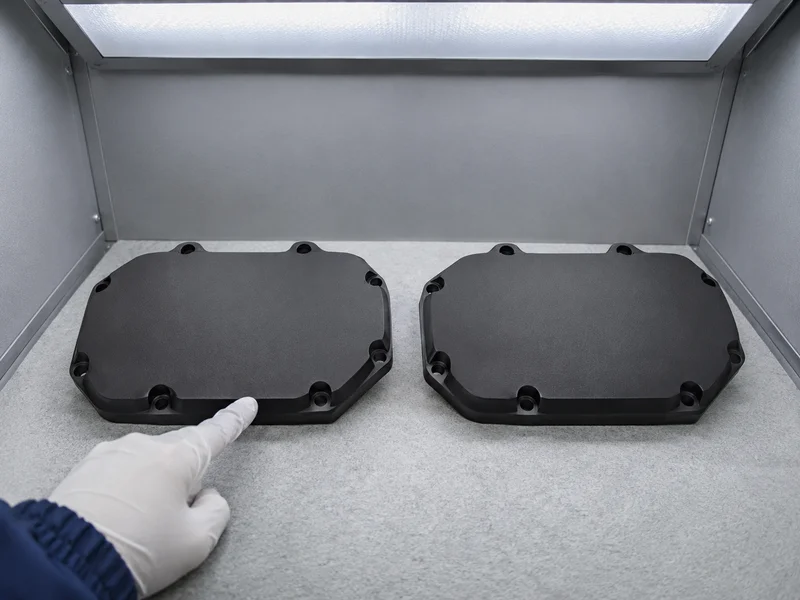
Controls:
- Media type and size fixed in the specification
- Media replacement schedule, since broken beads change texture
- Pressure and distance recorded
- Same operator method or automated blasting
- Reference sample checked for every lot
- Same anodizing line and batch where possible
For example, a retained “golden sample” compared under the same light catches drift before parts ship. Our quality control and inspection process uses reference samples for cosmetic finishes.
Key Takeaway: Overall, media condition is the most common cause of texture drift.
Which Materials Suit This Finish?
Most metals and some plastics suit this finish, with different results.
- Aluminum: the most common; ideal before anodizing
- Stainless steel: gives a fine satin; often followed by passivation
- Titanium: uniform grey matte
- Brass and copper: matte look, may need protective coating
- Plastics (PEEK, POM): mild matte effect with plastic media or fine beads
For example, a stainless steel cover blasted and passivated keeps a uniform satin look without plating. Our guide to CNC milling titanium components covers titanium finishes.
Key Takeaway: Equally, test the texture on the actual material before approving it.
Where Should Blasting Be Avoided?
Blasting should be avoided on surfaces where roughness or edge changes affect function.
Avoid or mask:
- Sealing faces and O-ring grooves
- Precision bores and fits
- Threads
- Electrical contact areas
- Optical or reflective surfaces
For example, blasting a valve sealing face can create leak paths; masking it keeps the machined finish. Our guide to GD&T surface finish explains how to specify functional finishes.
Key Takeaway: As a rule, show masked areas clearly on the drawing.
How Should Bead Blast Texture Be Specified?
Bead blast texture should be specified with media, target roughness, following finish, masking and a reference sample.
Specification items:
- Media type and size
- Target Ra range
- Following finish and color
- Masking areas
- Reference sample or texture standard
- Viewing conditions for appearance checks
For example, “Glass bead blast, fine (100–170 mesh), Ra 0.8–1.6 µm, black anodize Type II; mask threads and Ø10 H7 bores; match reference sample” leaves little room for doubt. Roughness parameters follow standards published by ISO.
Key Takeaway: Finally, a reference sample is the most effective texture specification.
FAQ
- Q: What is bead blast texture?
- A uniform matte surface created by blasting glass or ceramic beads at a part.
- Q: Why is bead blasting done before anodizing?
- It hides tool marks and gives an even matte anodized appearance.
- Q: Does bead blast texture affect dimensions?
- Only slightly, but it rounds edges and roughens fits, so mask functional surfaces.
- Q: Why do bead blasted parts look different between batches?
- Media wear, pressure, distance or alloy changes.
- Q: Can stainless steel be bead blasted?
- Yes, usually followed by passivation.
Conclusion
Bead blast texture gives machined parts a uniform, finished look. Control media, pressure and coverage, mask functional surfaces and specify the texture with a reference sample. To review a cosmetic machined part, send your 3D model and 2D drawing to our engineers.