
Bead Blast Surface Finish Chart: How to Get Best Results
A bead blast surface finish chart helps buyers and engineers choose the right blasting media, grit size and resulting roughness for a machined part. Bead blasting propels fine media, usually glass beads, at the surface to create a uniform matte finish that hides tool marks and gives a consistent look before anodizing or plating. Different media and sizes give very different results, from a soft satin to a coarse, grippy texture.
Without a chart or reference sample, “bead blast” can mean almost anything. For example, one supplier may use fine glass beads for a satin finish while another uses coarser media, and the parts no longer match. In this guide, we provide a practical bead blast surface finish chart, explain how media type, size and pressure affect roughness and appearance, compare bead blasting with other blasting methods and show how to specify a repeatable finish. For texture and appearance, see our guide to bead blast texture.
A bead blast surface finish chart links media type and size to typical roughness and appearance. Fine glass beads (about 70–140 mesh) usually give a smooth satin finish around Ra 0.8–1.6 µm on aluminum; medium beads (about 40–70 mesh) give a uniform matte around Ra 1.6–3.2 µm; coarse media or aluminum oxide give rougher, more aggressive textures. Results also depend on pressure, distance, angle, base material and prior machining. Because charts are approximate, the most reliable specification combines media, size, target Ra range and an approved reference sample.
In short: choose media and size from a chart, then lock the finish with a reference sample and Ra range.
Key points:
- Media: glass beads give smooth satin; oxide gives rougher etch.
- Size: finer media, finer finish.
- Control: reference samples keep batches consistent.
What Is a Bead Blast Surface Finish Chart?
A bead blast surface finish chart is a reference table that relates blasting media and parameters to the finish they produce.
It usually shows:
- Media type: glass bead, ceramic bead, aluminum oxide, plastic media
- Media size: mesh or micron range
- Typical roughness: Ra or Rz range
- Appearance: satin, matte, rough
- Typical uses
For example, a chart helps an engineer pick fine glass beads for an anodized handheld housing and coarser media for a grip surface. Roughness parameters are defined in standards from ISO, such as ISO 21920 (formerly ISO 4287).
Key Takeaway: Above all, a chart is a starting point; the approved sample is the final reference.
What Does a Typical Bead Blast Surface Finish Chart Show?
A typical bead blast surface finish chart for aluminum looks like this (approximate values):
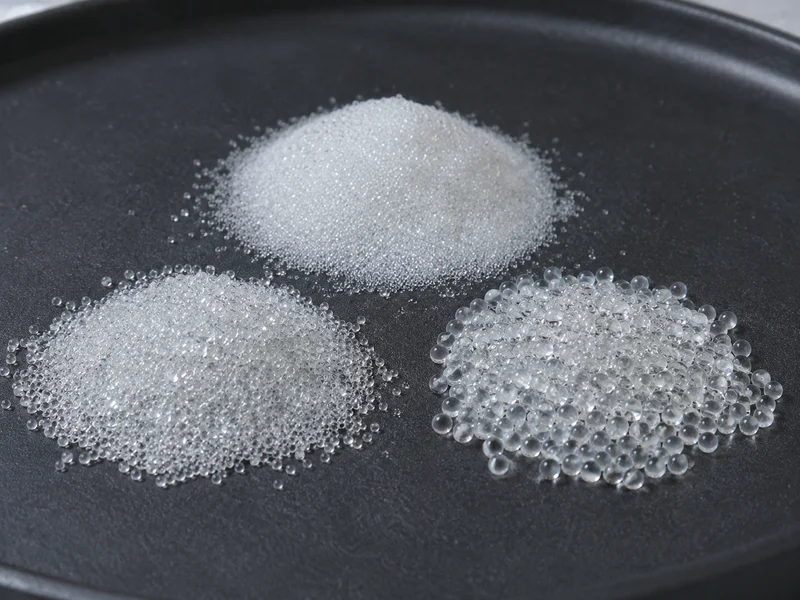
| Media (typical) | Size (approx.) | Typical Ra on aluminum | Appearance | Common uses |
|---|---|---|---|---|
| Fine glass bead | 100–170 mesh | about 0.8–1.6 µm | Smooth satin | Cosmetic housings before anodizing |
| Medium glass bead | 70–100 mesh | about 1.2–2.5 µm | Even matte | General parts |
| Coarse glass bead | 40–70 mesh | about 2.0–3.5 µm | Coarser matte | Hiding marks, grip areas |
| Ceramic bead | Fine to medium | about 0.8–2.0 µm | Satin, durable media | Repeatable production |
| Aluminum oxide | 120–220 grit | about 1.6–4.0 µm | Rough, etched | Paint and coating prep |
| Plastic media | Various | Very low change | Cleaning only | Deburring, paint removal |
Values vary with pressure, distance and material, so use them as guidance only. Our guide to surface roughness Ra vs Rz explains roughness parameters.
Key Takeaway: In other words, finer beads give smoother satin; oxide gives a rougher etch.
Which Factors Change the Result on a Bead Blast Surface Finish Chart?
Several factors change the result shown on a bead blast surface finish chart.
- Air pressure: higher pressure, rougher finish
- Nozzle distance and angle: affect intensity and uniformity
- Media condition: broken or worn media changes the finish
- Base material: soft aluminum marks more than stainless
- Prior machining: deep tool marks may still show
- Dwell time: longer blasting increases roughness
For example, worn glass beads that have broken into sharp fragments give a duller, rougher finish than fresh beads. Media maintenance keeps results consistent.
Key Takeaway: For this reason, control pressure and media condition, not just media type.
How Does Bead Blasting Compare With Other Blasting Methods?
Bead blasting compares with other blasting methods by how much it cuts versus how much it peens the surface.
| Method | Effect | Typical result |
|---|---|---|
| Glass bead blasting | Peens and smooths | Satin, uniform |
| Aluminum oxide blasting | Cuts and etches | Rough, good coating adhesion |
| Sand blasting | Aggressive cutting | Rough, less uniform |
| Shot peening | Compressive stress | Fatigue improvement |
| Vibratory finishing | Tumbling | Smoothed edges, softer look |
For example, a part to be powder coated often uses aluminum oxide for adhesion, while a cosmetic anodized part uses glass beads. Our guide to aluminum powder coating vs anodizing explains coating preparation.
Key Takeaway: Overall, choose glass beads for appearance and oxide for coating adhesion.
How Does Bead Blasting Affect Dimensions and Features?
Bead blasting affects dimensions and features slightly, so critical areas may need masking.
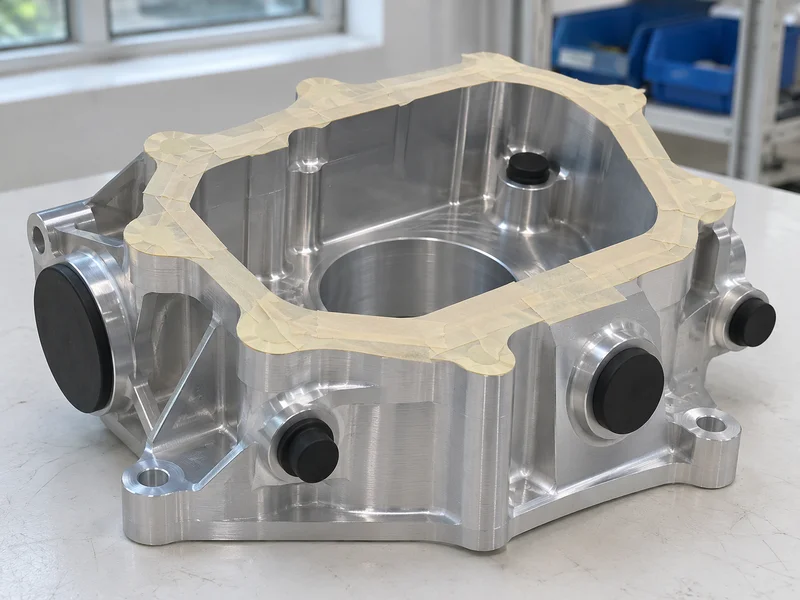
Effects:
- Very small material change on most surfaces
- Edge rounding on sharp edges
- Thread and fit surfaces can be roughened
- Sealing faces can lose required finish
Practice:
- Mask threads, bores and sealing faces
- Show masked areas on the drawing
- Blast before anodizing for cosmetic parts
For example, an O-ring groove should be masked so it keeps its machined finish. Our guide to threaded holes covers thread protection.
Key Takeaway: Equally, mask functional surfaces before blasting.
How Should You Specify a Bead Blast Finish?
You should specify a bead blast finish with media, size, target roughness and a reference sample.
Specification items:
- Media type and size, for example “glass bead 100–170 mesh”
- Target Ra range, for example Ra 0.8–1.6 µm
- Areas to blast and to mask
- Following finish, such as clear or black anodizing
- Reference sample approved for appearance
For example, “Bead blast glass bead 100–170 mesh, Ra 0.8–1.6 µm, then black anodize Type II; mask Ø8 H7 bores; match sample A” is complete. Our CNC machining services include sand and bead blasting before anodizing.
Key Takeaway: As a rule, a reference sample removes most finish disputes.
How Should Bead Blast Finishes Be Inspected?
Bead blast finishes should be inspected for roughness, uniformity and appearance.
Inspection points:
- Roughness with a profilometer at defined locations
- Uniformity under defined light
- Comparison with the reference sample
- No missed areas or over-blasted edges
- Masked areas intact
For example, comparing each lot with a retained sample under the same light catches drift from worn media. Our quality control and inspection process records finish checks when specified.
Key Takeaway: Finally, keep a retained sample from the first approved lot.
FAQ
- Q: What is a bead blast surface finish chart?
- A table relating media type and size to typical roughness and appearance.
- Q: What Ra does bead blasting give?
- Fine glass beads often give about Ra 0.8–1.6 µm on aluminum; coarser media give rougher finishes.
- Q: Does bead blasting change dimensions?
- Only slightly, but it rounds edges and roughens fits, so mask critical areas.
- Q: What is the difference between bead blasting and sand blasting?
- Bead blasting peens to a satin finish; sand blasting cuts more aggressively.
- Q: Should bead blasting be done before anodizing?
- Yes, for a uniform matte anodized appearance.
Conclusion
A bead blast surface finish chart guides media and size selection, but repeatable results need controlled parameters, masking and an approved reference sample. Specify media, size, target Ra and the following finish. To review a cosmetic machined part, send your 3D model and 2D drawing to our engineers.