
Bronze vs Brass vs Copper Alloy: How to Pick the Best One and Save Money
Bronze vs brass vs copper alloy is a frequent question for machined components such as bushings, fittings, electrical contacts, valve parts and wear plates. All three are copper-based, but they behave very differently. Copper offers the best electrical and thermal conductivity, brass is the easiest to machine and the most economical for fittings, and bronze gives the best wear and corrosion resistance for bearings and marine parts.
Choosing between them starts with the function, not the color. For example, a bushing that slides on a steel shaft usually needs bronze, a threaded fitting is usually brass, and a bus bar or heat spreader is usually copper. In this guide, we compare bronze vs brass vs copper alloy for machined components: composition, properties, machinability, corrosion, cost and how to choose and specify the alloy. For copper machining in detail, see our guide to the machinability of copper.
Bronze vs brass vs copper alloy: copper (such as C110) is almost pure copper with the highest electrical and thermal conductivity but low machinability. Brass is copper plus zinc (such as free-cutting C360 / CuZn39Pb3), with excellent machinability and moderate strength, used for fittings and connectors. Bronze is copper plus tin, aluminum or other elements (such as C932 bearing bronze, C954 aluminum bronze or C510 phosphor bronze), with better wear, fatigue and corrosion resistance, used for bushings, gears and marine parts. Choose by conductivity, wear, corrosion, machinability and cost.
In short: copper for conductivity, brass for easy machining and fittings, bronze for wear and corrosion.
Key points:
- Copper: best conductivity, hardest to machine cleanly.
- Brass: easiest to machine, economical.
- Bronze: best for bearings, wear and seawater.
What Is the Difference Between Bronze vs Brass vs Copper Alloy?
The difference between bronze vs brass vs copper alloy is mainly the alloying element added to copper.
| Material (typical) | Main alloying element | Example grades | Key strength |
|---|---|---|---|
| Copper | None (≥99.9% Cu) | C101, C110 | Conductivity |
| Brass | Zinc | C360, C464 (naval brass) | Machinability |
| Bronze | Tin, aluminum, silicon, phosphorus | C932, C954, C510 | Wear, corrosion, fatigue |
Copper alloy designations follow systems such as the UNS numbers and EN designations; specifications are published by ASTM International.
Key Takeaway: Read the alloy number, not the name. “Bronze” covers many very different alloys.
How Do Bronze vs Brass vs Copper Alloy Properties Compare?
Bronze vs brass vs copper alloy properties compare differently for strength, conductivity and wear.
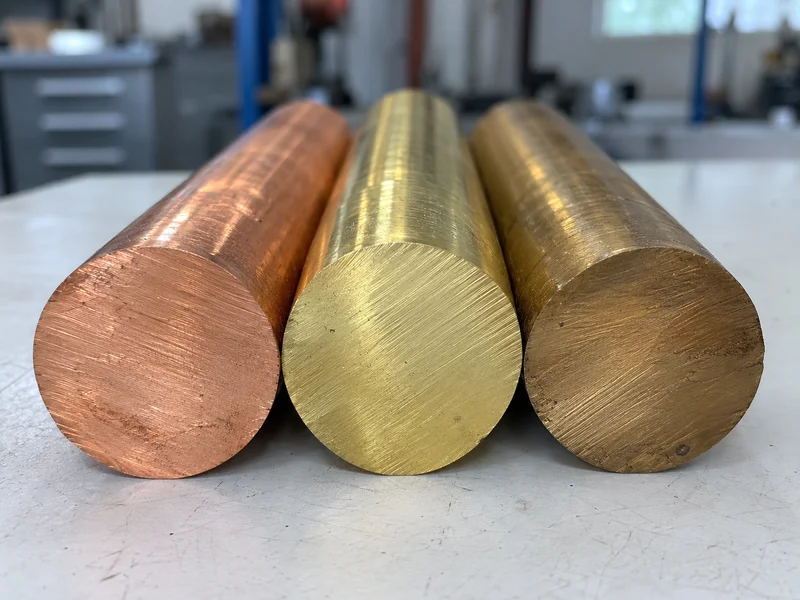
| Property (approx.) | Copper C110 | Brass C360 | Bronze C932 | Aluminum bronze C954 |
|---|---|---|---|---|
| Electrical conductivity (%IACS) | ~100 | ~26 | ~12 | ~13 |
| Tensile strength | Low–moderate | Moderate | Moderate | High |
| Wear resistance | Low | Moderate | High | High |
| Machinability (vs C360 = 100) | ~20 | 100 | ~70 | ~60 |
For example, an aluminum bronze bushing can carry high loads in a hydraulic cylinder, while C360 brass would wear quickly. Values vary with temper and supplier.
Key Takeaway: Strength and wear rise from copper to brass to bronze, while conductivity falls.
When Should You Choose Copper?
You should choose copper when electrical or thermal conductivity is the main requirement.
Typical uses:
- Bus bars and electrical terminals
- Heat sinks and heat spreaders
- RF and grounding components
- EDM electrodes (copper or copper-tungsten)
For example, a bus bar in switchgear uses C110 or C101 for conductivity. If machining is extensive, tellurium copper may be a compromise. Our CNC machining services machine copper and brass parts to drawing.
Key Takeaway: Choose copper only when conductivity truly matters; otherwise brass or bronze is easier.
When Should You Choose Brass?
You should choose brass when easy machining, moderate strength, good appearance and corrosion resistance in water are needed.
Typical uses:
- Fittings, valves and connectors
- Threaded inserts and fasteners
- Instrument and gauge parts
- Decorative hardware
For example, a small threaded fitting machined from C360 brass runs fast on a lathe and threads cleanly. For drinking water, lead-free brasses are required by many regulations. Our guide to threaded holes explains thread specification.
Key Takeaway: Brass is the default for machined fittings, but check lead limits for water and consumer products.
When Should You Choose Bronze?
You should choose bronze when wear, sliding contact, fatigue or seawater corrosion is the main concern.
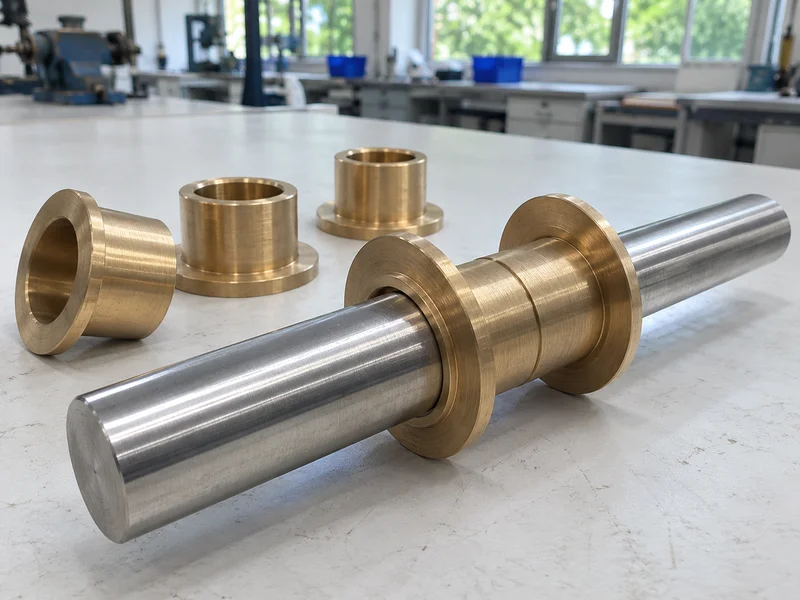
Typical uses:
- Bushings and plain bearings (C932, C954)
- Wear plates and guides
- Gears and worm wheels
- Marine and pump parts (aluminum or silicon bronze)
- Springs and contacts (phosphor bronze C510)
For example, a bushing on a slowly rotating steel shaft uses C932 bearing bronze because it tolerates marginal lubrication. Our guide to tolerance for slip fit explains bushing clearances.
Key Takeaway: For sliding parts, start with bronze.
How Do Machinability and Cost Compare in Bronze vs Brass vs Copper Alloy?
Machinability and cost usually favor brass, followed by bronze and then copper.
- Brass: fastest machining, lowest machining cost, small burrs
- Bronze: good to moderate machining; aluminum bronze is harder on tools
- Copper: slow to machine cleanly; more deburring
- Material price: varies with metal markets; copper content drives cost
For example, the same fitting may cost noticeably more in copper than in brass, mainly because of machining time and deburring. Our guide to CNC machining cost for custom parts explains cost drivers.
Key Takeaway: If two alloys meet the function, choose the one that machines faster.
How Should You Specify Bronze, Brass or Copper on a Drawing?
You should specify bronze, brass or copper with the exact alloy, temper and any regulatory limits.
Specification items:
- Alloy designation, such as C360, C932 or CW614N
- Temper or condition
- Lead-free or RoHS requirements
- Material certificate requirement
- Finish, such as nickel plating or passivation
- Acceptable alternatives
For example, “C360 brass, half hard, RoHS compliant, nickel plated 5–8 µm” is complete. RoHS restrictions are published on EUR-Lex. Grade and process for bronze alloys are confirmed per project.
Key Takeaway: Write the alloy number and any lead limit on the drawing.
FAQ
- Q: What is the difference between bronze, brass and copper?
- Copper is nearly pure; brass is copper with zinc; bronze is copper with tin, aluminum or other elements.
- Q: Which is easiest to machine?
- Free-cutting brass such as C360.
- Q: Which is best for bushings?
- Bronze, such as C932 bearing bronze or C954 aluminum bronze.
- Q: Which conducts electricity best?
- Copper, at about 100% IACS.
- Q: Is brass or bronze better in seawater?
- Bronze, especially aluminum or silicon bronze, generally performs better.
Conclusion
Bronze vs brass vs copper alloy is decided by function: copper for conductivity, brass for easy machining and fittings, bronze for wear and corrosion. Specify the exact alloy, temper and limits. To review material for your component, send your 3D model and 2D drawing to our engineers.