
CNC Machining Cost for Custom Parts: What Drives It
CNC machining cost for custom parts is built from a few predictable drivers: material, machine time, setups, tooling, finishing, inspection and quantity. Buyers who understand these drivers can design parts that cost less and compare quotes more fairly. Without that understanding, two quotes for the same small precision bracket can look very different, and it is hard to see why.
Most cost differences come from geometry and requirements rather than from the supplier’s hourly rate. For example, adding a 0.5 mm internal radius in a deep pocket may force a tiny tool and triple cycle time, while a 3 mm radius lets a standard tool finish it quickly. In this guide, we explain CNC machining cost for custom parts: the main cost drivers, how design and tolerances affect cost, setup and quantity effects, finishing and inspection, how to compare quotes, and practical ways to reduce cost. For tolerance effects, see our guide to tight tolerance machining.
CNC machining cost for custom parts depends on material (stock price and machinability), machine time (driven by volume removed, features, tool sizes and finish), number of setups and fixtures, programming, tolerances and surface finishes, secondary operations such as heat treatment and anodizing, inspection and documentation, and quantity, which spreads setup and programming costs. Cost falls with simpler geometry, standard tools, fewer setups, wider tolerances on non-critical features, easier materials and larger batches. Fixed prices are not meaningful without the drawing.
In short: material, machine time, setups, tolerances, finishing, inspection and quantity drive the price.
Key points:
- Geometry: drives machine time and tool size.
- Setups: each one adds labor and error risk.
- Quantity: spreads programming and setup costs.
What Drives CNC Machining Cost for Custom Parts?
CNC machining cost for custom parts is driven by a set of predictable factors.
| Cost driver | What increases it |
|---|---|
| Material | Expensive alloys, poor machinability, large stock |
| Machine time | Deep pockets, small tools, fine finishes |
| Setups | Features on many faces, special fixtures |
| Programming | Complex 5-axis surfaces, many features |
| Tolerances | Tight tolerances on many features |
| Finishing | Anodizing, plating, heat treatment, masking |
| Inspection | Full CMM reports, FAI, certificates |
| Quantity | Small batches carry full setup cost |
For example, the same bracket in 6061 aluminum and in 316 stainless may differ greatly in cost because stainless machines more slowly. Our guide to CNC machining materials compares machinability.
Key Takeaway: Ask which driver dominates your part. It shows where to save.
How Does Design Affect CNC Machining Cost for Custom Parts?
Design affects CNC machining cost for custom parts because geometry decides tools, cycle time and setups.
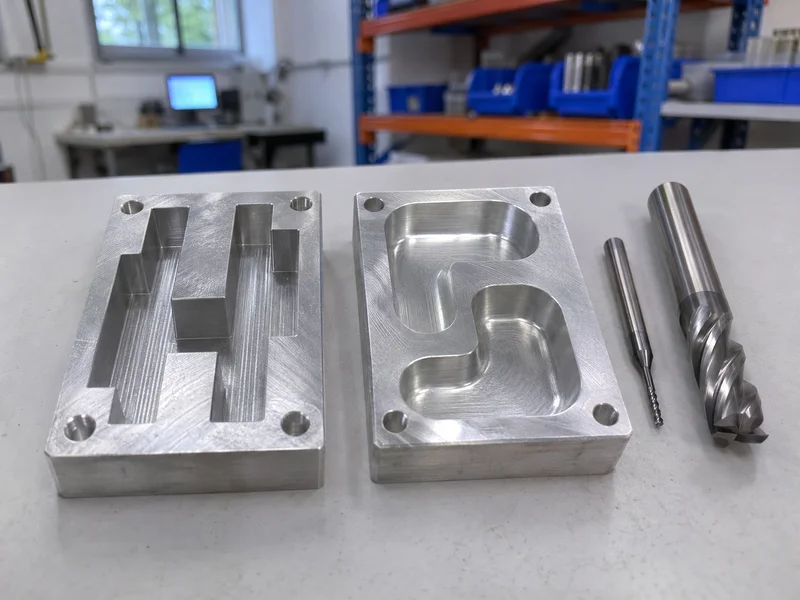
Costly features:
- Small internal radii needing small tools
- Deep, narrow pockets with long tools
- Thin walls that need light cuts
- Features on many faces
- Non-standard hole sizes and threads
- Text and fine engraving
Cost-saving changes:
- Larger internal radii matching standard tools
- Shallower pockets or through features
- Standard drill and thread sizes
- Features grouped on fewer faces
For example, designing a pocket depth at no more than about 4 × the corner tool diameter keeps machining efficient. Our engineering and DFM review suggests such changes.
Key Takeaway: Most cost is designed in. Review geometry before tolerances.
How Do Tolerances and Surface Finish Affect Cost?
Tolerances and surface finish affect cost because tighter values need extra passes, slower cutting and more inspection.
- General tolerances (for example ISO 2768-m) are cheapest.
- Tight tolerances need finishing passes and better measurement.
- Very tight tolerances may need grinding or EDM.
- Fine finishes need extra passes or polishing.
For example, specifying Ra 0.8 µm only on a sealing face instead of the whole part can save significant time. General tolerance classes are defined in ISO 2768. Our guide to surface roughness Ra vs Rz explains finish values.
Key Takeaway: Put tight tolerances and fine finishes only where function requires them.
How Do Setups and Quantity Change the Price per Part?
Setups and quantity change the price per part because fixed costs are spread over the batch.
Fixed costs per batch:
- Programming (mostly first order)
- Fixture design and making
- Machine setup and first-piece inspection
Variable costs per part:
- Material
- Cycle time
- Finishing and inspection per part
For example, a part with 2 hours of setup and 10 minutes of cycle time costs far more per piece at 5 pieces than at 200. Combining orders into larger batches reduces unit cost. Our guide to high volume CNC machined parts explains volume effects.
Key Takeaway: Share annual volumes. Batch planning lowers unit cost.
How Do Finishing and Inspection Affect Cost?
Finishing and inspection affect cost because they add process steps, handling and documentation.
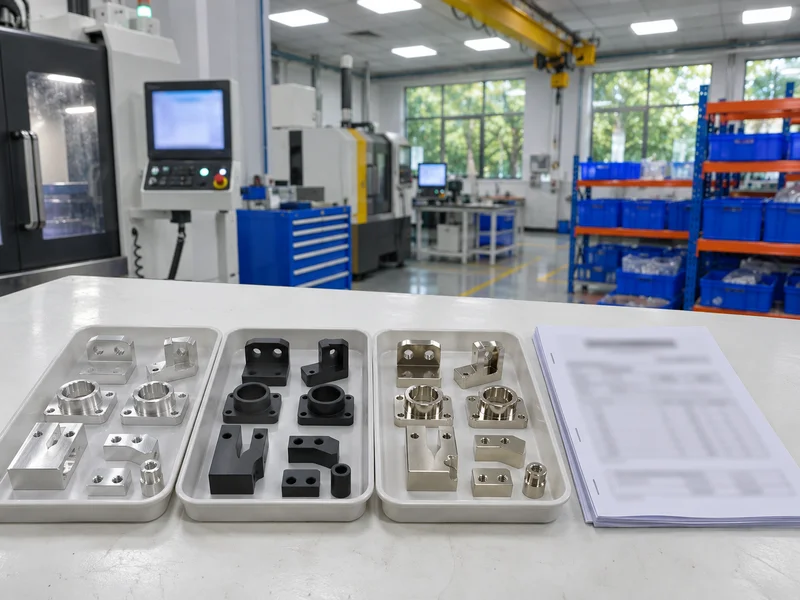
Finishing costs:
- Anodizing, plating, passivation, powder coating
- Masking of threads and fits
- Heat treatment and straightening
- Packaging to protect finishes
Inspection costs:
- First article inspection
- Full dimensional or CMM reports
- Material certificates
- Special tests such as hardness or coating thickness
For example, requiring full CMM reports on every part costs more than sampling plus a first article report. Our quality control and inspection process supplies reports on request.
Key Takeaway: Match inspection level to risk. Not every part needs full reports.
How Should You Compare CNC Machining Quotes?
You should compare CNC machining quotes on the same scope, not only on the unit price.
Compare:
- Material and grade quoted
- Finishing included or excluded
- Tolerances and finishes accepted as drawn
- Inspection and documents included
- Lead time and quantity breaks
- Packaging and shipping terms
For example, a low quote may exclude anodizing or assume wider tolerances. Clarifying scope prevents surprises. We do not publish fixed prices; every quote is based on the drawing and requirements.
Key Takeaway: Line up quotes by scope before comparing price.
How Can You Reduce CNC Machining Cost for Custom Parts?
You can reduce CNC machining cost for custom parts with design, specification and ordering changes.
Practical steps:
- Use standard radii, holes and threads.
- Reduce setups by grouping features.
- Relax non-critical tolerances.
- Choose machinable materials where function allows.
- Limit fine finishes to functional faces.
- Order in sensible batches.
- Ask for DFM feedback before freezing the design.
For example, switching a bracket from 304 to 303 stainless can shorten cycle time if corrosion needs allow. Our guide to CNC machining vs injection molding explains when another process becomes cheaper.
Key Takeaway: The biggest savings come before the drawing is released.
FAQ
- Q: What affects CNC machining cost?
- Material, machine time, setups, programming, tolerances, finishing, inspection and quantity.
- Q: Why are small CNC batches expensive?
- Setup and programming costs are spread over few parts.
- Q: Do tight tolerances increase CNC cost?
- Yes. They require extra passes, slower cutting and more inspection.
- Q: How can I reduce CNC machining cost?
- Simplify geometry, use standard features, relax non-critical tolerances and order in batches.
- Q: How should CNC quotes be compared?
- On the same material, finishing, tolerances, inspection and quantity scope.
Conclusion
CNC machining cost for custom parts is predictable once its drivers are clear. Simplify geometry, reduce setups, target tolerances and finishes, and order in sensible batches. To get a quote based on your drawing, send your 3D model and 2D drawing to our engineers.